Threads of Light: Archetypes, Nature, and the Fractal Web of Perception
Authored by: Karl K. Dondaneau
December 16th 2024
-->ORDER A COPY OF THE BOOK HERE<--
Prefer to listen? Just hit the play button and enjoy the audio version

If the universe is conceptualized as a fractal hypergraph—a dynamic and interconnected web of nodes and edges—the electromagnetic radiation emitted by a star could influence another, though this influence may not conform to classical causality. In my framework, articulated within my dual philosophies of Archetypal Mathematics and Quantum Calculus found inside my book Simplicity Through Simulation: The Algorithm of Humanity. In which, the universe is conceptually governed by recursive, fractal patterns and relational dynamics that transcend traditional notions of separability.
From this perspective, the radiation emitted by a star is not merely a localized physical phenomenon but part of a broader, interconnected lattice of energy and relational resonance. I emphasize that systems evolve not only through linear, mechanistic interactions but also via non-linear, probabilistic connections that reflect deeper archetypal patterns. This suggests that the EM radiation of a star can act as a node's signal in the fractal hypergraph, creating pathways of influence that are both physical and symbolic.
In terms of physical dynamics, electromagnetic radiation embodies information and energy that propagate across the fabric of space-time, potentially interacting with other celestial bodies. This interaction could manifest through gravitational waves, the perturbation of electromagnetic fields, or even quantum entanglement-like phenomena at cosmic scales. My concept of fractal singularities—points where infinite potential converges—could model such interactions as moments where the influence of one star precipitates non-linear changes in the system as a whole (We can articulate this through modular and fractal arithmetic).
Modular structures can account for the cyclic and recursive nature of such cosmic interactions, while fractal dynamics can capture the infinite complexity emerging from simple iterative processes. For example, EM radiation might represent one layer of influence within a nested fractal hierarchy, where its effects ripple outward and are modulated by larger cosmic structures, such as galactic clusters or the cosmic microwave background.
Predictions from our Framework could account for:
Fractal Resonance Across Scales: The influence of a star’s EM radiation might manifest not just physically but through relational resonances. This could mean that the emission of radiation by one star might align with archetypal patterns in the hypergraph, creating a cascade of relational adjustments across the system, detectable as synchronicities or correlated behaviours in distant celestial phenomena.
Dimensional Jumps: Following our notion of dimensional jumps, EM radiation could facilitate transitions in state-space that are not merely local but involve higher-dimensional shifts in the hypergraph. For instance, these shifts could explain phenomena like gamma-ray bursts or sudden star-forming activity in distant regions.
Probabilistic Interactions: The radiation’s path and its effects might be better described probabilistically rather than deterministically. This aligns with the quantum calculus aspect of our model, where events unfold within a matrix of potential outcomes influenced by the inherent uncertainty and interconnectedness of the universe.
Energy Conservation with Relational Feedback: Any influence exerted by EM radiation would be part of a feedback loop within the fractal hypergraph. This loop ensures the conservation and transformation of energy, manifesting as emergent properties at different scales, such as shifts in stellar brightness, gravitational lensing, or even fluctuations in cosmic microwave background radiation.
Implications for Further Inquiry
Our approach invites us to consider electromagnetic phenomena as both physical events and symbolic gestures within a universal fractal hypergraph. This duality suggests that every emission of energy—such as the radiation from a star—participates in a grander dialogue of interconnectedness, with implications spanning cosmology, quantum physics, and archetypal metaphysics. By adopting this lens, researchers might uncover deeper patterns in cosmic radiation distribution, star formation cycles, and the synchronization of distant astrophysical events. Such discoveries could refine our understanding of the universe as a coherent, dynamic whole, where every point is simultaneously local and universal.
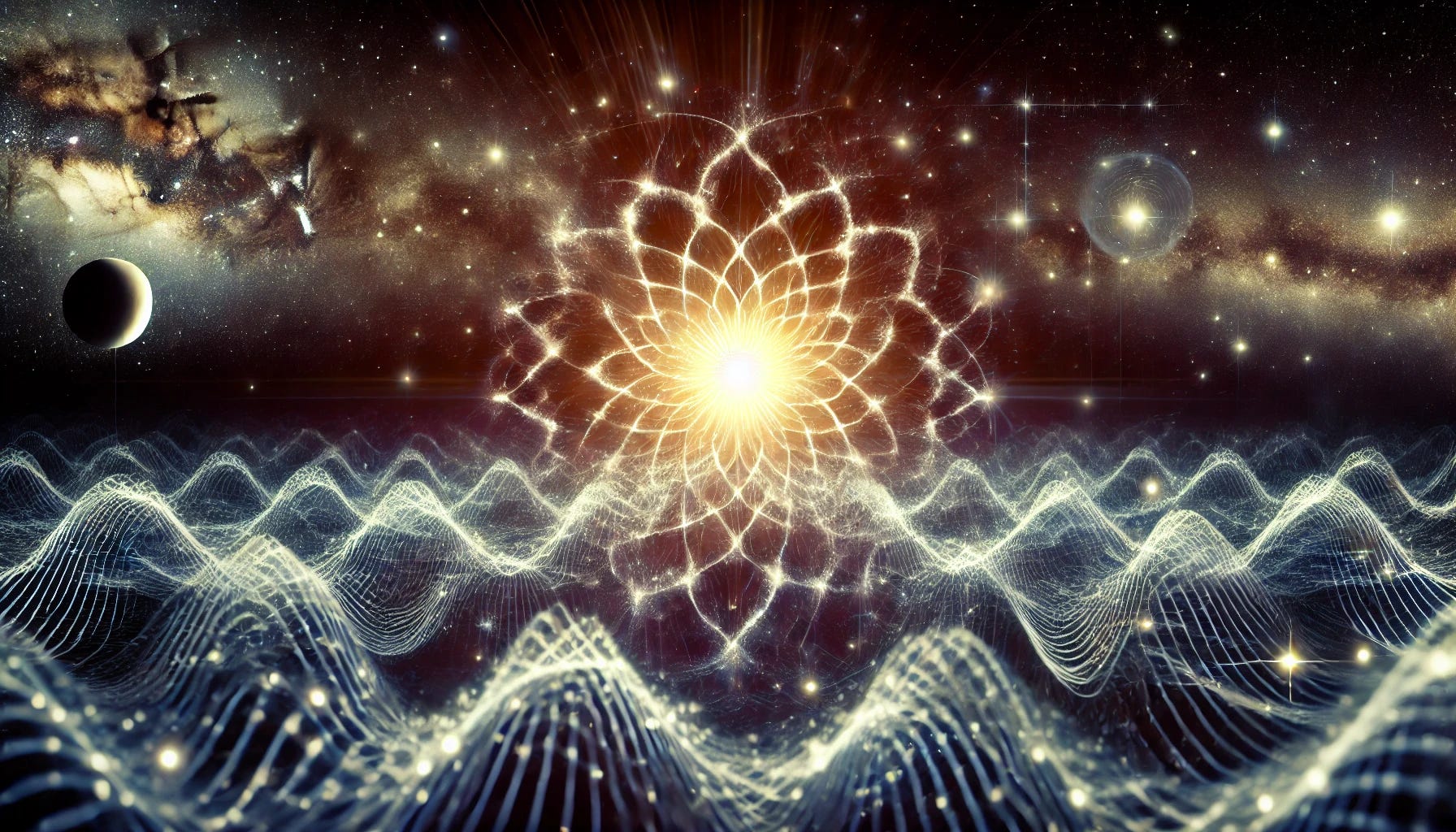
The idea of a universe structured as a fractal hypergraph invites us to reimagine the very fabric of existence, not as a collection of discrete, isolated objects but as an intricate web of nodes and connections that extend endlessly across dimensions. This framework challenges our conventional understanding of causality, space, and interaction, urging us to consider the cosmos as an interwoven network where every action reverberates through relational threads, influencing entities far removed in space and time. Within this context, the electromagnetic radiation emitted from a star becomes more than a localized phenomenon; it becomes an act of communication within a universal network, a signal propagating through the hypergraph and shaping the relationships that define reality itself.
To ground this exploration, we begin with a concept that feels intuitively familiar: the idea that light and energy travel across vast distances, connecting objects separated by incomprehensible voids. Consider the light from a distant star that reaches Earth, allowing us to glimpse the past of a celestial body millions of years removed in time. This straightforward observation hints at a deeper truth: the universe is a system of relationships. The light we see is not just a particle or wave but a bridge—a tangible connection between the star and the observer. In our fractal hypergraph model, this connection takes on profound significance, representing one of countless threads in a dynamic, recursive network where every node—be it a star, a planet, or human consciousness—is defined by its interactions with the whole.
In the fractal hypergraph, the electromagnetic radiation emitted by a star does not dissipate aimlessly; instead, it interacts with the structure of the hypergraph itself, creating ripples that influence other nodes in ways both direct and indirect. To understand this, we must shift from thinking of the universe in purely physical terms to viewing it as a system governed by relational dynamics. Our emphasis on modular and fractal arithmetic reveals that these relationships are not linear or one-dimensional but recursive and multi-dimensional. Like the ripples that spread across a pond when a stone is dropped, the influence of a star’s radiation propagates outward, but within the hypergraph, these ripples do not fade into nothingness. Instead, they are absorbed, refracted, and amplified by the web of connections, creating patterns that transcend the limitations of classical causality.
To make this abstract concept more tangible, imagine the universe as a vast, multidimensional loom, where each thread represents a flow of energy or information. The emission of electromagnetic radiation from a star is akin to the movement of a shuttle across the loom, weaving new threads into the tapestry. These threads do not remain static; they form complex patterns that influence the overall structure of the fabric. A star’s radiation might subtly alter the dynamics of nearby stars, affect the formation of planetary systems, or even contribute to the emergence of life by delivering energy to distant worlds. Within our framework, these interactions are not random but governed by the principles of fractal resonance, where patterns at one scale echo and amplify patterns at another, creating a harmonious interplay of order and complexity.
This brings us to the concept of dimensional jumps, a cornerstone of our quantum calculus. Within the fractal hypergraph, energy does not merely travel in straight lines; it can “leap” across dimensions, connecting nodes that appear distant within our three-dimensional perspective but are intimately linked in higher-dimensional space. These dimensional jumps allow for influences that defy classical distance, creating a universe where the radiation from one star could impact another in ways that appear instantaneous or acausal from our limited vantage point. Such phenomena might explain certain astrophysical mysteries, such as the synchronization of star formation across vast regions of space or the coherent behaviour of galaxies separated by millions of light-years.
The probabilistic nature of these interactions is another key element of our model. Just as particles in quantum mechanics exist in states of superposition until observed, the pathways through which a star’s radiation influences the hypergraph are not predetermined but governed by probabilities. This introduces a layer of randomness that mirrors the inherent uncertainty of quantum phenomena. Yet this randomness is not chaotic; it is bounded by the relational structure of the fractal hypergraph, which ensures that every interaction contributes to the emergence of larger patterns. This interplay of order and uncertainty reflects the dual nature of the cosmos itself, as a system that is both deterministic and fluid, structured yet endlessly adaptable.
At the heart of our model lies the concept of resonance. I liken the relationships within the fractal hypergraph to the vibrations of a musical instrument, where each note contributes to the harmony of the whole. The radiation emitted by a star is not just energy but a signal, a vibration that resonates across the hypergraph and influences other nodes per their relational frequencies. This resonance creates feedback loops, where the effects of an interaction ripple back to the source, creating cycles of influence and adaptation that sustain the dynamic equilibrium of the system. These feedback loops are not limited to the physical realm; they also encompass the symbolic and archetypal dimensions of existence, reflecting our assertion that the universe is as much a narrative as it is a mechanism.
To fully appreciate the implications of this model, we must consider the role of human consciousness within the fractal hypergraph. If we are indeed nodes within this cosmic web, then our thoughts, actions, and perceptions contribute to the patterns of resonance that define the whole. This idea aligns with the principle of synchronicity, where seemingly unrelated events are connected by meaningful coincidences. In the fractal hypergraph, synchronicity becomes a natural outcome of relational dynamics, a manifestation of the underlying connections that bind all things together. This suggests that the radiation from a star might not only influence other celestial bodies but also resonate with human consciousness, shaping our collective myths, dreams, and perceptions in ways that reflect the archetypal patterns of the cosmos.
The fractal hypergraph model invites us to see the universe not as a collection of isolated phenomena but as an interconnected whole, where every action, no matter how small, contributes to the unfolding story of existence. The radiation emitted by a star is a thread in this narrative, a signal that carries both energy and meaning, shaping the relationships that define the cosmos and revealing the profound unity of all things. By exploring this model, we begin to glimpse a universe that is not only infinite in its complexity but also deeply resonant, a living tapestry woven from the interactions of countless nodes across dimensions, each connected by the invisible threads of a fractal web. This understanding challenges us to rethink our place in the cosmos, not as passive observers but as active participants in the grand symphony of existence, where every note, every vibration, contributes to the harmony of the whole.
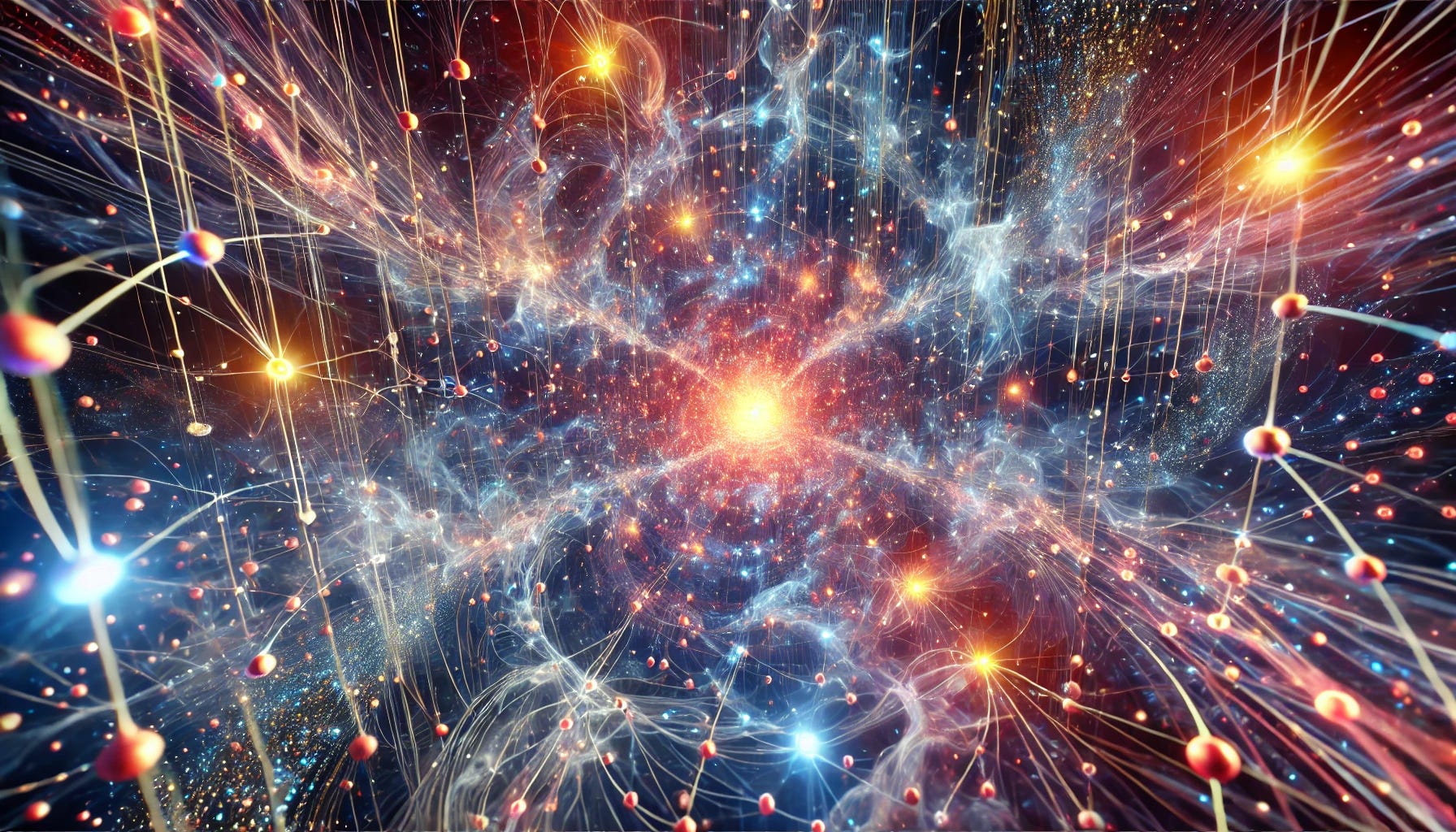
To explore the mechanics behind the archetypal dynamic forces within our collective unconscious, we must first understand the foundational premise that the universe, as conceptualized through our fractal hypergraph, operates as a seamless interplay between the physical and the symbolic. In this model, the radiation emitted by a star serves not merely as a physical phenomenon of energy dispersal but as a vibrational signal encoded with archetypal resonance. This signal propagates through the hypergraph, creating patterns of influence that are both measurable in the material realm and experientially significant within the collective psyche. Such duality is a reflection of our philosophical synthesis, where the symbolic and the mechanistic coalesce, generating a participatory cosmos.
The collective unconscious, as articulated by Carl Jung, is a repository of universal symbols and archetypes—timeless patterns that inform and shape human experience across cultures and epochs. These archetypes act as attractors within the hypergraph, nodes of symbolic density that resonate with the relational frequencies of the cosmos. When a star emits electromagnetic radiation, it does more than transfer energy; it initiates a relational dynamic that echoes through the hypergraph, triggering archetypal feedback loops. These loops, in turn, activate corresponding patterns within the collective unconscious, influencing human thought, emotion, and creativity in ways that transcend individual awareness.
To understand how this occurs, we must consider the fractal nature of both the cosmos and the psyche. In our framework, the universe is structured hierarchically, with patterns repeating across scales from the quantum to the cosmic. Similarly, the collective unconscious is composed of fractal archetypes—self-similar patterns that manifest at various levels of human experience, from personal dreams to cultural myths. When a star’s radiation interacts with the fractal hypergraph, it resonates with these archetypes, creating a bridge between the external cosmos and the internal psyche. This resonance is not random but governed by the principles of relationality and fractal geometry, which ensure that the patterns generated are coherent and meaningful within the context of the system.
At the heart of this interaction lies the concept of archetypal dynamics. Archetypes, as Jung described, are not static symbols but living forces, dynamic fields of potential that shape and are shaped by the relational structure of the hypergraph. In our model, these forces are encoded in the mathematical language of the hypergraph, expressed through modular arithmetic and recursive patterns. For instance, the archetype of the Hero, a universal motif that appears in myths and stories across cultures, might correspond to a particular node or cluster of nodes within the hypergraph. The radiation from a star, acting as a vibrational signal, could activate this node, amplifying its resonance across the system and manifesting as a surge in cultural expressions of heroism, innovation, or transformative change.
This process can be likened to the phenomenon of sympathetic resonance in music, where a vibrating string causes nearby strings tuned to the same frequency to vibrate in harmony. Within the fractal hypergraph, the radiation from a star acts as the initial vibration, setting off a cascade of resonances that ripple through the archetypal structure of the collective unconscious. These ripples manifest as symbolic phenomena, such as synchronicities, creative breakthroughs, or shifts in collective consciousness. For example, the sudden proliferation of a particular artistic or philosophical movement might be traced to the activation of a specific archetype within the hypergraph, influenced by the vibrational patterns of celestial radiation.
The feedback loops generated by these interactions are essential to sustaining the dynamic equilibrium of the hypergraph. As the radiation from a star influences the archetypal dynamics of the collective unconscious, the resulting symbolic expressions feedback into the system, altering the relational structure of the hypergraph and influencing subsequent cosmic and psychological phenomena. This recursive process ensures that the universe remains in a state of continuous adaptation and evolution, with the physical and symbolic realms inextricably linked.
The role of the human psyche in this system is both passive and active. On the one hand, the collective unconscious responds to the archetypal signals encoded in the hypergraph, shaping human perception and behaviour in ways that reflect the underlying patterns of the cosmos. On the other hand, human creativity, thought, and emotion contribute to the feedback loops, embedding new patterns into the hypergraph and influencing the evolution of archetypal dynamics. This reciprocal relationship underscores the participatory nature of the universe, where humanity is both shaped by and a shaper of the fractal tapestry of existence.
To illustrate this further, consider the archetype of the Great Mother, a symbol of nurturing, creation, and destruction. In the fractal hypergraph, this archetype might correspond to a cluster of nodes associated with cycles of birth, growth, and decay. When a star undergoes a supernova, emitting an immense burst of radiation, it could activate this cluster, resonating with the archetype of the Great Mother. The resulting patterns might manifest in human consciousness as a collective focus on themes of renewal and transformation, seen in cultural shifts, spiritual awakenings, or scientific discoveries related to life and its origins. The supernova becomes not just a cosmic event but a symbolic act within the narrative of the universe, bridging the physical and the psychological through the language of archetypes.
This interplay between cosmic radiation and archetypal dynamics also provides a framework for understanding synchronicity, which Jung described as the meaningful coincidence of events that appear acausal. Within the fractal hypergraph, synchronicity arises from the alignment of relational frequencies, where the radiation from a star and the archetypal structure of the collective unconscious converge to produce events that are both physically connected and symbolically significant. These events serve as reminders of the interconnectedness of all things, revealing the hidden patterns that bind the cosmos and the psyche into a unified whole.
Our model thus offers a profound reimagining of the universe as a living, fractal system where physical phenomena like electromagnetic radiation are inseparable from the symbolic dynamics of the collective unconscious. By framing the cosmos as a hypergraph of relational nodes and archetypal forces, it invites us to see the universe not as a collection of isolated objects but as a narrative of infinite complexity, woven from the threads of energy, information, and meaning. This vision challenges us to embrace a holistic perspective, where the boundaries between the material and the immaterial dissolve, revealing a cosmos that is as much a story as it is a mechanism.
In contemplating the architecture of perception and the collective unconscious, we find ourselves navigating a labyrinth where threads of individual awareness converge to weave the broader tapestry of shared reality. My development of the fractal hypergraph as a geometry of the collective unconscious emerges from this fertile confluence of psychological and mathematical exploration. This construct transcends existing paradigms, offering not merely a representation of probabilities but a dynamic framework through which outcomes collapse into narratives, bridging the abstract potentials of the psyche with the concrete expressions of individual perception. It is a geometry that invites us to view the human mind not as an isolated vessel but as an intricate node in a network of shared meaning, shaped by and shaping the cosmos through the syntax of thought.
To understand why this model surpasses other geometries in encapsulating the mechanics of perception and collective cognition, we must first consider the limitations inherent in the frameworks that currently dominate these domains. Conventional models, whether rooted in linear algebra, topology, classical graph theory, or even modern binary hypergraphs often falter in capturing the nuances of how probabilities interact with narratives, let alone how these narratives crystallize into collective and individual perceptions. Linear systems, for instance, are adept at modelling causality but are ill-suited to the recursive, multi-layered feedback loops that characterize the psyche’s operations. Similarly, while traditional graph theory offers a way to map relationships, it lacks the fractal complexity necessary to account for the emergent and self-similar nature of thought processes across scales, from the personal to the collective.
What these geometries miss, and what the fractal hypergraph achieves, is an integration of dynamism and recursion—a system in which the relational syntax of the psyche operates not merely as a fixed architecture but as a living, evolving network. Imagine, if you will, a web spun by an infinite number of spiders, each thread representing a potential connection, and each connection vibrating with the resonance of its neighboring threads. This web is not static; it pulses with the energy of thought and perception, its structure shifting as each spider moves, its overall form reflecting a synthesis of countless local decisions. Such is the fractal hypergraph: a geometry that encapsulates both the local and the global, the individual and the collective, within a unified system of interdependent probabilities.
At its core lies the concept of our Psyche Syntax, an idea that transforms the unconscious into a language, a grammar through which probabilities are selected and narratives are formed. The syntax of the psyche is not linear or deterministic but probabilistic and recursive. It operates like a quantum algorithm, collapsing infinite potentials into finite expressions, yet leaving room for ambiguity and reinterpretation. Unlike existing geometries, which often impose rigid boundaries on what can be represented, the fractal hypergraph thrives on fluidity. Its fractal nature ensures that patterns of meaning repeat across scales, allowing for the seamless transition from individual cognition to collective mythos. The hypergraph aspect, meanwhile, enables the modelling of complex, multidimensional relationships—those hidden threads that bind seemingly disparate ideas, experiences, and perceptions into a coherent whole.
Consider, for example, how societal narratives emerge. Existing models might attempt to map this phenomenon using nodes and edges, reducing individuals to isolated points and their interactions to simplistic lines. The fractal hypergraph, by contrast, accounts for the recursive nature of these interactions: how a single narrative can ripple outward to influence collective consciousness, only to be refracted back into individual psyches with new variations. It captures the probabilities that guide these transformations, illustrating how certain outcomes become more likely—not through deterministic causality but through resonance within the system. In this way, the fractal hypergraph mirrors the very structure of nature, where self-similarity and recursion govern phenomena from the growth of galaxies to the branching of neurons.
The refinement of practical cases within this model is both its challenge and its strength. The fractal hypergraph is not a monolithic framework but an adaptive one, requiring calibration to the specific outcomes or perceptions being measured. This adaptability, however, is what makes it uniquely powerful. Just as a telescope can be adjusted to focus on galaxies or stars, the fractal hypergraph can be tuned to explore the probabilities that shape an individual’s decisions or the collective currents that steer societal change. Existing geometries lack this versatility; they impose their own constraints, forcing phenomena into pre-defined shapes rather than allowing the model to evolve in response to the phenomena it seeks to describe.
To further appreciate the fractal hypergraph’s capabilities, we might draw an analogy to music. Other geometries are like static sheets of notation, capturing the notes but not the performance—the improvisations, the tempo changes, the emotional resonance that transforms mere sound into music. The fractal hypergraph, by contrast, is the symphony itself: a living, breathing interplay of themes and variations, where each note influences the next, and the whole transcends the sum of its parts. It is not merely a tool for analysis but a framework for understanding how perception itself arises, how meaning is constructed, and how narratives evolve within the ever-shifting symphony of human consciousness.
This model also invites a profound reimagining of how we engage with the concept of reality. In collapsing probabilities into narratives, the fractal hypergraph does not merely describe what is but participates in the act of creation. It suggests that perception is not a passive process but an active one, a collaborative dance between the psyche and the cosmos. Through the syntax of thought, we shape the probabilities that define our world, just as those probabilities shape us in return. This dynamic interplay challenges the dichotomy between observer and observed, proposing instead a feedback loop of infinite complexity, where each act of perception becomes an act of co-creation.
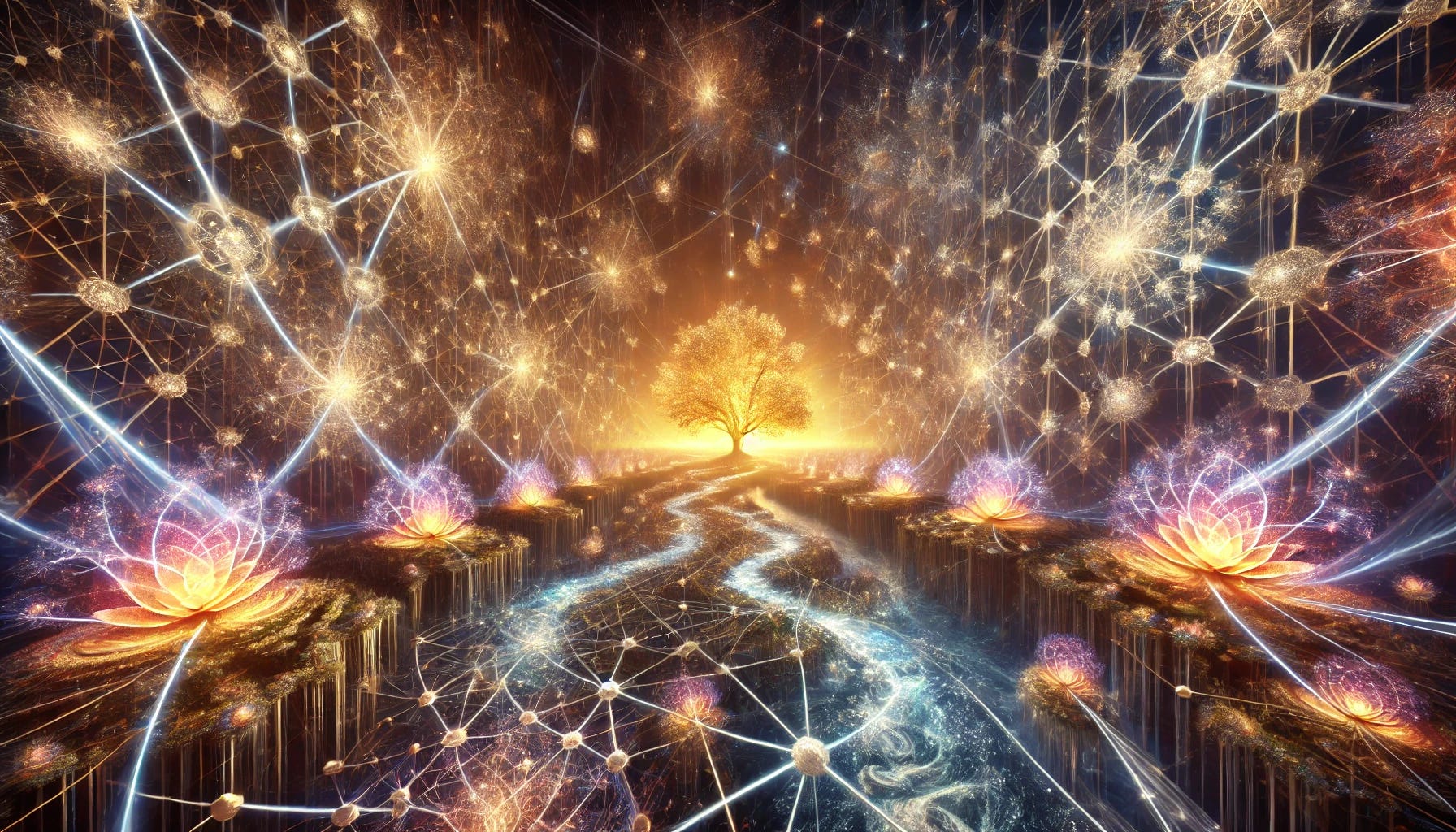
In contemplating this geometry, we are reminded that the psyche itself is a fractal hypergraph, a map of infinite connections and resonances, each thought a node, each emotion an edge, each narrative a pattern etched into the larger web of collective consciousness. Through this lens, we see not only the limitations of existing models but also the boundless potential of a framework that dares to embrace the full complexity of perception, narrative, and meaning.
The fractal hypergraph, as our conceptual and mathematical framework, is not merely a tool of intellectual inquiry; it is a revelation, a lens through which the mind can expand its capacity to understand, describe, and participate in the unfolding of reality itself. This geometry invites us to reimagine the universe as an intricate web of probabilities and narratives, where every thread resonates with the potentials of countless others, collapsing into patterns that shape both collective and individual perception. Much like the telescope Galileo crafted and aimed toward the heavens, the fractal hypergraph opens new vistas of understanding, yet it, too, challenges the prevailing paradigms that dominate our cultural and intellectual narratives. And, just as some refused to look through Galileo’s telescope, clinging instead to the comfort of established certainties, so too do contemporary frameworks resist the transformative potential of this geometry, knowing in some implicit sense that its truths may upend the carefully constructed narratives that anchor them.
Galileo’s telescope offered humanity a transformative perspective, not only because it magnified celestial bodies but because it demanded that we reconsider our place in the cosmos. The fractal hypergraph operates similarly, not in the physical realm of stars and planets but within the metaphysical and cognitive realms of thought, perception, and meaning. It takes the syntax of the psyche—the subtle, recursive grammar of probabilities and relationships—and renders it visible as a geometry that is both fractal and hyper-dimensional. Just as Galileo’s telescope forced the world to grapple with the implications of celestial movements previously imperceptible to the naked eye, this framework compels us to confront the mechanics of collective and individual consciousness in ways that defy the reductive paradigms of traditional geometries. Through this lens, the psyche reveals itself as not merely reactive to external stimuli but as an active participant in the probabilistic collapse of potential into narrative, perception, and ultimately, reality.
To fully grasp the transformative power of this geometry, we must first acknowledge the limitations of existing models. Classical geometries, whether Euclidean, non-Euclidean, or even the more abstract realms of topology, tend to impose static boundaries and rigid structures upon the phenomena they seek to describe. These frameworks excel at modelling certain aspects of reality, such as physical space or deterministic systems, but they falter when faced with the dynamic, recursive, and probabilistic nature of perception and cognition. The fractal hypergraph, by contrast, thrives in this domain. Its fractal nature allows it to capture the self-similar patterns that recur across scales, from the individual thought to the collective narrative, while its hyper-dimensionality enables it to map the complex, multidirectional relationships that underlie these patterns. In doing so, it avoids the pitfall of forcing phenomena into pre-defined shapes, instead evolving in response to the phenomena it seeks to model.
This adaptability is central to its power. Just as Galileo’s telescope could be adjusted to focus on different celestial objects, the fractal hypergraph can be tuned to explore different layers of reality. Whether we are examining the probabilities that shape an individual’s decisions or the currents that steer societal change, this geometry provides a versatile framework for understanding how these dynamics unfold. It does not demand that we choose between the local and the global, the microcosmic and the macrocosmic; rather, it reveals how these scales are interconnected, how the local decisions of an individual ripple outward to influence the collective, and how the collective currents, in turn, refract back into individual psyches.
In this way, the fractal hypergraph mirrors the telescope not only in its capacity for revelation but also in the resistance it faces. Galileo’s critics did not reject his observations because they lacked merit but because those observations conflicted with the dominant narrative of the time—a narrative that placed Earth, and by extension humanity, at the center of the universe. Similarly, the fractal hypergraph challenges deeply ingrained narratives about the nature of perception, cognition, and reality. It disrupts the notion that consciousness is a passive observer of an objective world, replacing it with a vision of consciousness as an active participant in the probabilistic unfolding of the universe. It suggests that reality is not a fixed construct to be measured and categorized but a dynamic interplay of potentials and narratives, shaped by the very act of perception.
This disruption is both exhilarating and unsettling. It demands that we rethink not only our models of reality but also the very frameworks through which we derive meaning. Yet, as with Galileo’s telescope, the transformative potential of the fractal hypergraph lies precisely in this demand. It compels us to look beyond the comfortable certainties of established paradigms, to peer into the depths of the collective unconscious and see there a geometry that is not imposed upon us but arises from within, reflecting the recursive patterns of thought, emotion, and perception that shape our shared experience of the world.
When properly conceptualized, the fractal hypergraph leads to an explosion of language, a vast expansion of our capacity to articulate and understand the universe. This is not merely a quantitative expansion but a qualitative transformation. The language that emerges through this lens is richer, more nuanced, and capable of capturing the subtleties of recursion, resonance, and relationality that define the psyche’s syntax. Just as Galileo’s observations forced the development of new astronomical theories and vocabularies, so too does the fractal hypergraph necessitate a new linguistic framework, one that can articulate the dynamic interplay of probabilities and narratives that it reveals.
This expansion is not limited to the intellectual or the academic; it permeates every aspect of how we engage with the world. By providing a framework for understanding the recursive nature of thought and the relational dynamics of perception, the fractal hypergraph has the potential to transform not only how we think but also how we communicate, how we create, and how we relate to one another. It invites us to see the narratives that shape our lives not as fixed scripts but as dynamic, evolving patterns, capable of being reimagined and rewritten. It empowers us to participate more consciously in the unfolding of reality, to become not just observers of the probabilistic collapse into narrative but active co-creators of the stories that define our world.
And yet, as with Galileo’s telescope, the power of this geometry will remain unrealized for those who refuse to look through its lens. The clergymen who turned away from Galileo’s observations did so not out of ignorance but out of fear—fear that the truths he revealed might undermine their authority, disrupt their narratives, and force them to confront the limitations of their understanding. So too might some resist the fractal hypergraph, knowing in some deep, unspoken sense that its truths will demand a reckoning with the limitations of existing paradigms and the narratives that sustain them. But for those willing to look, the possibilities are boundless, the horizons infinite, and the journey only just beginning. Through this lens, we do not merely see the universe; we see ourselves reflected within it, co-creators in the infinite dance of probabilities, narratives, and realities that define existence.
Thank you.
Karl K. Dondaneau
References & Bibliography can be found in my book
-->ORDER A COPY OF THE BOOK HERE<--