The Patterns We Leave Behind: How Your Choices Shape Reality
Authored by: Karl K. Dondaneau
December 18th 2024
-->ORDER A COPY OF THE BOOK HERE<--
Prefer to listen? Just hit the play button and enjoy the audio version!
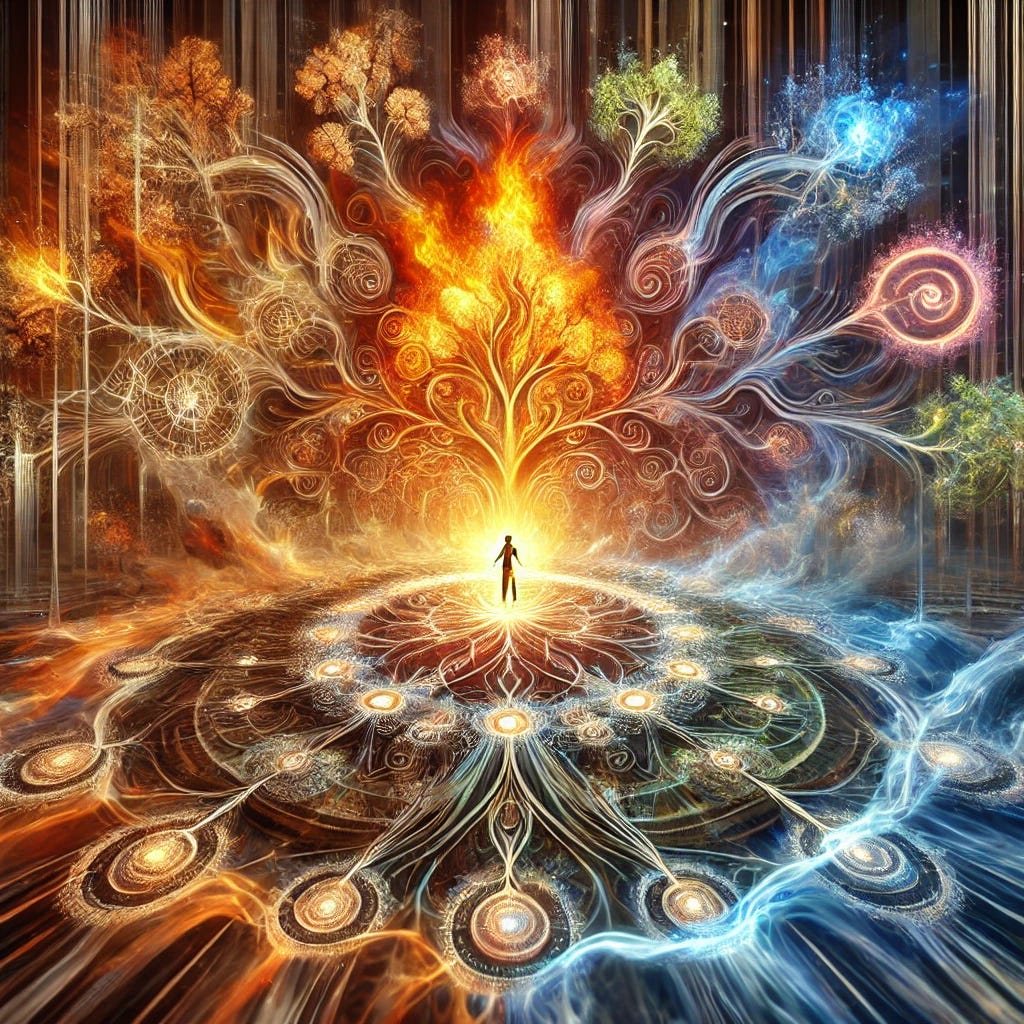
We find ourselves at the nexus of perception and creation, where every action, thought, and interaction contributes to the fabric of reality as we know it. This participatory metaphysics—our active engagement with the universe—places us not as passive recipients of a preordained world, but as co-creators, shaping the contours of existence with each choice we make. It is both a privilege and a burden, for the beauty and chaos we encounter in the world are reflections of our collective contributions.
Our engagement with media, particularly the omnipresent landscape of social media, offers a profound window into this participatory dynamic. Every post we create, every comment we leave, and every piece of content we consume feeds into an ever-expanding feedback loop of perception and influence. The algorithm becomes an allegory for our metaphysical state: a system that reflects what we give it, amplifying and reinforcing patterns until they form a fractal of thought and behaviour.
Imagine a fractal—a self-replicating pattern that grows infinitely, each iteration building upon the last. This is how our actions ripple through the metaphysical field of reality. When our behaviour is harmful—whether through thoughtless comments, disengaged consumption, or actions that harm others or the planet—these patterns do not dissipate. They echo, reverberating through the hidden feedback loops of perception. What begins as a seemingly isolated act—an angry tweet, an unconscious environmental choice—becomes a node in a larger structure, a fractal of harm that feeds back into our consciousness, influencing how we see the world.
Our psychological frameworks are the root of this dynamic. Beneath the surface, our unconscious processes absorb these patterns and reinforce them. If we consistently engage with negativity—consuming divisive content, spreading unkindness, or failing to reflect on our own behaviour—we prime our minds to perceive the world through a similar lens. What we consume shapes how we think, and how we think shapes what we perceive. The feedback loop solidifies, growing with each interaction, until it becomes a self-sustaining system of perception and action.
But just as harm can propagate through this system, so too can care, kindness, and reflection. Our metaphysical engagement is not inherently destructive—it is simply amplificatory. When we act with intention, when we choose to engage in ways that uplift others, nurture the planet, and foster connection, the same feedback system reinforces those patterns. Acts of kindness, even small ones, resonate outward, creating fractals of harmony that reshape not only our individual perceptions but the collective field of reality.
The duality of this system reveals the profound responsibility we carry. If our reality reflects our contributions, then to address the chaos and harm we see in the world, we must begin within ourselves. We must question not only our external actions but the internal patterns that guide them. Are we perpetuating harm through our unconscious habits? Are we allowing fear, anger, or apathy to drive our choices? Or are we cultivating a sense of awareness, a willingness to engage with the world in ways that foster growth and renewal?
It is not easy. The fractals of harm we have inherited—through culture, history, and personal experience—run deep. Social media, for instance, often thrives on negativity, rewarding outrage and polarization with attention. Breaking free from these patterns requires conscious effort: to pause before we react, to reflect on what we consume and how it shapes us, and to deliberately choose actions that align with the reality we wish to create.
Yet, the potential for transformation is immense. The feedback system is malleable, and responsive to our shifts in behaviour and thought. If we commit to creating patterns of care, awareness, and responsibility, the fractals that emerge from our actions can reshape the very fabric of perception. This is not a passive process; it demands engagement, self-reflection, and an understanding of our interconnectedness with the world around us.
In this participatory metaphysics, we see the world not as a fixed structure but as a living, breathing reflection of ourselves. It is both a mirror and a canvas, showing us the consequences of our actions while inviting us to paint a better picture. The good and the bad are not external forces acting upon us—they are the echoes of our collective choices. And as co-creators of reality, we hold the power to shape those echoes into something transformative.
The fractals we create through our thoughts and actions will continue to grow, spreading their influence through the feedback loops of perception and reality. The question we must ask ourselves is not whether we can escape this system—because we cannot—but what kind of fractals we wish to leave behind. Will we let harm and chaos dominate, or will we choose to cultivate patterns of renewal and connection? The answer lies in the countless decisions we make every day, and in the ways we choose to engage with each other and the world.
This participatory reality is not a burden we must bear alone; it is a shared endeavour. Each of us contributes to the fractals that shape our world, and together, we have the power to create something extraordinary. Let us act with intention, knowing that every thought, every word, and every action is a brushstroke in the ever-evolving masterpiece of existence.
Thank you.
Karl K. Dondaneau