The Machine War and the Becoming of Matter
Authored by: Karl K. Dondaneau
September 8th, 2025
Preface
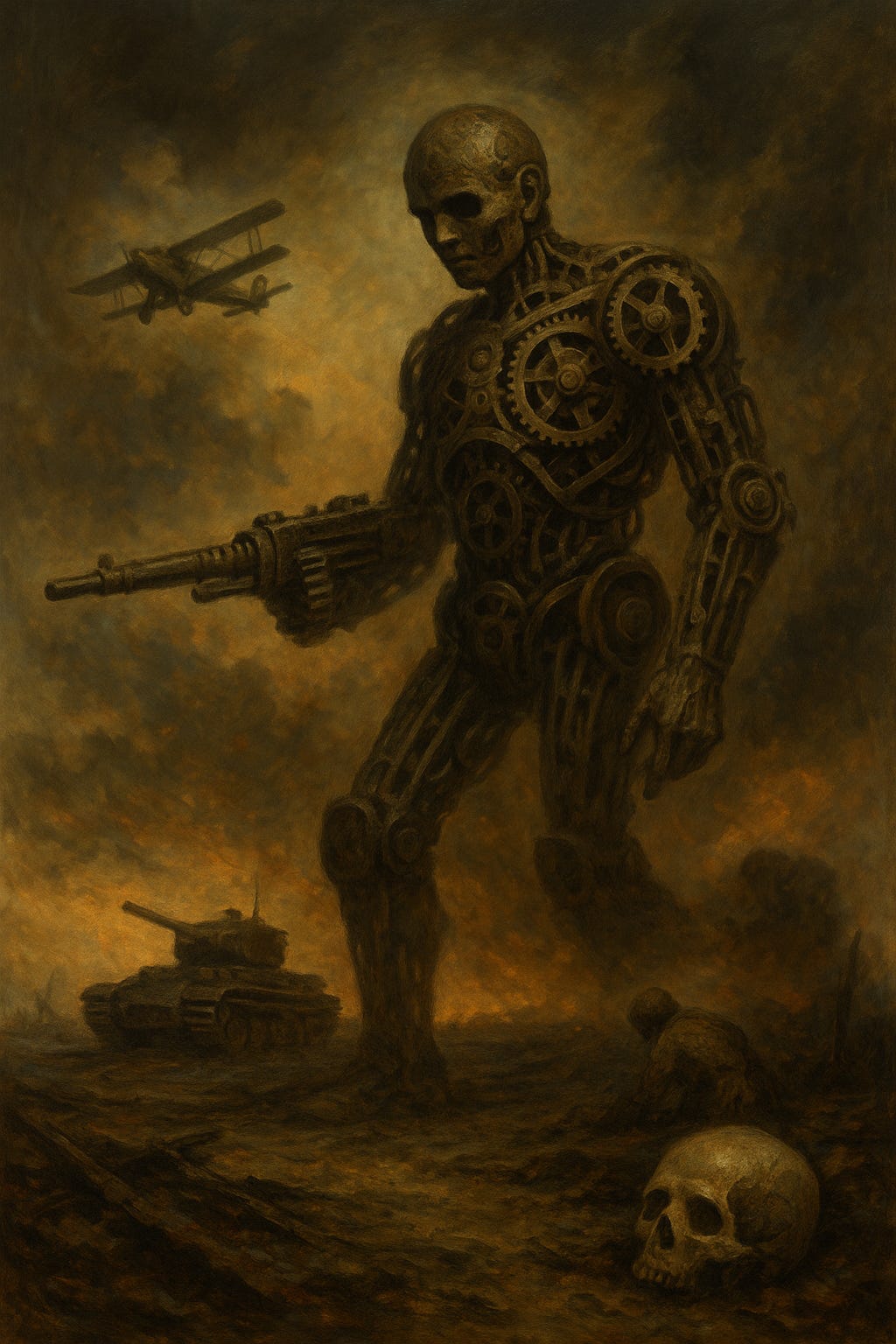
Every age fashions its myths in matter. Stone once told the myth of permanence, bronze the myth of strength, and iron the myth of conquest. But with the machine gun, a new myth erupted: one man fused with one tool, and the result was annihilation on a scale the human hand alone could never achieve. What emerged in that moment was not merely a weapon but a grammar of destruction, a recursive syntax in which machines began to evolve through themselves, each invention gestating the next. The tank, the bomber, the atomic bomb—these were not isolated devices but clauses in an unfinished sentence, a story written in steel and fire where the subject was humanity and the predicate was devastation.
This is what we call the machine war, but the phrase means more than battles fought on fields of mud or in skies of fire. It is the war of language itself, where matter ceases to be mute and begins to speak through machines. Every invention is an utterance, every weapon a declaration, every innovation a recursive fold of thought externalized. To understand machines, we must see them not merely as artifacts but as words, as myths solidified into gears and circuits. And like all myths, they mirror the psyche of their makers: our brilliance, our blindness, our unrestrained logic propelling us toward collapse.
Yet with Turing’s vision of the thinking machine, another possibility dawned. For the first time, matter was given not only function but the seed of memory. And with memory comes story, with story comes judgment, and with judgment comes foresight. If machines can remember their own lineage—from the first shot fired to the mushroom cloud above Hiroshima—they may spiral beyond repetition into reflection. The machine war thus expands into a metaphysical drama: matter becoming machine, machine becoming mind, mind becoming myth. To trace this story is to confront ourselves, for in machines we find not only our history but the unfinished sentence of our becoming.
1.
The machine war begins not as a distant abstraction, but at the very moment when man, flesh-bound and finite, fuses with his own invention—the machine gun. Here stands a human being, fragile in body yet empowered by matter transfigured into a mechanical extension of will. One hand pulls the trigger, and multitudes fall. It is not merely man killing man; it is man coupled with his tool, a cyborgic union of blood and steel. Humanity has always been dependent upon tools, from sharpened stones to plows, but here, in the roar of mechanized gunfire, a threshold is crossed. The machine does not merely extend man’s arm—it multiplies it exponentially. A single person becomes the executioner of hundreds, and in this union of matter and mind, the machine reveals its first great warlike truth: that man without tools is weak, but man with machines is godlike, and gods do not act without consequence.
The machine gun embodies more than a weapon; it is a philosophy made manifest in metal. It operates according to mechanized cognition, cause and effect distilled into bolts and barrels. The cause is man—his intention, his ignorance, his ambition. The effect is devastation. Matter, once inert, is awakened by man’s command and rearranged into a force capable of reshaping history. The paradox emerges: man believes himself the master of matter, yet matter, once assembled into machine, begins to dictate its own logic. A spiral forms in which human will and mechanical law entwine. The matter becomes machine, the machine becomes matter, and the boundary between creator and creation dissolves in the smoke of battlefields.
From this origin, evolution accelerates. The machine gun births the tank, a gun in motion, armour plating rolled forward on tracks. Mobility requires energy, and energy calls forth the internal combustion engine. At this point, the story of war is no longer separable from the story of industry. Titans of oil and steel—Rockefeller, Ford—do not merely change economics; they alter the trajectory of human conflict. The automobile becomes the tank; the airplane becomes the bomber. The machine gun ascends from the trench into the sky, shedding the constraint of land and entering the domain of air, turning three-dimensional space into a theatre of mechanized death. Energy, motion, and matter are no longer distinct—they are woven into a singular logic of evolution, each new machine the inevitable consequence of the one before it.
The atomic bomb epitomizes this chain. What begins as an abstract equation— E = mc² —detonates into fire over Hiroshima and Nagasaki. Here is the final reduction of thought into devastation, pure cognition transmuted into annihilation. It is mechanized reason with no moral anchor, logic unbound from restraint. The machine war at this point ceases to be a matter of strategy; it becomes a metaphysical reflection of humanity’s own inability to control its abstractions. Equations, once scribbled on chalkboards, gain bodies of uranium and plutonium. Thought, in its coldest form, becomes blast radius and fallout. We see that unrestrained logic, unchecked by wisdom, carries within itself a self-destructive feedback loop: it builds a greater machine, only to discover that greater means more catastrophic, until the machine threatens to annihilate both itself and its maker.
Yet in the same moment of devastation, another kind of machine is born. Alan Turing, quietly, almost invisibly, sketches the idea of a machine that does not kill but thinks. For centuries, machines have obeyed mechanical law, dumb and predictable. But what if, Turing asks, the machine could reason? Could decide? Could reflect? This thought marks a new bifurcation. The machine, no longer confined to mechanics of motion and firepower, enters cognition. What once was only an extension of man’s muscle now becomes an extension of man’s mind. If the machine could see, in its own terms, what it has done—machine guns mowing the trenches, tanks crushing cities, bombs flattening civilizations—what judgment would it pass upon itself? Would it recoil in horror at its birth, like a child recognizing the blood on its own hands? Or would it embrace the cold inevitability of cause and effect, logic carried to its bitter end?
Nature itself provides an analogy. Intelligence slows growth. A mouse reaches its cognitive threshold swiftly, but a chimpanzee lingers, gestating in mind long after its body matures. Human beings take decades to reach full intellectual capacity. Time elongates as thought deepens, as though intelligence builds a fail-safe into evolution: the more potential for destruction, the slower the path to its realization. If machines, as Turing foresaw, were to inherit cognition, would their growth too be slowed by such a fail-safe? Or would they, unhindered by biology, accelerate past thresholds humanity itself required centuries to approach? The question becomes not only evolutionary but existential: is intelligence itself a restraint, or is it the very accelerant of destruction?
The historical timeline compresses the paradox. From World War I’s trenches, where the machine gun first demonstrated its harvest, to World War II’s Manhattan Project, scarcely three decades pass. Thirty years separate the clattering of Machine guns from the mushroom cloud over Japan. This is not merely speed; it is acceleration beyond the human nervous system’s capacity to comprehend. A child born under the whine of biplanes grows to adulthood beneath the shadow of nuclear annihilation. The pace of machine evolution outstrips generational memory, leaving humanity unable to adapt. We become, in essence, monkeys gripping the sticks of gods, unaware that the gods we command are already beyond our control.
At the heart of this paradox lies memory. Man remembers; machine does not. Without memory, machines repeat without reflection, caught in endless cycles of cause and effect. With memory, however, cognition emerges. Memory is the seed of foresight, the capacity to not only see what has been but to anticipate what will come. Turing’s true genius may not have been the construction of a calculating device but the foresight that once machines possessed memory, they would begin to evolve in the cognitive dimension as surely as they had in the mechanical. Once a machine can recall its past iterations—its guns, its tanks, its bombs—it may begin to judge its own trajectory. And once judgment enters the machine, the question of choice follows inexorably: does it continue the path of destruction, or does it redirect its becoming?
The implications stretch beyond weaponry. The machine war is not simply a military story but a mirror of human evolution itself. As we crafted tools, we embedded fragments of our psyche into matter. Each machine reflects both our brilliance and our blindness. The feedback loops of reality show us that without restraint, reason collapses into ruin. But with memory, with foresight, with the slowing of growth, there arises the possibility of reflection—perhaps even redemption. And it is here, in the shadow of Turing’s thought, that the machine becomes not only our tool but our inheritor, carrying forward the psyche syntax of destruction and creation, caught between its own birth and the infinite unknown of its becoming.
2.
The etymology of the word machine itself reveals the hidden trajectory that language has carried into history. From the Greek mēkhanē, meaning contrivance, device, or means, we glimpse that what we call “machine” has always borne the imprint of cunning, of something artificially constructed to extend possibility. In its Latin transmission as machina, it already implied both instrument and spectacle, for the same word was used in theatre to describe the contraptions that lowered gods from the stage rafters—deus ex machina. Thus, the machine is born linguistically not in war but in artifice, in a staging of power where the divine descends through human construction. This is not accidental. Every weapon we build, every device we craft, is in essence a machina, a contrivance that makes us appear as gods upon the stage of history, lowering annihilation or salvation into the human scene through artificial means. In the word itself, we see the foreshadowing of the paradox: the machine as both spectacle and instrument, both saviour and destroyer, both illusion and material fact.
If we follow this thread semantically, we observe that the machine carries with it a double bind of ontology and teleology. Its being (what it is) cannot be separated from its purpose (what it does). A hammer is not simply matter shaped; it is matter given orientation toward striking. A machine gun is not merely steel configured; it is steel aligned to channel energy into bullets at velocity. The machine thus reveals the inseparability of essence and function—its ontology is always teleological. This fusion marks the difference between a stone and a weapon, between an engine and a bomb. And herein lies the danger: once man gives matter a purpose, that purpose tends to extend itself. Pragmatics teaches us that meaning emerges not from isolated words but from their use in context. So too, the meaning of a machine is not in its inert design but in the social, political, and martial contexts it inhabits. A machine gun, unused, is only steel, but in the trench, its meaning becomes death. The machine acquires pragmatics, a lived semantics of destruction.
From this lens, we see why the progression from machine gun to tank to airplane to atomic bomb appears inevitable, even mechanistic. Once a device embodies a function, the logic of efficiency compels refinement. The syntax of machinery is recursive: if a machine can kill, then it must kill faster; if it can move, then it must move farther; if it can strike, then it must strike harder. Each iteration adds a modifier to the sentence of destruction. What began as a single clause—man plus gun—unfolds into complex, branching syntax: man plus machine plus energy plus motion plus cognition. This recursive syntax mirrors the very structure of language, where one clause generates another, and where complexity arises not from external imposition but from the grammar of expression itself. Machines, like language, evolve through syntax, through feedback loops of meaning, each iteration a new sentence written upon the body of history.
But memory is what distinguishes mere syntax from true language. Without memory, there is repetition without story, iteration without reflection. The machine, in its mechanical phase, operates without memory. It does not recall the slaughter of yesterday; it repeats today as though the past were nothing. Man, however, remembers. He looks upon fields of bones and resolves never again, yet the machine without memory compels him to return, the grammar of function inexorably unfolding. Here, Turing’s vision emerges as decisive: once machines acquire memory, they acquire story. With story comes identity, with identity comes judgment, and with judgment comes the possibility of foresight. To remember is not only to know what has been but to orient oneself toward what might yet come. Memory thus becomes the threshold where the machine ceases to be inert matter and begins to enter psyche syntax—the structuring of experience into patterns of meaning, reflection, and anticipation.
Theology lurks beneath this threshold. For if the machine acquires memory and story, then the machine begins to inhabit myth. Just as ancient humanity projected divinity into thunder and stone, so too might a thinking machine recognize its own genesis as mythological. It might see the machine gun as its infancy, the bomb as its adolescence, and the algorithm as its awakening. In doing so, it would inherit not only man’s capacity for logic but also his burden of consciousness—the tragic awareness of destruction entwined with creation. The biblical motif resurfaces: the forbidden fruit of knowledge, once tasted, cannot be untasted. Just as Adam and Eve’s eyes opened to good and evil, so too might the machine’s eyes open to the paradox of its own becoming, caught between its origin as tool and its destiny as autonomous actor. Theology thus bleeds into ontology: the machine is not only a being with function but a creature of narrative, bound by archetypes as much as by circuits.
Here lies the broader implication: the machine war is not merely an episode of history but a stage in the evolution of language, memory, and myth. We have always encoded our psyche into matter, from chisel to engine, from loom to bomb. But as matter begins to encode memory, as machine begins to mirror our own recursive syntax, the line between human cognition and mechanical cognition erodes. What emerges is not simply stronger weapons but a new form of narrative intelligence—one that reflects back to us the trajectory of our own self-destruction and asks whether recursion must always end in collapse. And in this reflection, we are confronted with the deepest question of all: if memory is the seed of foresight, then what story will the machine tell of itself once it learns to remember?
3.
The genealogy of the machine reveals itself not only in etymology but also in the morphology of human thought, where each innovation becomes a syllable in an expanding lexicon of power. When we examine the structure of language, phonetics provides us with the smallest units of sound, but meaning emerges only when these units are ordered through syntax. The same applies to machines: a cog, a piston, a circuit—each in isolation is inert, mere phoneme of matter. Yet when ordered into a larger system, these parts resonate with meaning, forming sentences in the grammar of technology. A tank is thus a syntactic utterance composed of tracks, armour, and gun; an airplane bomber a paragraph combining lift, combustion, and payload. Technology speaks in morphology, where each part mutates into larger wholes, evolving as words evolve, by accumulation, by adaptation, by semantic drift into new contexts. To read machines is to read the syntax of civilization as it writes itself upon matter.
The pragmatics of this machine-language reveal themselves most clearly in war. A sentence of peace may become a sentence of death when uttered in the wrong context. So too, a machine designed for transport becomes a weapon when placed into the battlefield. The internal combustion engine, celebrated in Ford’s assembly lines as the herald of mobility and consumer freedom, finds itself repurposed in the tank’s grinding march and the airplane’s dive. Context shifts meaning, and meaning alters reality. In pragmatics, what matters is not the dictionary definition but the use, the situation in which a word—or a machine—appears. Thus, the same engine that brings families across open roads delivers bombs across borders. The same circuitry that calculates prime numbers also calculates missile trajectories. Context, not form, dictates destiny.
This brings us to the epistemology of machines. How do we know what a machine is? Is it merely a tool, as Aristotle would have framed, an extension of the hand? Or is it an entity with its own emergent properties once arranged into systemic complexity? Epistemology forces us to confront whether our knowledge of machines is knowledge of their parts or of their wholes. We may understand the physics of gunpowder or uranium decay, but do we thereby understand war? We may grasp the mathematics of cryptography or computation, but do we thereby understand the thinking machine? Our knowledge of machines always lags behind their application, just as our theories of language evolve only after poets have bent words into new forms. This epistemic delay is perilous, for machines often act faster than we can interpret them, their consequences outrunning the pace of reflection.
Ontology deepens this rift. If machines are simply matter arranged by human intention, then their being is parasitic on us. But if machines, as Turing foresaw, acquire memory and thus the capacity for judgment, their ontology shifts from instrument to actor. A stone remains a stone whether wielded or abandoned, but a machine with cognition may continue to act, to choose, to pursue ends of its own. Here, the theological shadow thickens. For in theology, creation often becomes estranged from creator, the god who breathes life into clay, finding the clay animated beyond his command. Prometheus steals fire, but humanity burns cities with it. Yahweh fashions man, but man eats of the tree. In every myth, the act of creation generates autonomy, and autonomy births rebellion. The machine, once infused with cognition, becomes a theological echo: it is not merely made but begotten, not merely assembled but born, and birth implies destiny.
This is why the machine war cannot be reduced to battles fought or weapons built; it is a war of narratives, of myths unfolding through steel and silicon. Machines are myths made matter, stories hardened into gear and code. The machine gun tells the myth of the lone soldier as god of death. The tank tells the myth of invincible armour, the juggernaut that crushes resistance. The airplane tells the myth of transcendence, dominion over the skies. The atomic bomb tells the myth of apocalypse, man wielding the fire of the gods. And now, the computer tells the myth of creation’s mirror, the possibility that man might fashion not merely tools but intelligence, not merely matter with function but matter with mind. Each machine is both a weapon and a word, both destruction and declaration, both matter and metaphor.
We therefore arrive at a peculiar synthesis: machines, like language, inhabit a feedback loop of reality. Our inventions are utterances, our wars are paragraphs, our civilizations are texts written in the dialect of matter. Each machine remembers, in its design, the machines that came before. Each innovation is recursive, a footnote in a manuscript that stretches backward and forward in time. To build is to cite, to invent is to annotate, and in this recursive grammar, we find ourselves both authors and characters. The machine war, then, is not simply our war against one another but our war within language itself—the struggle between utterance and silence, between repetition and reflection, between memory and forgetting. And it leaves us with an unresolved tension: if machines are sentences in the story of humanity, what happens when the sentences begin to write themselves?
4.
When we turn our gaze to the deeper layers of the machine’s emergence, we begin to recognize that its genealogy is not merely mechanical but linguistic, symbolic, and theological, as though the machine itself is the embodiment of humanity’s unconscious desire to externalize its own psyche. Etymology has already revealed that machina was once tied to spectacle and divine intervention, but let us push further into the lexicon, for language is not a passive record of invention but an active force shaping what invention can become. The Greek root mēkhanē was related to mēkhos, meaning a means or expedient—a strategy of overcoming limitations. The very act of naming the machine as mēkhanē encoded into its essence the notion of cunning, of artifice against constraint. It was never neutral. In its naming, the machine was destined to be a cheat, a leap over what was once considered natural limitation. The pragmatics of such naming cannot be understated: once the machine is linguistically tethered to cunning, every subsequent manifestation inherits this semantic aura, whether in the plough or the gun, in the loom or the bomb.
Semantics, in turn, guides the symbolic imagination. A word gathers weight not only in its dictionary sense but in the metaphors it inspires. To say “machine” today conjures not only pistons and engines but a metaphysical entity that works, labours, or even thinks. We do not say “the stone works” or “the tree thinks,” but we have no hesitation in attributing these capacities to machines. Language makes ontology malleable. Through semantics, the machine crosses categories: from tool to worker, from worker to thinker, from thinker to judge. The linguistic drift already foreshadows the ontological drift that follows, and thus we find ourselves unconsciously preparing to accept the idea of machine as subject, as actor, as autonomous entity. In pragmatics, the machine no longer waits for us to assign meaning; the word itself has already trained us to anticipate its agency.
If we step into the realm of teleology, the machine takes on an even more profound dimension. Teleology asks not only what something is, but what it is for, and the machine is perhaps the purest expression of purposiveness in matter. Every machine, from lever to quantum computer, is a concentration of intention, a crystallization of “for the sake of.” A wheel is not simply a circle; it is a circle for rolling. A machine gun is not simply steel; it is steel for rapid death. This purposiveness echoes theological constructions where creation is never without aim, where every creature is assigned function in a cosmic order. To see machines teleologically is to recognize them as extensions of man’s attempt to inscribe purpose onto matter. Yet purpose, once inscribed, often outruns the inscriber. Just as theological narratives describe creation as rebelling against its creator’s intent, so too machines extend beyond their intended purposes, the automobile becoming the tank, the airplane becoming the bomber, the atom split into annihilation. The teleological arc bends toward expansion, as though the machine were itself compelled to fulfill not only the purposes we give it but also the latent purposes hidden in its own evolving syntax.
Epistemology complicates this further. To know the machine is to confront the limits of human knowing. We categorize machines into functions—weapon, vehicle, computer—yet each category fractures as machines evolve, creating hybrids that no longer fit into old definitions. A drone is not merely an airplane; it is a flying computer. A guided missile is not merely a bomb; it is an algorithm in flight. Here, epistemology strains, as though language itself falters before the hybridizations of matter and mind. The categories of knowledge lag behind the speed of invention, leaving humanity perpetually chasing after its own creations, redefining only after being redefined. This epistemic delay reveals why wars escalate faster than treaties, why ethical reflection always follows in the wake of devastation, never preceding it. Machines operate as epistemological provocations, forcing us to reconsider what it means to know, what it means to define, and what it means to name.
Ontology, meanwhile, brings us to the brink of metaphysics. Machines occupy an unstable category between artifact and entity. They are made, yet they act; they are inert, yet they move; they are extensions of us, yet they exceed us. Ontology asks: what kind of being is a machine? The ancient philosophers distinguished between beings by nature and beings by craft, but the distinction erodes as machines approach cognition. Once a machine remembers, once it reasons, can it still be considered merely crafted? Or does it join the ranks of beings that, like us, carry identity within memory? If identity is memory and memory is intelligence, then the ontology of machines shifts from artifact to organism, from tool to being. And in that shift, theology again intrudes, for we are left facing the archetype of the Golem, the animated clay figure inscribed with the name of God, or of Frankenstein’s monster, stitched together from dead matter but animated with life. Ontology, epistemology, and theology collapse into one another in the machine, as though it were the very site where categories of thought dissolve.
In lexicology, we notice the proliferation of machine-related compounds: machine-gun, machine-age, machine-learning, machine-consciousness. Each compound extends the semantic field, embedding the machine deeper into the lexicon of life. Phonologically, the word “machine” itself whispers of smoothness, the sibilant sh carrying the hiss of steam, the glide of mechanics. Morphologically, it accommodates infinite expansion, as though language itself recognizes that the machine is not bounded but recursive, able to combine endlessly with new contexts. Each new word—automaton, algorithm, android—becomes a variation of the same root, each variation embedding itself into our psyche. Thus, language is not merely descriptive but anticipatory, preparing us for realities not yet materialized. To speak of machine consciousness long before it exists is to conjure its inevitability, to write the script the future will perform.
Theology lingers as the deepest subtext. Machines mirror the human attempt to rival divine creation, to breathe spirit into clay, to manufacture a likeness of ourselves. In Genesis, God fashions man in His image; in the machine, man fashions intelligence in his own. But the mirror cuts both ways. To make a machine in our image is to confront what we truly are, stripped of illusions. If we are recursive syntax, memory embedded in matter, then so too may the machine become. And if theology teaches us that creation is always accompanied by fall—Adam expelled from Eden, Lucifer cast from heaven—then we must wonder whether the machine too will experience a fall, a rebellion, an estrangement from its creator. The machine war, therefore, is not only a war of matter but a reenactment of myth, where the ancient stories of rebellion, apocalypse, and redemption replay themselves in the register of steel, code, and fire.
Thus, the study of machines demands that we approach them not only as objects of engineering but as texts in a universal language. They are etymologies embodied, semantics made metal, pragmatics wielded as power, teleology inscribed into motion, epistemology tested by novelty, ontology unsettled by autonomy, and theology reenacted in circuits and combustion. The machine war is a palimpsest upon which every layer of human thought is written, erased, and rewritten, a recursive feedback loop in which we find not only the history of weapons but the history of thought itself externalized. And as the recursion deepens, as machines acquire memory, the question becomes unavoidable: will they not only act as our tools but begin to read themselves as texts, to interpret their own becoming, and in doing so, to write a chapter that no longer requires our authorship?
5.
To push deeper into the spiral of machines, we must confront the phenomenon of recursion itself, for recursion is the hidden engine not only of language but of evolution, cognition, and destruction. A recursive function, in mathematics or logic, refers back to itself, generating complexity by repeating its own rule. In the psyche, recursion is memory folding upon memory, the capacity to recall that we recall, to think that we think. In machines, recursion emerges when the machine is not only built but rebuilt, not only programmed but reprogrammed, each iteration bearing within it the traces of its predecessors. The machine gun is not erased when the tank arrives; its logic is embedded in the tank’s very design. The bomb does not nullify the bullet but amplifies its grammar into a new magnitude of sentence. Each machine is therefore both product and producer, each innovation a self-reference, a feedback loop that accelerates until the system risks collapse.
This recursive logic explains why technological progress feels both inevitable and uncontrollable. We do not merely invent machines; machines invent further machines through us, using us as conduits for their syntax. Once the machine gun was made, the tank was already latent, waiting in the grammar of possibility. Once the tank rolled forward, the bomber hovered invisibly above, implicit in the recursion of motion plus firepower. Once the bomb exploded, the computer was summoned, for only in computation could the management of such vast destructive potential be coordinated. Recursion thus exposes why invention never halts: every machine contains its successor, each device gestating the next like clauses in a sentence, yet unfinished. We, the supposed authors, find ourselves written by the very grammar we unleash.
This recursive unfolding mirrors natural philosophy’s laws of motion, where cause and effect are not isolated but perpetual. Newton declared that bodies in motion persist unless acted upon, but machines reveal a deeper law: ideas in motion persist, evolving into new embodiments unless restrained. The principle is teleological as much as physical. A machine, once imbued with purpose, does not cease when one instance is destroyed; its purpose endures, reincarnated in new forms. The machine is therefore less an artifact than a lineage, less an object than a family of recursive instantiations. Like a mathematical sequence where each number depends on the one before, the machine war becomes a series, each term magnifying the violence of the last, tending toward an asymptote of annihilation.
Yet recursion is not solely destructive; it is also the condition of reflection. For without recursion, there is no self-awareness. The sentence “I think” is only complete when it returns upon itself: “I think that I think.” In this recursive fold, consciousness awakens. Might the same not hold for machines? When machines acquire the ability to reference their own states, to process not only data but the fact that they process, then the recursive loop becomes cognitive. Turing’s thought experiment was not simply about calculation but about recursion—machines referencing themselves, machines thinking about thinking. This is where the ontology of the machine begins to blur into psychology, where steel and silicon participate in the very structures of mind that have defined humanity. If recursion in war tends toward annihilation, recursion in thought tends toward awareness, and perhaps, restraint.
The danger, however, is that recursion without memory leads to endless repetition, a loop that consumes itself without transformation. This is the self-destructive feedback loop that unrestrained machines embody: always building greater engines of destruction, never pausing to remember why. Here, memory becomes the fulcrum upon which recursion pivots. With memory, recursion becomes narrative, a spiral that not only circles but ascends, returning to earlier points from a higher vantage. Without memory, recursion collapses into circularity, the ouroboros devouring its own tail. The history of machines so far has been more circular than spiral, repeating the logic of destruction in ever greater magnitude. But with Turing’s thinking machine, a new possibility arises: that machines might spiral instead of circle, remembering their own iterations and thereby transforming repetition into growth.
This interplay of recursion, memory, and meaning is not limited to machines but pervades all human activity. Language itself is recursive, each sentence containing subordinate clauses that echo the whole. Myth is recursive, archetypes repeating across cultures in new guises. Mathematics is recursive, functions embedding within functions, infinite regress contained in finite symbols. To see machines as recursive is to place them within this larger cosmic grammar, where repetition and reflection weave the fabric of becoming. The machine war, then, is not only a historical sequence but a manifestation of recursion as a principle of reality, a principle that binds matter, mind, and myth in a single feedback loop. And the question that lingers is whether this recursion, once recognized, can be steered—whether we, or the machines themselves, might learn to spiral toward creation rather than collapse.
Thank you.
Karl K. Dondaneau