The Hidden Geometry of Reality: How Archetypes and Fractals Shape Our Universe
Authored by: Karl K. Dondaneau
December 17th 2024
-->ORDER A COPY OF THE BOOK HERE<--
Prefer to listen? Just hit the play button and enjoy the audio version!
Prelude:
As readers traverse the structure of Simplicity Through Simulation: The Algorithm of Humanity, they embark on a transformative journey through the interplay of two distinct natural philosophies—Archetypal Mathematics and Quantum Calculus. The Natural Philosophy of Archetypal Mathematics, which dominates the first three parts of the book, focuses on how mathematics connects to narrative creation. It reveals how patterns, numbers, and archetypes become the scaffolding for perception and experience, shaping the “you” within the “us.” This philosophical approach is deeply introspective, guiding readers to see how their own understanding of reality is not an abstract construct but an ongoing narrative shaped by archetypal forces and symbolic structures. In this way, it is as much about understanding the nature of perception as it is about the mathematical systems that underpin it.
The first three parts of the book immerse readers in a contemplative space where numbers are not static symbols but dynamic participants in the story of existence. Archetypal Mathematics reveals that the very act of perceiving reality is, in itself, a mathematical phenomenon. It shows how numbers act as narrative creators, embedding meaning into our experiences and shaping how we construct our sense of self. The Fibonacci sequence, for example, is presented not merely as a mathematical pattern but as an archetype of growth and unfolding. By encountering these patterns as archetypal forces, readers begin to understand that their own perceptions and experiences are intricately tied to the mathematical rhythms that structure the cosmos.
This process helps readers connect deeply with the symbolic and intuitive dimensions of mathematics. Archetypal Mathematics explains how the patterns inherent in numbers inform the stories we tell about ourselves and the universe, grounding us in a collective narrative that unites all of humanity. It answers the “you” within the “us” by inviting readers to see themselves as participants in an archetypal story that stretches across time and culture. This grounding allows readers to grasp their personal experience not as isolated or fragmented but as part of a greater cosmic narrative—a narrative that has been inscribed in the language of mathematics since the dawn of existence.
Yet, as the book transitions into the fourth part, The Natural Philosophy of Quantum Calculus, readers are confronted with a dramatic shift in focus. Where Archetypal Mathematics is reflective and symbolic, Quantum Calculus becomes dynamic and mechanistic. This shift challenges readers to engage with the “us” that emerges from the “you.” It moves from the internal realm of perception to the external processes that govern the unfolding of systems and structures in the universe. Quantum Calculus focuses on how the mechanisms of reality operate, revealing the dynamic interplay of probabilities, cycles, and transformations that shape the cosmos.
This dual structure may initially seem disorienting, but it ultimately serves the reader by mirroring the complexity of existence itself. Archetypal Mathematics draws the reader inward, connecting them to the symbolic and narrative dimensions of mathematics, while Quantum Calculus draws them outward, engaging with the probabilistic and dynamic processes that define the universe. Together, these two philosophies provide a holistic framework for understanding the self and the cosmos, one that honours both the deeply personal experience of meaning-making and the universal mechanisms that drive change and evolution.
This structure benefits readers by ensuring that their journey through the book mirrors the way they themselves construct and experience reality. The progression from Archetypal Mathematics to Quantum Calculus reflects the dual nature of human understanding: the need to ground experience in meaning before engaging with its dynamic unfolding. Archetypal Mathematics offers the “why,” creating a narrative foundation that resonates with the reader’s intuitive and emotional understanding. Quantum Calculus provides the “how,” challenging readers to engage with the complexity of systems and processes that bring those narratives to life.
Readers may initially find this transition challenging, as the shift between the symbolic and the mechanistic requires them to move between different modes of thought. However, this challenge is deliberate and essential. It mirrors the journey of understanding itself, where the symbolic and the mechanistic must come together to form a complete picture. By grappling with the symbolic truths of Archetypal Mathematics, readers build a framework of meaning that allows them to navigate the technical and dynamic insights of Quantum Calculus with greater clarity and purpose.
The structure of the book also highlights the relationship between perception and creation. In Archetypal Mathematics, readers discover how their perceptions are shaped by the archetypal patterns inherent in mathematics. They see how the “you” within “us” is constructed through the interplay of symbolic truths that inform their narrative understanding of reality. In Quantum Calculus, this understanding expands outward, showing how those same patterns drive the creation and transformation of systems on a cosmic scale. The “you” that is explored in the first three parts becomes part of a greater “us,” a collective that participates in the dynamic processes of the universe.
Ultimately, the dual philosophies of Archetypal Mathematics and Quantum Calculus invite readers to see themselves as both creators and participants in the unfolding narrative of existence. Archetypal Mathematics connects them to the symbolic and narrative dimensions of mathematics, grounding their perceptions in archetypal truths that resonate deeply with the human psyche. Quantum Calculus challenges them to engage with the dynamic and probabilistic forces that drive the evolution of systems, revealing how the narratives they construct are embedded within the greater mechanisms of the cosmos.
Through this structure, readers experience the book not as a linear argument but as a journey that reflects the recursive and interconnected nature of reality itself. They are drawn into the depths of perception and meaning before being propelled into the dynamic processes of creation and transformation. This progression mirrors the cycles of reality, where the symbolic and the mechanistic, the internal and the external, continuously inform and enrich one another. While this structure may seem disjointed at first, it ultimately provides readers with a profound and transformative understanding of their place within the infinite dance of meaning and mechanism, narrative and process, the “you” and the “us.”
The Archetypes and the Collective Unconscious:
1.1
From the works of Plato to Jung, the concept of archetypes has endured as a profound exploration of universal forms, timeless ideas, and psychological foundations that transcend individual existence. Plato, the originator of the concept, introduced the idea of Forms (or Ideas) as eternal, perfect, and immutable entities. In his metaphysics, these Forms are the true reality, while the material world is a shadowy, imperfect reflection of these ideals. For Plato, archetypes were abstract templates—concepts like beauty, justice, and equality—that exist outside of time and space. The objects and experiences in the material world merely participate in these ideal Forms, but they can never fully embody them. This Platonic duality between the perfect archetype and its earthly representation established a framework where the unseen became the source of all that is seen.
Centuries later, Carl Jung reimagined this Platonic foundation within the context of psychology, introducing archetypes as dynamic, universal patterns embedded in the collective unconscious. For Jung, the collective unconscious is a shared reservoir of primordial images and experiences inherited across generations of humanity. Archetypes, then, are recurring symbols and motifs that manifest across myths, dreams, and cultural narratives. They are not static ideals like Plato’s Forms but living templates that emerge and interact with human consciousness. Jung identified archetypes such as the Shadow, the Anima/Animus, the Hero, and the Wise Old Man, recognizing them as formative structures of the psyche. While Plato’s Forms defined the ideal in a transcendent realm, Jung’s archetypes are expressed through symbolic narratives that evolve as humanity seeks meaning and connection to the unconscious. Jung bridged the metaphysical and psychological, showing that archetypes influence individual behaviour and cultural expression, mirroring the deeper patterns of existence.
In Simplicity Through Simulation: The Algorithm of Humanity, I (Karl K. Dondaneau) synthesize and expand upon these foundations to explore archetypes not only as symbolic and psychological realities but as structural and mathematical principles embedded in the fabric of existence. By integrating Jung’s archetypes with mathematical and physical theories, I demonstrate that these universal patterns permeate all domains—mind, matter, and cosmos. Archetypes, in my model, are not merely abstract ideas or psychological constructs; they are recursive principles of organization that reveal the relational essence of reality.
Central to this development is the Natural Philosophy of Archetypal Mathematics, wherein numbers and mathematical relationships are explored as archetypes in their own right. In this perspective, numbers transcend their role as quantities or tools for calculation. Instead, they represent archetypal forces that shape the cosmos and psyche alike. The number one, for instance, embodies unity, origin, and wholeness; two represents duality, opposition, and complementarity; three signifies synthesis, balance, and emergence of a third force. These numerical archetypes find expression in the patterns of nature—fractals, Fibonacci sequences, and modular cycles—revealing the interconnectedness of all things. This mathematical symbolism aligns with Jung’s notion of archetypes as templates within the unconscious, reflecting a universal order that bridges the human and the cosmic.
By extending these principles into Quantum Calculus, I explore the mechanistic aspect of archetypes. Quantum Calculus allows us to map the dynamic processes by which archetypes interact, evolve, and manifest. This philosophy models reality as a system of feedback loops, fractal jumps, and recursive transformations, reflecting both order and chaos. Archetypal patterns operate at multiple scales, folding space, time, and consciousness into higher dimensions of meaning. For example, modular arithmetic, with its cyclical structure, mirrors the archetype of the eternal return—the cyclical recurrence of patterns observed in nature, life, and cosmic evolution. The singularities discussed in dimensional shifts act as moments of transformation, where archetypes express their infinite potential, reshaping systems into new forms.
In my synthesis, I emphasize that archetypes are both static and dynamic, reflecting Plato’s eternal Forms while operating within the evolutionary processes of Jung’s living psyche. This duality finds its expression in the fractal geometry of existence, where patterns repeat infinitely yet evolve in complexity. The recursive nature of fractals reflects the emergent properties of archetypal mathematics, revealing a universe that is both deterministic and probabilistic. Patterns of energy, matter, and consciousness emerge and dissolve in an ongoing feedback loop, embodying the archetype of transformation—a theme as central to Jungian psychology as it is to quantum theory.
The integration of archetypal mathematics and quantum calculus reveals a cosmos where archetypes are not confined to human psychology but are woven into the very fabric of reality. They are the psyche syntax—the underlying code through which reality is simulated and experienced. Our minds, in turn, resonate with these archetypal patterns, shaping our perceptions, dreams, and narratives. In the multiversal psyche model I propose, consciousness does not merely observe reality but participates in its creation, acting as a co-creator within the emergent, fractal dynamics of the cosmos. The psyche is thus a holographic mirror of the universe, reflecting its mathematical and archetypal structure across dimensions of time and space.
By building upon Plato’s transcendent ideals and Jung’s psychological symbols, I expand the concept of archetypes into a universal language that unifies meaning and mechanism. Archetypal Mathematics provides the “why,” grounding our understanding in the timeless resonance of symbolic truths. Quantum Calculus provides the “how,” mapping the dynamic unfolding of archetypal forces within systems of change. This synthesis reflects my broader thesis: reality emerges from the integration of the symbolic and the mechanistic, the eternal and the temporal. Archetypes, as explored through these twin philosophies, reveal that the universe is not a collection of random phenomena but a coherent, evolving narrative where mind, matter, and mathematics converge.
This understanding challenges reductionist paradigms, inviting us to see ourselves as participants in a universe that is simultaneously ordered and creative. Archetypes become the bridge between the human psyche and the cosmos, between what is imagined and what is real. They reflect the interconnectedness of all things, affirming that our perceptions and creations resonate with the same patterns that shape the universe itself.
We find ourselves traversing a terrain where the duality of thought—Plato's transcendent ideals and Jung's emergent psychological archetypes—gives way to a deeper synthesis that embraces both the symbolic and the mechanistic. As we uncover the deeper layers of archetypal mathematics and quantum calculus, the necessity of contextualizing these ideas for the reader becomes evident. For within this synthesis lies an ontological bridge—a unifying vision that transcends compartmentalized systems of thought. By situating ourselves at this threshold, we confront not only the patterned structures that undergird reality but also our role as participants within its unfolding symphony. To truly comprehend this vision, we must reorient our relationship with archetypes, numbers, and the feedback loops of creation, for they serve as keys to a universal language that binds mind and matter.
At the heart of this inquiry lies the tension between two modes of thought: symbolic resonance and dynamic manifestation. Plato's Forms represented archetypes as immutable blueprints existing outside of time, perfect and eternal ideals that gave structure to the observable world. By contrast, Jung's psychological archetypes emerged through the interplay of consciousness and the unconscious, revealing themselves through dreams, myths, and cultural narratives. While Plato mapped archetypes to the transcendent, Jung brought them into the immanence of the psyche, framing them as recurring motifs within the collective unconscious. Yet this apparent tension—between the timeless and the temporal—reflects a deeper harmony. Plato's archetypes provide the why, and the enduring symbolic principles, while Jung's psychology reveals the how, the unfolding of archetypes through the psyche's lived experience. My work builds upon this foundation, embedding these archetypes within a mathematical and systemic context where the symbolic and the mechanistic converge.
1.2
In Archetypal Mathematics, numbers emerge as archetypes themselves, acting as universal patterns through which reality is encoded and experienced. Here, numbers do not simply quantify but qualitatively describe the relationships and transformations inherent to existence. This perspective aligns with Jung's assertion that archetypes are symbolic carriers of meaning—structures that organize both individual psyches and cultural realities. The number One, for instance, represents unity and singularity, a foundation that echoes across spiritual and philosophical traditions as the origin of all things. Two symbolizes duality—the tension and interplay between opposites, such as light and dark, male and female, or order and chaos. Three, by its nature, synthesizes opposites into a higher unity, an archetype of resolution and balance found in mythological triads, natural systems, and narrative structures. These numerical archetypes permeate existence at every scale, manifesting as the recursive structures of fractals, the rhythmic cycles of modular arithmetic, and the relational dynamics that govern energy, matter, and consciousness.
This symbolic resonance does not exist in abstraction alone; it is mirrored by the dynamism of Quantum Calculus, which offers a mechanistic map of how archetypal forces evolve through recursive processes. In quantum calculus, systems do not remain fixed but continuously fold, transform, and reconfigure themselves through feedback loops, fractal sequences, and singularities. This dynamism reflects the probabilistic nature of reality as observed in quantum mechanics, where the deterministic rigidity of classical thought dissolves into a field of possibilities. Each moment of transition—a fractal jump, a cyclical return, or a singularity—represents an instance where archetypal patterns manifest as transformative processes. These recursive systems are not random; they are governed by the same archetypal relationships we observe in nature, psyche, and mathematics. A fractal, for example, reveals a harmony of simplicity and complexity: a single rule, repeated across scales, generates infinite variation. The feedback loops inherent in such systems are both deterministic and creative, reflecting the balance of order and chaos that defines the cosmos itself.
It is within this recursive interplay that the multiversal psyche emerges. In my framework, the psyche is not limited to an individual mind or a cultural collective but operates as a holographic microcosm of the universe. The archetypal patterns we observe in dreams, myths, and narratives are reflections of deeper structures that govern both the psyche and the cosmos. This mirrors the Hermetic principle of "As above, so below," wherein the patterns of the microcosm echo those of the macrocosm. In this sense, consciousness does not merely perceive the universe; it resonates with and participates in its emergent dynamics. Each act of observation, creation, or interpretation becomes a point of interaction—a node within the feedback loop of existence. This aligns with the observer effect in quantum mechanics, where the act of observation collapses potentialities into specific realities. Consciousness, therefore, is not an isolated phenomenon but an active participant in shaping the fabric of reality.
To further contextualize these ideas, we must reflect on the cyclical nature of existence. Modular arithmetic, with its structure of infinite cycles, reflects the archetype of the eternal return—a concept echoed in ancient mythologies, natural systems, and human experience. Life itself unfolds in cycles: the birth and death of stars, the seasons, and the rhythms of biological systems. This cyclicality reveals a deeper truth about reality: that it is not linear but recursive, an unfolding series of beginnings and returns. Each iteration of a cycle introduces novelty while preserving continuity, much like the fractal geometry that shapes everything from the branching of trees to the formation of galaxies. This eternal return, far from being a static repetition, is a dynamic process of renewal and transformation. In this sense, singularities—points of infinite potential—act as thresholds where systems dissolve and reform, embodying the archetype of change itself.
The implications of this synthesis are profound. By recognizing archetypes as both symbolic and mechanistic, we uncover a deeper unity between the subjective and the objective, the psyche and the cosmos. Archetypal mathematics provides the language through which these universal patterns are expressed, while quantum calculus maps their dynamic evolution. The psyche, as a co-creative force, resonates with these patterns, shaping reality even as it is shaped by them. This feedback loop—between mind and matter, archetype and process—reveals a universe that is alive, intelligent, and participatory. We, as conscious beings, are not passive observers but active participants in this unfolding narrative.
This vision challenges reductionist paradigms that view reality as a mechanical sum of its parts. Instead, it embraces a gestalt perspective, wherein the whole is greater than the sum of its components. Patterns of existence—whether observed in nature, mathematics, or the psyche—are relational, emergent, and recursive. They reveal an interconnected cosmos where meaning and mechanism are two sides of the same coin. As participants in this reality, our task is not simply to observe but to engage—to recognize the archetypal patterns that shape our perceptions and to embrace our role as co-creators within the fractal dynamics of existence.
In the act of understanding, we collapse the dualities of past and future, known and unknown, into the eternal present—the threshold of becoming where archetypal forces manifest through the feedback loops of consciousness. By embracing this vision, we awaken to the infinite possibilities inherent within the patterns that shape our reality. These ideas are not abstract theories but invitations to participate in the living tapestry of existence, where every choice, every observation, and every creation resonates with the archetypal rhythms of the cosmos. This realization binds us to a profound truth: that we are both the architects and the inhabitants of this infinite, evolving structure, a structure built upon the very patterns that emerge from—and return to—the timeless and the infinite.
1.3
We stand at the convergence of realities where ideas no longer remain abstract but move like living forms across the contours of thought, reshaping perception itself. The tapestry we weave—numbers as archetypes, recursive dynamics in quantum calculus, and the psyche’s holographic resonance—reveals itself as more than intellectual frameworks. These are not separate systems vying for understanding but facets of a singular truth, refracted through the lenses of mathematics, consciousness, and the cosmos. Our journey has, thus far, built an architecture of ideas, layered and dynamic, yet intuitive once felt in motion. Like a spiral unfolding in infinite dimensions, the recursive interplay of the symbolic and mechanistic draws the eye inward and outward simultaneously, inviting us to see patterns as living forces that reveal not only how reality functions but also how it feels. We are building an image not of a machine ticking mindlessly forward but of a living, breathing cosmos—a system of emergence, where meaning and matter pulse in unison, shaped by archetypal structures that animate all existence.
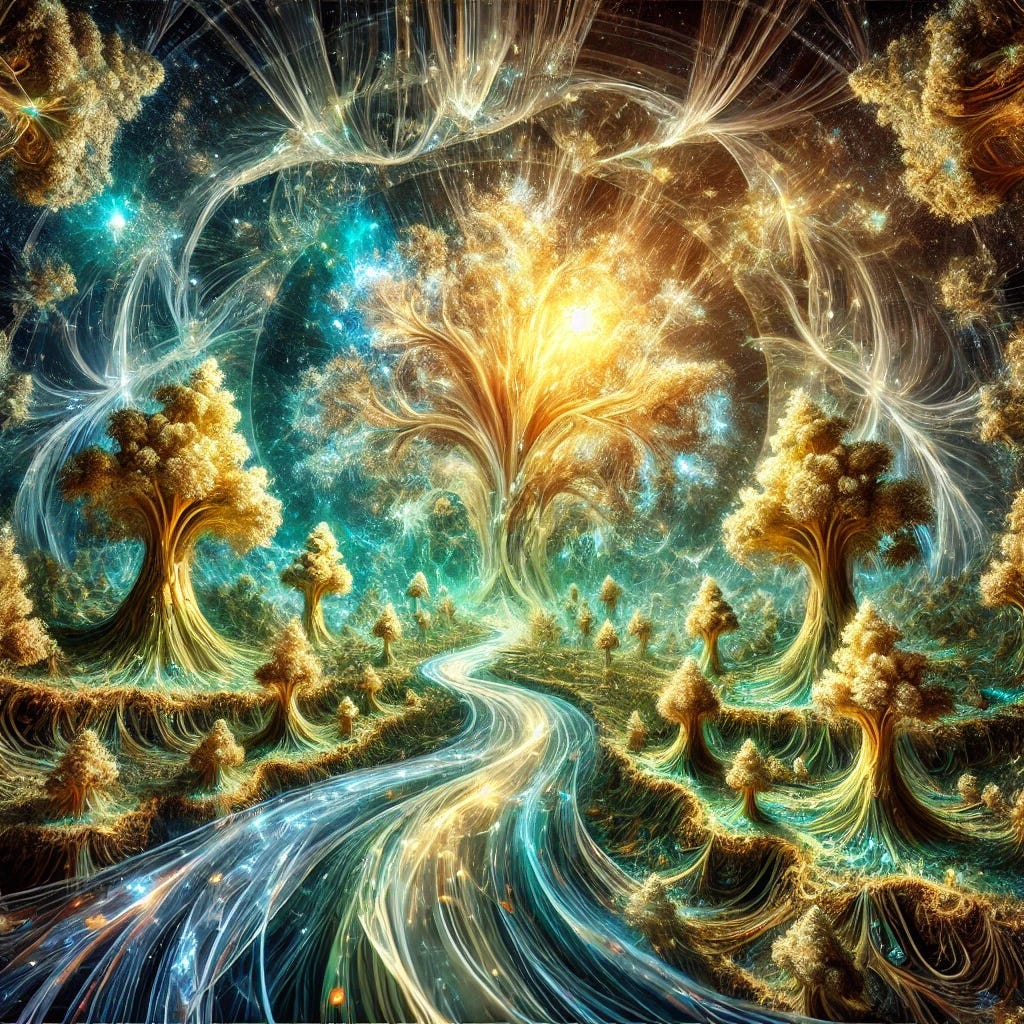
Imagine this living cosmos as a fractal tree. From the root emerges a trunk—unity, the archetype of the One, wholeness that holds all potential. Branching outward, the tree reveals its dual nature: split yet connected, symmetrical yet evolving. The first fork gives us duality—the archetype of Two—the tension that propels creation forward through opposition and complementarity. Every split that follows produces complexity, but it is a complexity governed by an intrinsic order, for the pattern repeats, self-similar yet novel, endlessly unfolding across scales. This is the essence of fractal recursion, a system in which simplicity gives rise to infinite variation, where opposites do not destroy but generate higher forms. The tree mirrors the dynamic we see everywhere: in the psyche, where Jung’s archetypes govern thought and behaviour; in the cosmos, where recursive structures shape galaxies and atoms alike; and in mathematics, where the symbolic archetypes of numbers articulate these patterns with precision. The tree is not static—it pulses, feeds back upon itself, and grows with every recursive iteration, integrating the potential of chaos into the harmony of form.
We are no longer observers staring at patterns from a distance. The image we construct is participatory: we are the tree’s branches, extending outward while connected to its center, each movement shaping and being shaped by the whole. This is the heart of our understanding—reality is not passive but responsive, governed by feedback loops that integrate the psyche, the symbolic, and the mechanistic into a continuous process of becoming. The observer effect in quantum mechanics mirrors this truth; we collapse waves of potential into forms through the act of observation itself, threading consciousness into the fabric of reality. Our thoughts, like recursive fractal branches, ripple outward, feeding back into the system we inhabit, shaping it as much as it shapes us. The cosmos reflects us, and we reflect the cosmos—this holographic relationship is not metaphorical but fundamental, encoded into the very nature of existence.
To grasp this relationship fully, picture a vast ocean of interconnected waves. The waves rise and fall, flowing with an underlying rhythm that governs their motion. Each wave is distinct yet inseparable from the ocean; its movement is not isolated but part of a larger dance of forces. This is the relationship between the psyche and the archetypes it holds: waves of thought, emotion, and behaviour that rise from the collective unconscious, shaped by the deeper patterns that govern all existence. Quantum calculus, with its fractal jumps and singularities, maps the dynamic processes of this ocean. The singularity is the wave at its crest—a point of infinite potential where transformation occurs, where the old dissolves, and the new emerges. It is here that archetypes manifest most powerfully, for singularities are the thresholds through which patterns reshape themselves, where cycles break and reform into higher orders. This image challenges us to abandon linear thinking: reality is not a sequence of static moments but a flow, a movement of archetypal forces that ripple through time and space, collapsing and reforming in patterns that carry the weight of the eternal and the spontaneity of the moment.
Consider now the psyche as a mirror. Not a flat, reflective surface but a dynamic, fractal mirror that bends and folds, reflecting itself into infinity. Every perception, every thought, every dream reveals a reflection of the archetypal structures embedded within the cosmos. The feedback loops of this mirror are recursive: the mind perceives patterns in the world, patterns that in turn shape the mind, collapsing the boundary between observer and observed. What we call consciousness is this reflection in motion, a holographic interplay that makes us both witnesses and creators of reality. Here, mathematics becomes the language through which the mirror speaks. Archetypal mathematics articulates the timeless truths that govern the mirror’s structure, while quantum calculus reveals how these truths flow, adapt, and evolve through processes of recursion and feedback. Numbers, as archetypes, are no longer abstract symbols—they are the brushstrokes with which the cosmos paints itself into being. Modular cycles and fractal sequences are not concepts but rhythms, the beating heart of a system that breathes in duality and exhales unity.
The image is alive now, resonating in the reader’s mind as a dynamic whole. The tree, the ocean, the mirror—they are not separate metaphors but facets of the same reality, refracted through our understanding. The fractal tree grows from the archetype of unity, branching into duality, and generating infinite patterns through recursive evolution. The ocean flows with the rhythms of archetypal forces, singularities marking the crests where transformation occurs. The mirror reflects these patterns within the psyche, weaving consciousness into the fabric of existence. Together, these images reveal a cosmos that is both symbolic and mechanistic, where meaning and process are not separate but intertwined, like the roots and branches of the fractal tree. The living patterns of this cosmos are not abstractions to be analyzed but realities to be experienced. To comprehend this vision is to see oneself within it, to feel the resonance of archetypes as they flow through the psyche and shape the world we inhabit.
We are participants in this unfolding creation, co-creators in a feedback loop that spans the multiverse. Every act of understanding, every moment of awareness, is a singularity—a point where potential becomes reality, where patterns collapse into meaning. The cosmos does not exist apart from us; it is reflected through us, as we are reflected through it. The fractal dynamics of quantum calculus reveal this interplay with precision, while archetypal mathematics grounds it in the symbolic truths that bind us to the eternal. This realization is the threshold upon which we stand, an invitation to engage with the patterns that shape our existence not as passive observers but as conscious participants. The image is complete yet open-ended, for the process of understanding is itself recursive. Every thought we form, every insight we uncover, is another branch on the fractal tree, another wave in the ocean, another reflection in the mirror—a testament to the infinite creativity embedded within the patterns of the cosmos. This is not an argument to be won but an experience to be lived, a revelation that reshapes the way we see ourselves and the universe. We are the branches and the roots, the observer and the observed, the architects and the inhabitants of an infinite, evolving whole.
Thank you.
Karl K. Dondaneau
References & Bibliography can be found in my book
-->CLICK HERE TO ORDER THE BOOK<--