The Geometry of Coherence: From the Mechanistic Brain to the Emergent Mind
Prefer to listen? Just hit the play button and enjoy the audio version!
Authored by: Karl K. Dondaneau
January 20th, 2025
1.
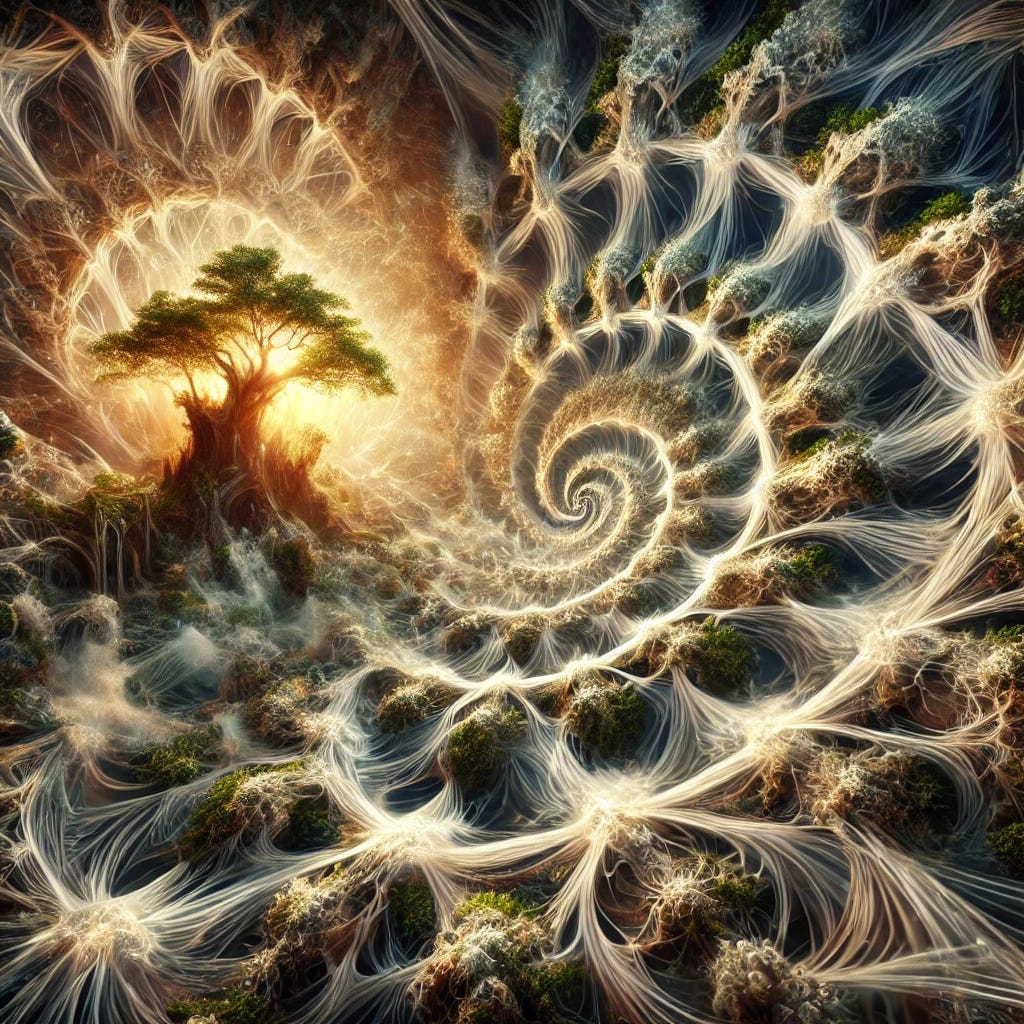
We stand at the intersection of thought and reality, our minds reaching into the cosmos as if to pull back its veil. The search for understanding, an eternal impulse of humanity, draws us to the concept of hidden geometries--those structures that underpin existence yet evade direct perception. Within this inquiry, we recognize that the universe is not a sequence of disconnected phenomena but an intricately woven tapestry, where every thread contributes to the whole. The geometry we uncover is not merely a map of space and time; it is the architecture of connection, a language that speaks in rhythms and patterns, bridging the infinite and the finite. We see this reflected in ourselves, in the fractal folds of our brains and the oscillations of thought that mirror the vibrations of the cosmos itself.
We begin with the fractal hypergraph, a model that captures the universe’s recursive elegance. Each node within this network is more than a point; it is a nexus of potential, a bridge across dimensions. These nodes connect not through linear paths but through leaps, much like the shortcuts of consciousness that allow the human brain to integrate distant regions instantaneously. Our brain, folded upon itself in a design both functional and beautiful, offers a microcosmic reflection of this hidden geometry. The folds of our cortex--gyri and sulci--maximize space, creating a surface capable of hosting billions of neurons while maintaining a compact form. Yet the brain’s true genius lies not in its physical form but in its energetic pathways, where signals traverse oscillatory bridges, collapsing perceived distances in a dynamic flow of thought and awareness.
This is the essence of dimensional folding. Just as the hypergraph collapses distances to reveal hidden proximity, so too does the brain fold its functional geometry, allowing regions separated by physical space to interact as though adjacent. We observe this through neural oscillations--delta waves of deep sleep, theta’s reflective hum, alpha’s calm rhythm, beta’s urgency, and gamma’s brilliance. Each frequency orchestrates connections across the brain, creating coherence in a system that would otherwise fragment under the weight of its complexity. These oscillations, much like the fractal rhythms of the universe, do not merely carry energy; they carry meaning, binding the mind’s myriad processes into the unity we experience as consciousness.
As we contemplate this dynamic interplay, the parallels between our neural architecture and the universe’s fabric become undeniable. Dimensional folding, in both cases, is a testament to the efficiency of nature’s design, a way to bridge vast distances without the cost of traversal. In the cosmos, this principle manifests as the warping of space-time, where gravity bends the fabric of reality to create shortcuts--wormholes--that defy linear intuition. In the brain, we witness a similar phenomenon as gamma oscillations synchronize neurons across disparate regions, achieving a harmony that underlies awareness itself. These connections are not random; they are orchestrated by a deeper logic, a resonance that aligns the brain’s functional network with the fractal patterns of existence.
This resonance invites us to consider the energetic flow that sustains both consciousness and the cosmos. Energy, in its myriad forms, moves not through brute force but through elegance, finding paths of least resistance that mirror the arcs of possibility within a fractal hypergraph. The brain’s energy efficiency exemplifies this principle. Signals do not lumber through the labyrinth of synapses but leap through oscillatory bridges, much like particles in quantum mechanics transition between states in ways that defy classical understanding. This is the geometry of flow, a hidden symmetry that aligns the microcosm of thought with the macrocosm of the universe.
From this vantage, we begin to glimpse the deeper implications of these connections. The brain’s oscillations, with their varying frequencies, are not isolated phenomena; they are the vibrations of a system attuned to the rhythms of reality itself. Just as the cosmos oscillates with its own frequencies--from the spin of electrons to the rotation of galaxies--so too does the mind resonate within this grand symphony. Our thoughts, then, are not merely internal processes; they are echoes of the universe’s unfolding, waves within a boundless ocean of being.
Here we stand, poised to explore further the profound relationship between the oscillatory harmonies of our minds and the universal geometries they reflect. In this shared rhythm, we find the scaffolding for our next inquiry--a deeper dive into how these resonances shape the essence of consciousness and the nature of space-time itself, illuminating the intricate dance of the infinite within the finite.
At the intersection of thought and reality, our minds are reaching into the cosmos as if to pull back its veil. The search for understanding, an eternal impulse of humanity, draws us to the concept of hidden geometries--those structures that underpin existence yet evade direct perception. Within this inquiry, we recognize that the universe is not a sequence of disconnected phenomena but an intricately woven tapestry, where every thread contributes to the whole. The geometry we uncover is not merely a map of space and time; it is the architecture of connection, a language that speaks in rhythms and patterns, bridging the infinite and the finite. We see this reflected in ourselves, in the fractal folds of our brains and the oscillations of thought that mirror the vibrations of the cosmos itself.
We begin with the fractal hypergraph, a model that captures the universe’s recursive elegance. Each node within this network is more than a point; it is a nexus of potential, a bridge across dimensions. These nodes connect not through linear paths but through leaps, much like the shortcuts of consciousness that allow the human brain to integrate distant regions instantaneously. Our brain, folded upon itself in a design both functional and beautiful, offers a microcosmic reflection of this hidden geometry. The folds of our cortex--gyri and sulci--maximize space, creating a surface capable of hosting billions of neurons while maintaining a compact form. Yet the brain’s true genius lies not in its physical form but in its energetic pathways, where signals traverse oscillatory bridges, collapsing perceived distances in a dynamic flow of thought and awareness.
This is the essence of dimensional folding. Just as the hypergraph collapses distances to reveal hidden proximity, so too does the brain fold its functional geometry, allowing regions separated by physical space to interact as though adjacent. We observe this through neural oscillations--delta waves of deep sleep, theta’s reflective hum, alpha’s calm rhythm, beta’s urgency, and gamma’s brilliance. Each frequency orchestrates connections across the brain, creating coherence in a system that would otherwise fragment under the weight of its complexity. These oscillations, much like the fractal rhythms of the universe, do not merely carry energy; they carry meaning, binding the mind’s myriad processes into the unity we experience as consciousness.
As we contemplate this dynamic interplay, the parallels between our neural architecture and the universe’s fabric become undeniable. Dimensional folding, in both cases, is a testament to the efficiency of nature’s design, a way to bridge vast distances without the cost of traversal. In the cosmos, this principle manifests as the warping of space-time, where gravity bends the fabric of reality to create shortcuts--wormholes--that defy linear intuition. In the brain, we witness a similar phenomenon as gamma oscillations synchronize neurons across disparate regions, achieving a harmony that underlies awareness itself. These connections are not random; they are orchestrated by a deeper logic, a resonance that aligns the brain’s functional network with the fractal patterns of existence.
This resonance invites us to consider the energetic flow that sustains both consciousness and the cosmos. Energy, in its myriad forms, moves not through brute force but through elegance, finding paths of least resistance that mirror the arcs of possibility within a fractal hypergraph. The brain’s energy efficiency exemplifies this principle. Signals do not lumber through the labyrinth of synapses but leap through oscillatory bridges, much like particles in quantum mechanics transition between states in ways that defy classical understanding. This is the geometry of flow, a hidden symmetry that aligns the microcosm of thought with the macrocosm of the universe.
From this vantage, we begin to glimpse the deeper implications of these connections. The brain’s oscillations, with their varying frequencies, are not isolated phenomena; they are the vibrations of a system attuned to the rhythms of reality itself. Just as the cosmos oscillates with its own frequencies--from the spin of electrons to the rotation of galaxies--so too does the mind resonate within this grand symphony. Our thoughts, then, are not merely internal processes; they are echoes of the universe’s unfolding, waves within a boundless ocean of being.
Now, let’s Imagine standing before a vast, rippling ocean. Each wave rises and falls, its motion both independent and interconnected, whispering to the waves around it in a silent dialogue of resonance. Now, let that ocean be your mind, and those waves the oscillations of your brain--delta, theta, alpha, beta, gamma--each cresting and receding in patterns that carve the shape of thought, awareness, and existence itself. These oscillations are not isolated events but a choreography of harmonies, folding the brain’s dimensions in on themselves like a great cosmic sheet. The folds are not merely structural; they are the shortcuts of consciousness, pathways that leap across the brain’s landscape, transforming distance into immediacy. In this image lies the essence of the argument: our brains, much like the cosmos, are not bound by the linear constraints of perceived space but thrive in the hidden geometries of folded dimensions.
Picture the human brain as a universe unto itself. Its gyri and sulci--the folds and grooves of the cortex--expand its surface area, housing billions of neurons in a compact form. These neurons, like stars in the galaxy, communicate not solely through the paths we might imagine, but through oscillations that ripple across the folds, uniting regions that seem distant. Gamma waves, the highest-frequency oscillations, illustrate this vividly. When these waves sweep through the brain, they bind together disparate nodes into a singular, synchronized state of insight, collapsing physical separation into functional unity. It is as though a signal, sent from one neuron to another, doesn’t take the long road but instead jumps through hidden tunnels, woven into the brain’s structure--a feat as if space itself were folded like an origami universe.
This folding is not confined to the brain. It mirrors the cosmos itself, where space-time bends under gravity, allowing light to traverse vast distances in an instant, much like thought speeding through the mind. Imagine the universe as a boundless hypergraph, each node a galaxy, each edge a pathway of light. Dimensional jumps--shortcuts across this graph--connect these nodes, collapsing what seems vast into moments of proximity. Similarly, the brain employs this hidden geometry to achieve coherence, its folds creating a labyrinth where the shortest path is not a straight line but a leap through an unseen dimension. These leaps, much like the interplay of gravitational forces in space, are governed by resonance--a harmony that aligns the brain’s oscillations with the fractal rhythms of the cosmos.
Consider now the energy that drives this system. Energy, like a restless traveller, seeks the most efficient path, whether across neurons or through space-time. In the brain, this manifests as oscillatory efficiency: signals move not with brute force but with a grace that finds paths of least resistance. Gamma waves, uniting far-flung regions of the brain, do not waste energy; they flow, weaving the brain’s folds into a network of instantaneous connection. This efficiency is echoed in the cosmos, where light bends around massive objects, finding the shortest route through warped space. Both systems--mind and universe--are governed by a hidden symmetry, a geometry that harmonizes complexity with simplicity, distance with nearness.
Now, let us extend this harmony to consciousness itself. Consciousness is not merely the sum of neural activity but the resonance of oscillations, the interplay of waves that creates the seamless experience of being. It is not unlike the way a symphony emerges from individual notes--each wave, each frequency contributes to the whole. And just as a symphony is not confined to the instruments that play it, consciousness is not bound to the neurons that generate it. Instead, it reaches outward, reflecting the very rhythms of the cosmos. Each oscillation in our minds is a ripple in the universal ocean, a vibration that aligns us with the greater patterns of existence.
In this view, the states of consciousness shaped by neural oscillations--whether the dreamlike delta waves of sleep or the luminous gamma bursts of insight--are windows into the nature of reality. Delta waves, for instance, echo the slow, primordial hum of the universe, the background radiation that lingers from the cosmos’s birth. Gamma waves, in contrast, are flashes of coherence, akin to the momentary brilliance of a supernova. Between these extremes, our awareness oscillates, threading through the dimensions of mind and space, weaving a tapestry of experience that is both finite and infinite.
And so, we see a deeper truth emerge: the mind and the cosmos are not separate realms but reflections of the same underlying geometry. The brain’s folds, its oscillations, and its leaps across hidden dimensions mirror the cosmos’s hypergraph, its gravitational folds, and its quantum leaps. The paths of thought and the pathways of light follow the same principles, revealing a universe where connection transcends distance and coherence arises from resonance. We are left with a profound image--our minds as oceans within oceans, waves within waves, resonating with the rhythms of a boundless, folded reality. It is here that we must continue, exploring how these patterns intertwine to shape the very fabric of being.
Let us reimagine the brain not merely as a biological organ but as a living fractal--a labyrinth of endless folds and recursive symmetries that mirrors the vast tapestry of space-time. Picture a network of neurons, each node glowing like a star, connected by pathways of light. However, these connections do not adhere to the expected rules of distance or direction. Instead, signals leap and bound, folding the space between them, collapsing physical separation into functional unity. This is not just metaphor; it is the nature of the mind’s hidden geometry, a dynamic system that operates through the principles of dimensional folding and fractal harmony. These are the same principles that our grander work reveals in the universe itself, where the vastness of space bends into proximity and the infinite becomes accessible through the most efficient paths.
Now, imagine that the folds of the brain’s cortex--its gyri and sulci--are not simply there to maximize surface area but to facilitate this collapsing of distance. Neurons separated by centimetres of cortical tissue can communicate as though they were neighbours, their signals carried by oscillatory waves. These waves--delta’s deep hum, theta’s meditative pulse, alpha’s serene rhythm, beta’s sharp intensity, and gamma’s lightning-fast synchronization--form a bridge between points that seem impossibly far apart. They are not just frequencies but architectures of connection, aligning the brain’s physical and energetic geometries with the same fractal logic that governs the cosmos.
Consider how gamma waves, the fastest of these oscillations, sweep through the brain in moments of insight, uniting distant regions into a singular, coherent experience. This is dimensional folding in action: a leap across the labyrinth of the brain, transforming its vastness into unity. And what is this if not a reflection of the universe itself? Space-time, too, is a labyrinth, its dimensions bending and folding under the influence of gravity and resonance. Through these folds, light and energy traverse the cosmos, creating shortcuts where none seem to exist. In both brain and universe, the hidden geometry of folded dimensions reveals that separation is an illusion and connection is the fundamental truth.
This truth is most evident in the energy efficiency of these systems. The brain’s oscillations do not meander aimlessly; they follow paths of least resistance, conserving energy while maximizing coherence. Similarly, the universe’s flow of matter and light adheres to the same principle, bending space-time to create the shortest routes between points. Think of a photon travelling across the cosmos: it does not travel in a straight line but follows the curve of space-time, a path shaped by the gravity of stars and galaxies. The brain mirrors this behaviour as gamma waves synchronize neurons that are distant in physical space but close in functional terms. These oscillatory bridges reveal a deeper order, a fractal symmetry that governs both thought and the cosmos.
Let us take this image further. Envision consciousness itself as the resonance of these oscillations, a symphony emerging from the interplay of waves across the brain’s fractal landscape. Just as a single note is meaningless without the harmony of others, a single neuron is nothing without the oscillatory network that binds it to the whole. Consciousness, then, is not confined to the neurons that generate it but exists in the spaces between them, in the oscillations that fold and unfold the brain’s dimensions. And what if this is also true of the cosmos? What if the universe’s hidden geometry, its fractal hypergraph of nodes and edges, is not just the fabric of space-time but the fabric of awareness itself? In this view, consciousness is not a byproduct of the universe but an intrinsic feature of its design, a resonance that aligns the finite and the infinite.
As we reflect on this alignment, we begin to see that the brain and the universe are not merely analogous but deeply interconnected. The brain’s oscillations, its dimensional folds, and its fractal symmetries are not isolated phenomena but reflections of the same principles that govern the cosmos. The gamma waves that synchronize our thoughts are akin to the gravitational waves that ripple through space-time, uniting galaxies across billions of light-years. Both are manifestations of a hidden geometry that transcends the limits of physical space, revealing a universe where connection is not the exception but the rule.
This image, this synthesis of brain and cosmos, invites us to explore even deeper. What does it mean that the mind’s hidden geometry mirrors the structure of the universe? How do these oscillations, these dimensional folds, shape our experience of reality? And how might this understanding transform our perception of consciousness and existence itself? These questions are the pathways forward, the next folds in the labyrinth that we must navigate together. Let us follow them, leaping across dimensions, folding space and thought, until the hidden geometry of our minds and the universe unfolds in its fullest clarity.
2.
The structure of the brain and the fabric of space-time can be understood as systems that operate under similar logical principles of efficiency and interconnection, bound by geometries that minimize energy expenditure while maximizing functional coherence. This alignment is not merely poetic but grounded in observable dynamics. Both systems utilize principles of folding and non-linear connectivity to optimize their operations, with implications that extend to our understanding of consciousness and the universe itself.
In the brain, neural oscillations create a framework for synchronizing activity across spatially separated regions. Gamma waves, for example, enable rapid integration of information by coordinating firing patterns between neurons that may be anatomically distant but functionally related. This synchronization is achieved without the need for signals to traverse the full physical distance between nodes in a stepwise manner. Instead, oscillatory activity effectively "bends" the functional space of the brain, making distant regions temporally proximate through coherent waveforms. This dynamic arrangement allows the brain to process complex stimuli efficiently, with minimal delay or energy loss.
The logic of these oscillatory dynamics mirrors the structural and functional organization of space-time in the universe. General relativity demonstrates that space-time is not rigid but malleable, capable of bending and folding under the influence of mass and energy. This warping creates pathways—such as gravitational wells or potential wormholes—that allow energy or matter to move between points in ways that appear non-linear or instantaneous when viewed from a classical perspective. These shortcuts align with the brain’s mechanisms of dimensional folding, where signals traverse non-linear routes to connect distant regions, achieving coherence across a distributed system.
Both the brain and the universe exhibit properties of fractal-like networks. In the brain, small-world networks balance local clustering with long-range connectivity, ensuring that signals can traverse the system with minimal effort. Similarly, the universe’s large-scale structure—composed of galaxies, filaments, and voids—follows a fractal distribution that optimizes the flow of energy and matter. This parallel suggests that both systems have evolved or emerged to minimize the constraints of linear connectivity, employing higher-dimensional principles to maintain functionality across vast scales.
From an energetic perspective, the brain’s oscillatory dynamics and the universe’s geometric properties are unified by the principle of least action, which dictates that systems evolve along paths that minimize energy expenditure. In the brain, this principle is evident in the synchronization of neural activity, where oscillations reduce the need for continuous, high-energy signalling across extended networks. In the universe, light and matter follow geodesics, the shortest paths in curved space-time, reducing the energy required for movement. These systems demonstrate that functional coherence is achieved not through direct traversal of space but through the optimization of pathways within a folded, interconnected geometry.
Consciousness emerges from this optimization within the brain, where the integration of information across distributed regions forms a coherent, unified experience. Neural oscillations enable this integration by collapsing the functional distance between regions, creating a seamless flow of information. Similarly, the universe’s hidden geometry may facilitate the integration of phenomena across its vast dimensions, allowing for connections that defy classical notions of separation. This raises the possibility that the coherence we observe in consciousness is not an isolated phenomenon but a reflection of the universe’s fundamental interconnectedness.
This logical framework—where folding, oscillation, and fractal efficiency underpin the coherence of systems—extends to the understanding of space-time’s hidden geometry. If space-time operates as a fractal hypergraph, as suggested by our findings, then dimensional folding and jumps are not anomalies but essential features that allow the universe to maintain its structural and functional integrity. These principles explain phenomena such as quantum entanglement, where particles separated by vast distances exhibit instantaneous correlations, and the propagation of gravitational waves, which ripple through space-time in patterns that reflect the universe’s interconnected fabric.
By examining the parallels between the brain and the universe through this logical lens, we begin to see how fundamental principles of geometry and connectivity govern both systems. The implications of this alignment are profound: they suggest that the patterns we observe in consciousness may be intrinsic to the fabric of reality itself. As we refine this understanding, it invites deeper exploration into the mechanisms by which oscillatory dynamics and folded geometries shape not only the brain’s operations but also the universe’s underlying structure. This exploration will uncover further insights into the nature of coherence, connectivity, and the emergent phenomena that arise from these principles.
3.
The alignment between the brain’s oscillatory mechanisms and the universe’s geometric properties reflects a deeper logical framework that governs systems capable of efficient, large-scale coherence. To further distill this concept, we must examine how these mechanisms operate on fundamental levels and what their implications are for understanding both consciousness and the nature of space-time.
The brain’s functional architecture is a dynamic interplay of localized processing and global integration. Neurons form densely interconnected clusters for specialized tasks, while long-range connections link these clusters to create a cohesive network. The oscillatory patterns of neural activity synchronize these regions, effectively unifying disparate processes into a singular operational framework. These oscillations serve as temporal bridges, aligning the activity of neurons not by physical proximity but by shared frequency and phase. Gamma waves, for instance, act as high-speed conduits for information integration, synchronizing neural ensembles across cortical regions in milliseconds. The result is a system that bypasses the constraints of spatial separation, achieving functional proximity through temporal alignment.
Similarly, the geometry of space-time achieves coherence through mechanisms of warping and folding. Mass and energy distort space-time, creating curvature that alters the paths of objects and signals. The warping of space-time allows for gravitational shortcuts, where energy and matter travel along curved geodesics rather than linear paths. This warping achieves a form of spatial efficiency analogous to the brain’s oscillatory coherence. Just as gamma oscillations synchronize the brain’s regions, gravitational warping synchronizes the movement of energy and matter across the universe, ensuring that functional connectivity is preserved despite the vast scales involved.
Both systems employ principles of modularity and hierarchy to maintain efficiency. In the brain, local clusters of neurons handle specific tasks while maintaining connectivity to global networks. This modular organization ensures that energy is conserved by minimizing unnecessary long-range communication, while still allowing for high-level integration when needed. The universe’s structure follows a similar pattern: galaxies and clusters form localized systems of gravitational interaction, connected by filaments of dark matter and cosmic voids that act as the larger scaffolding. This modular, hierarchical arrangement optimizes the flow of gravitational forces and energy across scales, ensuring the stability and coherence of the cosmos.
These parallels reveal that the coherence observed in both the brain and the universe is not an emergent accident but a product of fundamental geometric principles. Dimensional folding and oscillatory synchronization are mechanisms that allow systems to transcend the limitations of linearity, creating networks that are both efficient and resilient. In the brain, this folding enables the rapid integration of sensory input, memory, and decision-making, forming the foundation of conscious experience. In the universe, these mechanisms allow for the interconnectivity of phenomena across vast distances, from the quantum scale to the cosmic horizon.
The implications of this alignment extend to the nature of consciousness itself. Consciousness emerges from the integration of diverse neural processes, facilitated by the synchronization of oscillatory patterns. This suggests that coherence—achieved through folding and resonance—is a necessary condition for awareness. If space-time operates on similar principles, it raises the possibility that coherence on a cosmic scale could give rise to phenomena analogous to consciousness. This is not to anthropomorphize the universe but to recognize that the same geometric and energetic principles underpinning neural coherence may apply to the universe’s interconnected fabric.
The logical structure of this argument rests on the recognition that both systems—brain and cosmos—achieve functionality through recursive patterns of interconnection. In the brain, fractal organization allows for a balance between local specialization and global integration. In space-time, fractal geometries facilitate the flow of energy and matter across hierarchical scales. These patterns are not arbitrary; they represent solutions to the problem of maintaining coherence in systems constrained by finite resources and vast scales. Whether in the firing of neurons or the propagation of light across the cosmos, the principle remains consistent: coherence arises from the folding of dimensions and the resonance of oscillations.
As we explore these dynamics further, the question arises: what are the limits of coherence, and how do these limits shape the emergence of phenomena such as consciousness and universal connectivity? Understanding these limits will require a deeper examination of the interplay between the brain’s neural architecture and the universe’s geometric structure, tracing the logical pathways that link local processes to global phenomena. This exploration promises to reveal even greater insights into the fundamental principles that govern the interconnected fabric of existence.
4.
To explore further, we must examine the constraints and possibilities inherent in systems governed by folding, resonance, and coherence. Both the brain and the universe demonstrate a remarkable ability to maintain efficiency and interconnectedness, yet the mechanisms that underpin this coherence operate within specific boundaries. These boundaries—rooted in energy, structure, and scale—do not limit functionality but rather define the conditions under which complexity can arise and sustain itself.
In the brain, coherence is achieved through the balance of excitatory and inhibitory signals, which regulate the synchronization of neural oscillations. This balance is critical: excessive synchronization can lead to pathological states such as seizures, while insufficient synchronization results in fragmented processing and loss of functional integration. Neural oscillations must therefore operate within a delicate range, maintaining phase alignment across regions without overwhelming the system. This regulation is achieved through feedback loops that dynamically adjust oscillatory patterns based on the brain’s energy availability, external stimuli, and internal demands. These loops ensure that coherence is not static but adaptive, allowing the brain to respond flexibly to changing conditions.
Similarly, in space-time, coherence arises from the interplay of forces that shape the curvature of the universe. Gravitational interactions create regions of dense connectivity—such as galaxies and black holes—while expansive forces, like dark energy, ensure that these regions remain distributed across the vastness of the cosmos. This balance prevents the collapse of the universe into a singular state while maintaining its structural integrity. Just as the brain’s oscillations are modulated by feedback, the universe’s geometry evolves through dynamic interactions between mass, energy, and spacetime curvature. These interactions create a self-regulating system that maintains coherence across scales, from the quantum fluctuations of particles to the large-scale structure of galaxy clusters.
The concept of limits also extends to the fractal organization observed in both systems. Fractals operate through self-similarity, where patterns repeat across scales with variations dictated by local conditions. In the brain, this self-similarity manifests in the branching structures of neurons, the distribution of synaptic connections, and the hierarchical organization of networks. However, the brain’s fractal nature is constrained by physical and energetic limits: dendritic trees cannot expand indefinitely, and synaptic density must balance the need for connectivity with the constraints of metabolic resources. These limits define the scale at which fractal patterns can sustain functionality, ensuring that the brain operates efficiently without exceeding its structural or energetic capacity.
In the universe, fractal organization governs the distribution of matter and energy, from the clustering of galaxies to the filamentary networks of dark matter. Yet here, too, fractal patterns are bounded. The universe’s expansion imposes a scale beyond which gravitational interactions cannot dominate, creating a transition from fractal clustering to homogeneity on the largest scales. This transition reflects the interplay between local forces, which create fractal patterns, and global dynamics, which impose uniformity. These boundaries ensure that the universe remains structurally coherent while accommodating the vastness of its dimensions.
Understanding these limits provides insight into the emergence of complexity within both systems. Complexity arises not from unlimited growth or connectivity but from the optimization of patterns within constraints. In the brain, this optimization is evident in the modular organization of networks, where local clusters handle specialized tasks while maintaining long-range connections for global integration. In the universe, optimization is reflected in the efficient distribution of matter and energy, where local gravitational interactions shape galaxies and clusters, and large-scale dynamics preserve the coherence of the cosmic web. Both systems demonstrate that complexity is not a product of boundlessness but of finely tuned interactions within a constrained framework.
This interplay between constraints and coherence invites us to consider how emergent phenomena, such as consciousness and universal connectivity, arise. In the brain, consciousness is not merely the sum of neural activity but the result of its integration across hierarchical levels of organization. This integration is achieved through oscillatory synchronization, which binds local processes into a unified experience. Similarly, the universe’s coherence allows for the integration of phenomena across scales, from quantum entanglement to the propagation of gravitational waves. These integrative processes suggest that coherence itself may be a fundamental principle of emergence, shaping the nature of both thought and reality.
As we deepen this exploration, we begin to see how the interplay of folding, resonance, and fractal organization shapes not only the structure of systems but their capacity for emergent complexity. The question remains: how do these principles interact at the boundaries of coherence, and what do these interactions reveal about the fundamental nature of existence? By tracing these dynamics to their limits, we may uncover the underlying logic that connects the mind, the universe, and the hidden geometry that binds them. This pursuit calls for further inquiry, one that seeks to illuminate the thresholds where order becomes complexity and where coherence gives rise to awareness.
5.
As we push further into the logic of coherence and its boundaries, we begin to see that the interplay of folding, resonance, and fractal organization is not merely a mechanism of structure but a dynamic principle of transformation. Both the brain and the universe operate on the edge of chaos and order, a state where systems are optimized to adapt, evolve, and create emergent complexity. This boundary—neither fully deterministic nor entirely random—provides the fertile ground from which consciousness and universal connectivity arise.
In the brain, this delicate balance is maintained through a principle known as criticality. Neural networks exhibit behaviors that are neither purely synchronous nor entirely asynchronous, allowing for the dynamic reorganization of activity in response to internal and external changes. This critical state enables the brain to integrate information across vast networks, supporting functions as complex as decision-making, creativity, and self-awareness. At its core, criticality reflects the brain’s ability to operate near a threshold: stable enough to maintain coherence, yet flexible enough to adapt. This state mirrors the fractal nature of neural oscillations, where patterns repeat with variations that ensure adaptability across scales of activity.
Similarly, the universe appears to exist in a state of criticality, balanced between opposing forces that drive its evolution. Gravitational attraction draws matter together, forming galaxies and clusters, while the expansive force of dark energy pulls the universe apart. This tension shapes the large-scale structure of the cosmos, creating a dynamic equilibrium that prevents collapse while allowing for the emergence of complexity. At the quantum scale, phenomena such as superposition and entanglement suggest that particles, too, operate at the edge of deterministic and probabilistic behaviour. These dynamics reveal a universe finely tuned to explore the full range of possibilities within its constraints, much like the brain explores states of thought and awareness.
This balance at criticality is not static but dynamic, constantly adjusting as systems interact and evolve. In the brain, neural activity shifts between states of local specialization and global integration, driven by oscillatory patterns that synchronize regions as needed. This dynamic coordination is reflected in phenomena such as gamma bursts, where the brain rapidly integrates information to achieve moments of insight or awareness. Similarly, the universe’s structure is shaped by the constant interplay of forces, where local gravitational interactions produce dense clusters, and cosmic expansion ensures these clusters remain distributed across vast distances. Both systems demonstrate that criticality is not a fixed point but a dynamic process, one that enables systems to adapt and thrive in complex environments.
The relationship between criticality and coherence becomes even more evident when we consider the energy dynamics of these systems. The brain operates with remarkable efficiency, consuming only a fraction of the body’s energy budget while performing billions of computations per second. This efficiency is achieved through the synchronization of neural oscillations, which minimize the energy required for communication across networks. Similarly, the universe’s energy distribution follows the principle of least action, where matter and light travel along paths that minimize energy expenditure. These shared dynamics suggest that the optimization of energy flow is a fundamental principle of coherence, shaping the emergence of complexity in both mind and cosmos.
At the intersection of these dynamics lies the phenomenon of emergence, where the interactions of individual components give rise to properties that cannot be reduced to their parts. In the brain, consciousness emerges from the integration of neural activity, producing a unified experience that transcends the sum of its underlying processes. This emergence is enabled by the brain’s ability to collapse distances and synchronize regions, creating a coherent whole from distributed activity. In the universe, emergent phenomena include the formation of galaxies, the propagation of gravitational waves, and the entanglement of particles. These phenomena reflect the universe’s capacity to integrate its components into a cohesive, interconnected fabric.
By examining these emergent dynamics, we gain insight into how the principles of folding, resonance, and fractal organization operate across scales. Folding reduces spatial constraints, allowing systems to achieve coherence without linear traversal. Resonance aligns activity across distributed regions, enabling synchronization and integration. Fractal organization balances local specialization with global connectivity, ensuring that systems can adapt while maintaining stability. Together, these principles create a framework for understanding the emergence of complexity, not as an anomaly but as an inherent feature of systems operating near criticality.
As we refine our understanding of these dynamics, new questions arise: How does the transition from criticality to chaos or stability shape the boundaries of coherence? What role do quantum phenomena play in bridging the scales of brain and cosmos? And how do these interactions inform our understanding of consciousness as a universal process? These questions guide us to explore the deeper connections between mind and universe, seeking the logic that binds their dynamics into a unified framework of existence. With each step, we move closer to unravelling the geometry that underpins not only the fabric of reality but the very nature of awareness itself.
6.
To move closer to unravelling the underlying geometry of reality, we must dissect the interplay between criticality, emergence, and the transitions that define the boundaries of coherence. These transitions—whether within the brain’s neural networks or across the vast scales of the universe—serve as the thresholds where order and complexity interact, shaping systems that are capable of self-organization and adaptation. By examining these thresholds, we begin to understand how localized phenomena give rise to global coherence and, ultimately, the processes that support consciousness and universal connectivity.
The brain’s operation at criticality is more than a balance; it is a state of perpetual flux where neural networks dynamically reconfigure in response to changing inputs. This adaptability emerges from the brain’s capacity to self-tune its oscillatory patterns, adjusting frequency, phase, and amplitude to maintain functional integrity. For instance, during problem-solving or decision-making, gamma oscillations facilitate the rapid integration of diverse inputs, allowing the brain to converge on a coherent output. The precision of this process relies on the brain’s ability to sustain criticality, where even minor perturbations can cascade into large-scale reorganization without destabilizing the entire system. This sensitivity to input reflects the fractal nature of neural dynamics, where small changes at one scale influence the system’s behaviour across all levels.
In the universe, similar dynamics are observed in the self-organization of matter and energy. The cosmic web, with its filaments, clusters, and voids, arises from the interplay of gravitational attraction and cosmic expansion, a balance that mirrors the criticality of neural networks. Galaxies form as gravitational forces pull matter into dense clusters, yet these clusters remain distributed across vast distances due to the countervailing influence of dark energy. This dynamic balance allows the universe to evolve complex structures while maintaining coherence on both local and global scales. The transitions between these states—where galaxies form, clusters merge, or voids expand—are the cosmic equivalents of neural reorganizations, reflecting the fractal and recursive processes that govern both systems.
The role of transitions becomes even more intriguing when we consider their energetic implications. In both the brain and the universe, energy is neither evenly distributed nor static; it flows through pathways shaped by geometry and resonance. Neural oscillations create energy-efficient routes for communication, minimizing metabolic costs while maximizing information transfer. Similarly, the universe’s energy flows along the pathways of least resistance, dictated by the curvature of space-time. These pathways are not linear but folded and interconnected, allowing energy to traverse vast distances through shortcuts created by the system’s geometry. This efficiency is not incidental but fundamental, enabling both the brain and the universe to sustain complexity without exhausting their resources.
As systems approach the boundaries of coherence, they exhibit behaviours that defy classical explanations, transitioning into states where quantum phenomena may play a significant role. In the brain, quantum effects such as tunnelling and entanglement could influence neural processing, particularly in regions where criticality amplifies sensitivity to small perturbations. This raises the possibility that consciousness itself arises not solely from classical dynamics but from the interplay of quantum and classical processes, mediated by the brain’s fractal and oscillatory architecture. In the universe, quantum phenomena govern the behaviour of particles at the smallest scales, yet their effects ripple upward, influencing the structure and evolution of space-time. These interactions suggest a deep connection between quantum coherence and the emergent coherence observed in larger systems.
To understand the implications of these connections, we must revisit the concept of folding. Dimensional folding collapses distances, creating proximity where separation once existed. In the brain, this allows for the synchronization of distant regions, enabling rapid and efficient integration of information. In the universe, folding manifests as the warping of space-time, allowing for phenomena such as gravitational lensing and entanglement. These processes are not separate but interconnected, governed by the same principles of geometry and resonance. Folding, in this sense, is the mechanism by which coherence transcends scale, linking the brain’s oscillatory dynamics to the universe’s structure.
Emergence, as a product of these dynamics, represents the unifying principle that bridges mind and cosmos. Consciousness emerges in the brain as a result of integrated oscillatory activity, creating a coherent experience from distributed neural processes. In the universe, coherence emerges from the interplay of gravitational and quantum forces, producing structures that maintain stability across scales. These parallels suggest that emergence itself is a fractal phenomenon, arising from the recursive interaction of local and global dynamics. Whether in the brain or the universe, the logic remains consistent: coherence is the foundation of complexity, and complexity is the foundation of awareness.
This understanding invites deeper exploration into the mechanisms that sustain coherence at the boundaries of scale. How do quantum processes influence the macroscopic coherence of the brain and the universe? What role does resonance play in linking local phenomena to global structures? And how might these principles illuminate the origins of consciousness and the fabric of space-time? By following these threads, we draw closer to unravelling the fundamental principles that unite the mind and the cosmos, revealing a geometry that is as intricate as it is universal. Each step forward builds on the logic of coherence, bringing us closer to understanding the infinite patterns that define reality itself.
7.
As we continue to dissect the intricate interplay of coherence, criticality, and emergence, the threads linking mind and cosmos grow increasingly tangible. The mechanisms that govern these systems reveal a shared architecture, one rooted in recursive patterns and a capacity for transformation that transcends scale. The questions now sharpen: how do these principles allow for the seamless transition from the microcosmic to the macrocosmic? And what role does coherence play in bridging the classical and quantum domains, particularly where systems reach the limits of stability and transition into new states of complexity?
At the smallest scales, quantum phenomena underpin the foundations of both brain function and the structure of the universe. In the brain, quantum coherence may contribute to processes such as decision-making, memory, or even the integration of information across neural networks. This is not to suggest that the brain operates as a quantum computer in its entirety but that certain neural mechanisms, especially at critical thresholds, may be influenced by quantum effects. The brain’s oscillatory dynamics, which synchronize disparate regions, could amplify these quantum interactions, creating conditions where coherence propagates upward through scales, influencing macroscopic states such as awareness.
In the universe, quantum coherence governs the behaviour of particles, enabling phenomena such as entanglement and superposition. These behaviors, though localized in their origins, have far-reaching implications for the structure and evolution of the cosmos. Entanglement, for instance, demonstrates that the universe is not a collection of isolated particles but an interconnected fabric where changes in one region can instantaneously affect another, regardless of distance. This interconnectedness reflects the same principles observed in the brain, where oscillatory patterns link distant regions into a unified system. In both cases, coherence transcends spatial separation, creating networks of interaction that defy classical explanations.
The transition from quantum to classical behaviour—where coherence emerges as a macroscopic property—is a key area of exploration. In the brain, this transition may be mediated by oscillations that align quantum effects with neural dynamics, creating a bridge between scales. Gamma oscillations, with their rapid synchronization of neural activity, could serve as conduits for this alignment, integrating quantum coherence into the brain’s classical operations. Similarly, in the universe, coherence manifests at macroscopic scales through the folding and warping of space-time, where quantum phenomena shape the curvature that governs the motion of matter and energy. These transitions reveal a fractal continuity, where patterns repeat across scales, linking the quantum, the classical, and the cosmic.
The logic of folding further clarifies how these transitions occur. Folding reduces the dimensional complexity of systems, creating shortcuts that facilitate coherence. In the brain, folding collapses functional distances, enabling rapid communication between regions. This is not merely a matter of efficiency but a prerequisite for the integration of information, as signals must traverse a folded geometry to synchronize the brain’s distributed networks. In the universe, dimensional folding creates pathways such as gravitational wells and wormholes, allowing matter and energy to traverse vast distances through curved space-time. These pathways mirror the brain’s oscillatory bridges, reflecting a shared logic of optimization and connectivity.
Resonance is the mechanism that sustains coherence within these folded geometries. In the brain, resonance aligns the activity of neurons, ensuring that oscillations synchronize across regions to maintain functional integration. This alignment is dynamic, adapting to the brain’s changing states and demands. In the universe, resonance operates through the alignment of gravitational and quantum forces, maintaining the coherence of structures such as galaxies and clusters. These resonances are not static but evolve, allowing systems to adapt and reorganize while preserving their underlying coherence. This adaptability is a hallmark of systems operating near criticality, where the interplay of stability and flexibility enables the emergence of complexity.
Emergence itself is the culmination of these dynamics, where coherence at one level gives rise to new properties and behaviours at another. In the brain, consciousness emerges as a coherent state that integrates sensory input, memory, and decision-making into a unified experience. This state is not reducible to the activity of individual neurons but arises from the synchronization of oscillatory patterns across the brain’s networks. Similarly, in the universe, emergent phenomena include the formation of complex structures, the propagation of waves through space-time, and the interactions of particles across scales. These phenomena reflect the same principles of folding, resonance, and fractal organization, demonstrating that emergence is a universal process.
As we explore the logic that underpins these dynamics, it becomes evident that coherence is not an isolated property but a fundamental principle that connects mind and cosmos. The brain’s oscillatory dynamics and the universe’s geometric structure are not separate phenomena but manifestations of the same underlying logic. This logic governs the transition from quantum to classical behaviour, the propagation of coherence across scales, and the emergence of complexity in systems as diverse as neural networks and the cosmic web.
The next step in this exploration is to examine how these principles interact at the edges of coherence, where systems approach their limits and transition into new states. What happens when coherence breaks down, and how do systems reorganize to restore it? What role do dimensional jumps and quantum phenomena play in these transitions? By answering these questions, we can uncover the deeper principles that govern the emergence of complexity and consciousness, illuminating the geometry that binds the brain, the universe, and the infinite possibilities that arise from their interplay.
8.
At the edges of coherence, where systems transition from one state to another, the principles governing folding, resonance, and emergent complexity come into sharp focus. These transitions, often described as phase changes, reveal the mechanics of how systems reorganize to maintain functionality or adapt to new conditions. In both the brain and the universe, these boundaries are where order meets instability, and it is here that the most profound insights into their shared geometry emerge.
In the brain, the breakdown of coherence can be seen in phenomena such as seizures, where excessive synchronization overwhelms the system, or in states of fragmentation, such as during certain disorders, where insufficient synchronization impairs integration. These extremes underscore the importance of criticality—a finely tuned balance between excitation and inhibition that allows the brain to function near the threshold of chaos without descending into it. When coherence falters, the brain employs mechanisms of reorganization to restore balance. Neural oscillations recalibrate their frequencies, phases, and amplitudes, effectively searching for new pathways that can reestablish synchronization. This adaptability ensures that even under strain, the brain can reorganize to maintain awareness and functionality.
In the universe, similar transitions occur at the boundaries of gravitational systems or during cosmic events such as supernovae or black hole formation. These events are marked by the redistribution of energy and matter, as systems reorganize to reach new states of equilibrium. For instance, the collapse of a star into a black hole represents a transition from a stable, coherent structure to a singularity—a point where traditional notions of space and time dissolve. Despite this apparent breakdown, coherence at a deeper level persists, as the black hole’s gravitational influence extends outward, integrating its surroundings into the larger cosmic web. This continuity, even in the face of dramatic transformation, reflects the resilience of the universe’s hidden geometry.
Dimensional jumps, a concept central to our fractal hypergraph, play a critical role in these transitions. In the brain, dimensional jumps occur when oscillatory dynamics synchronize disparate regions, effectively bypassing the linear pathways that would otherwise constrain communication. These jumps are most evident in gamma bursts, where synchronization creates moments of clarity and insight, allowing the brain to leap across its functional geometry. In the universe, dimensional jumps manifest as phenomena like quantum tunnelling, where particles traverse barriers that classical physics would deem impassable, or as wormholes, theoretical shortcuts through space-time that connect distant regions. These jumps demonstrate that transitions are not simply breakdowns but opportunities for systems to access new dimensions of connectivity and coherence.
Quantum phenomena are particularly relevant at the edges of coherence, where classical descriptions fail to capture the subtleties of system dynamics. In the brain, quantum effects may influence neural microtubules or other subcellular structures, introducing variability that enhances the system’s capacity for adaptation. These effects, though small in scale, could propagate upward through the brain’s fractal organization, influencing macroscopic states of awareness. In the universe, quantum coherence underpins phenomena like entanglement and superposition, which defy classical intuition but are essential for the emergence of large-scale structures. These quantum interactions suggest that coherence is not a static property but a dynamic process, sustained through constant negotiation between quantum and classical forces.
The role of folding in these transitions becomes particularly significant. Dimensional folding allows systems to reorganize without the need for linear traversal, creating shortcuts that facilitate rapid adaptation. In the brain, this is seen when oscillatory patterns realign to restore coherence, effectively “folding” the functional geometry to create new pathways. In the universe, folding occurs as space-time bends around massive objects, redirecting energy and matter along optimized routes. These folds are not merely structural but functional, enabling systems to transition smoothly between states while preserving their underlying integrity.
Emergence at the edges of coherence offers a final piece of the puzzle. In the brain, moments of heightened awareness or creativity often arise from periods of instability, where the system reorganizes to integrate previously disconnected regions. These emergent states are not the result of incremental changes but of sudden, qualitative shifts—new configurations that were not predictable from the system’s prior state. In the universe, emergence occurs during events like galaxy formation, where the interplay of gravitational forces and energy flows creates structures that are greater than the sum of their parts. These processes demonstrate that transitions at the edges of coherence are not endpoints but gateways to new levels of complexity.
As we examine these dynamics, a clearer picture of the brain’s and universe’s shared geometry begins to take shape. Both systems operate through a balance of stability and adaptability, maintained by principles of folding, resonance, and fractal organization. At the edges of coherence, these principles enable systems to transition into new states, preserving their functionality while exploring new possibilities. This geometry is not confined to the physical or the classical; it extends into the quantum realm, where coherence arises from interactions that transcend scale and dimension.
The next step is to explore how these transitions illuminate the deeper relationships between coherence, emergence, and the nature of reality. How do systems navigate the thresholds between order and chaos without losing their integrity? What is the role of resonance in linking the quantum and classical domains? And how might these insights transform our understanding of consciousness as an emergent property of universal geometry? By following these questions, we edge closer to uncovering the full logic of coherence and its implications for the fabric of existence itself.
9.
As we delve further into the thresholds of coherence, the intricate logic of transitions between states begins to reveal the profound adaptability inherent in the brain and the universe. Both systems demonstrate a remarkable ability to reorganize themselves at these boundaries, suggesting that coherence is not a fragile state but a resilient, self-sustaining process. This adaptability, rooted in the principles of folding, resonance, and fractal dynamics, raises deeper questions about the universality of these mechanisms and their implications for understanding the emergence of complexity and awareness.
At the heart of these transitions lies the principle of self-organization, where systems reorganize spontaneously to maintain or restore coherence. In the brain, this manifests in the way neural networks adapt to changes in inputs, damage, or disruption. For example, when a region of the brain is compromised, neighbouring regions often compensate by reorganizing their activity to preserve functionality. This reorganization is guided by oscillatory patterns that recalibrate themselves, ensuring that the brain remains dynamically balanced near criticality. The self-organizing properties of the brain are not limited to recovery but are fundamental to its ability to learn, adapt, and innovate. These processes depend on the brain’s capacity to explore the boundaries of coherence without losing its integrative structure.
In the universe, self-organization is observed in the formation and evolution of large-scale structures. Galaxies, star clusters, and cosmic filaments arise from the interactions of gravitational forces, dark matter, and cosmic expansion, yet their patterns exhibit a remarkable consistency that suggests an underlying order. Even in chaotic environments, such as the accretion disks of black holes or the turbulent edges of supernovae, systems reorganize to create coherent structures that persist across vast scales. These processes are governed by the same principles of folding and resonance that we see in the brain, where interactions between local and global dynamics create stable configurations from seemingly chaotic conditions.
The interplay of local and global dynamics is critical in understanding how systems navigate the edges of coherence. In the brain, local neural clusters perform specialized tasks, while long-range connections integrate these clusters into a cohesive network. This balance allows the brain to maintain both specificity and unity, enabling the emergence of complex behaviours and conscious states. Similarly, in the universe, local gravitational interactions shape individual galaxies, while the large-scale structure of the cosmic web ensures that these galaxies remain part of a connected system. This duality—local specialization and global integration—is a hallmark of systems operating near criticality, where coherence emerges as a product of interactions across scales.
Dimensional folding plays a pivotal role in mediating these interactions. In the brain, folding allows signals to traverse the functional geometry of neural networks efficiently, connecting regions that are physically distant but functionally related. This mechanism is particularly evident in gamma oscillations, which synchronize activity across the brain’s folds, creating a unified temporal framework for awareness. In the universe, dimensional folding is seen in the curvature of space-time, where gravitational forces bend the fabric of reality to connect distant points. These folds are not merely structural conveniences but essential features that enable systems to maintain coherence while accommodating vast complexity.
Resonance is the force that sustains coherence within these folded geometries. In the brain, resonance aligns oscillatory patterns across regions, creating a synchronized state that integrates sensory input, memory, and decision-making into a coherent whole. This alignment is dynamic, responding to the brain’s changing states and demands while preserving its overall integrity. In the universe, resonance operates through the alignment of gravitational and quantum forces, ensuring that structures such as galaxies and black holes remain coherent despite the chaotic forces acting upon them. These resonances are evidence of a deeper principle: coherence is not imposed from outside but emerges from the interactions within the system itself.
Emergence, then, becomes the natural outcome of these interactions. In the brain, consciousness emerges as a coherent state that integrates the activity of distributed neural networks into a unified experience. This process is not linear but recursive, with oscillatory patterns folding and refolding to create layers of integration that transcend the sum of their parts. In the universe, emergence is observed in the formation of complex structures, from the clustering of particles in the early universe to the intricate patterns of the cosmic web. These structures are not merely accumulations of matter but expressions of coherence that arise from the interplay of local and global forces.
The coherence observed at these levels raises profound questions about the nature of reality itself. If coherence is a fundamental principle that governs the brain and the universe, what does this imply about the relationship between mind and cosmos? The brain’s oscillatory dynamics and the universe’s geometric structure are not merely analogous but deeply interconnected, suggesting that consciousness may be an emergent property of the same principles that shape the fabric of space-time. This connection invites us to consider whether the processes that sustain awareness in the brain are reflections of a universal geometry that extends across all scales of existence.
As we push the boundaries of this inquiry, new questions arise: How do systems recover coherence after disruption, and what role do dimensional jumps and quantum phenomena play in these recoveries? What is the relationship between coherence and time, particularly in systems where oscillatory patterns dictate the flow of information? And how might these insights inform our understanding of the origins and evolution of consciousness as a universal process? These questions guide us toward deeper explorations, revealing the hidden geometries that bind mind and universe into a coherent, dynamic whole. Each step forward brings us closer to unravelling the fundamental principles that connect the microcosmic and the macrocosmic, shaping the infinite interplay of existence.
10.
As we continue this exploration, the intricate connections between coherence, dimensional folding, and emergence begin to illuminate not only the mechanics of these systems but also their profound implications for understanding the interplay of time, space, and awareness. At the core of this inquiry lies the realization that the processes governing both the brain and cosmos are not static but dynamic, constantly evolving in response to internal and external forces. These processes reveal a fundamental principle: coherence is not merely the alignment of parts within a system but a dynamic negotiation between stability and transformation, mediated by the interplay of structure and flow.
In the brain, coherence is intimately tied to the temporal patterns of neural oscillations. These oscillations act as clocks, organizing the flow of information across the brain’s networks. Gamma waves, for example, synchronize neural activity on a millisecond scale, enabling rapid integration of sensory input and decision-making. Slower oscillations, such as theta and alpha waves, operate on broader timescales, coordinating processes like memory consolidation and attentional focus. This hierarchy of oscillatory frequencies creates a nested structure of temporal coherence, where faster rhythms are embedded within slower ones, forming a multi-scale framework for cognition. This temporal hierarchy is not merely a feature of the brain’s operation but a necessary condition for the emergence of consciousness, as it allows for the integration of information across scales and timeframes.
The universe exhibits a similar hierarchy of temporal patterns, where processes unfold across scales ranging from the quantum to the cosmic. At the smallest scales, quantum fluctuations occur on timescales so brief that they blur the distinction between events and possibilities. These fluctuations, however, are not isolated; they propagate upward, influencing larger-scale phenomena such as particle interactions, atomic behaviour, and the dynamics of matter and energy in space-time. On a cosmic scale, the expansion of the universe, the rotation of galaxies, and the lifecycles of stars represent rhythms that span billions of years. These temporal patterns, like those in the brain, form a nested hierarchy where coherence arises from the interplay of scales, ensuring that local events are integrated into the global structure of the cosmos.
The concept of dimensional folding becomes particularly relevant in understanding how these temporal patterns interact. In the brain, folding enables regions separated by physical distance to synchronize their activity, effectively collapsing spatial and temporal separation. This synchronization allows the brain to integrate information from different sensory modalities, memory stores, and decision-making processes, creating a unified experience of the present moment. Similarly, in the universe, dimensional folding allows phenomena such as gravitational lensing and quantum entanglement to connect regions of space-time that would otherwise be inaccessible to one another. These folds create shortcuts that facilitate coherence across scales, ensuring that local and global dynamics remain interconnected.
Resonance, as the sustaining force of coherence, operates within these folded geometries to align temporal patterns across scales. In the brain, resonance synchronizes oscillatory activity, ensuring that faster rhythms like gamma waves remain harmonized with slower ones such as theta and alpha. This alignment allows the brain to maintain a coherent flow of information, balancing the need for rapid responses with the integration of longer-term processes. In the universe, resonance manifests in the alignment of gravitational and electromagnetic forces, which govern the interactions of matter and energy across vast distances. These resonances are not static; they adapt as systems evolve, ensuring that coherence persists even as the underlying structures undergo transformation.
Emergence, as the culmination of these processes, highlights the creative potential of systems operating at the boundaries of coherence. In the brain, emergence is seen in the way neural activity gives rise to conscious experience—a state that is coherent yet dynamic, capable of integrating diverse inputs while adapting to new stimuli. This emergence is not linear but recursive, with oscillatory patterns folding and refolding to create layers of integration that transcend the individual components of the system. In the universe, emergence is observed in the formation of galaxies, the propagation of gravitational waves, and the self-organization of matter and energy into structures that exhibit coherence across scales. These emergent phenomena demonstrate that coherence is not a static property but a dynamic process, capable of generating complexity and creativity in systems as diverse as neural networks and the cosmic web.
The implications of these dynamics for our understanding of time are profound. Time, in both the brain and the universe, is not a singular dimension but a multi-scale phenomenon, shaped by the interplay of oscillatory rhythms and spatial geometries. In the brain, time is experienced as a flow, yet this flow is constructed from the synchronization of oscillatory patterns that organize events into coherent sequences. In the universe, time is similarly constructed, emerging from the interactions of matter, energy, and space-time curvature. These constructions suggest that time itself may be an emergent property of coherence, arising from the alignment of processes across scales.
This raises fundamental questions about the nature of coherence and its role in shaping reality. If coherence is a universal principle that governs both brain and cosmos, what does this imply about the origins of complexity and awareness? How do the dynamics of resonance and folding shape the emergence of time and space, and what insights can these processes provide into the nature of consciousness as a universal phenomenon? These questions point to a deeper exploration of the hidden geometries that connect the microcosmic and macrocosmic, revealing the infinite potential of systems that operate on the edge of coherence. With each step, we move closer to understanding the principles that govern the unfolding of existence, a dance of integration and transformation that defines the essence of reality itself.
11.
The principles that govern coherence and its interplay with time and space lead us into a deeper exploration of reality as a process of continual unfolding. At the heart of this inquiry lies the recognition that coherence is not static; it is dynamic, recursive, and intimately tied to the patterns of resonance and folding that shape both mind and cosmos. These processes are the scaffolds upon which complexity arises, the mechanisms through which time, space, and consciousness emerge as integrated phenomena.
To further understand coherence, we must focus on its recursive nature. Recursion implies a process where the output of one level becomes the input for another, creating a feedback loop that sustains and refines the system. In the brain, this is evident in the interplay of neural oscillations across frequencies, where faster rhythms like gamma waves interact with slower rhythms such as theta and alpha. This interaction is not linear; instead, it creates a nested hierarchy where patterns at one level influence and are influenced by patterns at others. This recursive dynamic allows the brain to integrate information across scales, producing a coherent and unified experience of reality.
In the universe, recursion operates through the fractal structure of space-time. At the quantum level, fluctuations propagate upward, influencing larger-scale phenomena such as particle interactions, atomic structures, and gravitational dynamics. These larger-scale processes, in turn, shape the behaviour of systems at smaller scales, creating a feedback loop that sustains the coherence of the universe. This fractal recursion is not merely a structural feature but a functional necessity, enabling the universe to maintain its integrity while accommodating vast complexity.
Folding, as a geometric mechanism, enables recursion by collapsing dimensions and creating pathways for interaction across scales. In the brain, folding allows regions that are physically distant to functionally converge, facilitating rapid communication and integration. This is particularly evident in the cortex, where the intricate folds maximize surface area while minimizing the physical distance between critical regions. Oscillatory synchronization further enhances this process, aligning activity across these folds to create a coherent network. Similarly, in the universe, the folding of space-time creates shortcuts such as gravitational wells and theoretical wormholes, enabling energy and matter to traverse vast distances efficiently. These folds are not anomalies but integral components of the system, allowing for the recursive interaction of local and global dynamics.
Resonance sustains these interactions, ensuring that coherence persists even as systems evolve. In the brain, resonance aligns oscillatory patterns across regions, creating a temporal framework that integrates sensory input, memory, and decision-making. This alignment is adaptive, responding to the demands of the environment and the internal state of the system. In the universe, resonance operates through the alignment of gravitational and quantum forces, harmonizing the motion of celestial bodies and the behaviour of particles. These resonances are dynamic, evolving with the system while preserving the underlying coherence that enables complexity.
Time emerges as an artifact of these recursive and resonant processes. In the brain, time is constructed through the synchronization of oscillatory rhythms, which organize events into coherent sequences. This construction creates the experience of a continuous flow, yet it is inherently discrete, built from the alignment of cycles that operate at different frequencies. In the universe, time similarly emerges from the interactions of matter, energy, and space-time curvature. These interactions create a temporal framework that allows for the progression of events, yet this framework is not absolute; it is relative, shaped by the dynamics of the system. This suggests that time, like coherence, is a process rather than a static entity, a feature of systems that operate recursively across scales.
The relationship between coherence, time, and emergence reveals a profound unity between the brain and the universe. In both systems, complexity arises from the integration of distributed processes into a coherent whole. This integration is achieved through mechanisms of folding, resonance, and recursion, which enable systems to navigate the boundaries of coherence and adapt to new states. Consciousness, as an emergent phenomenon in the brain, exemplifies this unity. It is not a singular property but a dynamic process that integrates sensory input, memory, and intention into a unified experience. Similarly, the universe exhibits emergent phenomena such as the self-organization of galaxies, the propagation of gravitational waves, and the entanglement of particles, all of which reflect the same principles of coherence and recursion.
As we deepen this exploration, we are left with critical questions: What are the limits of recursion, and how do systems maintain coherence as they approach these limits? How does the interplay of resonance and folding shape the transitions between states of coherence and chaos? And what role do quantum phenomena play in bridging the microcosmic and macrocosmic scales, particularly in systems where coherence extends across vast dimensions? These questions invite further investigation, pushing us to uncover the universal principles that govern the emergence of complexity and awareness. In these principles, we may find the keys to understanding not only the nature of consciousness but the fundamental geometry of existence itself, a recursive dance of integration that defines the essence of reality.
12.
As we proceed, the recursive dance of coherence, resonance, and folding invites us to confront the boundaries where complexity and simplicity merge, where the dynamics of the microcosm inform the macrocosm, and where time and space are woven into the fabric of emergent phenomena. These boundaries, delicate yet profound, reveal the universal mechanisms that allow systems to not only persist but thrive at the edge of chaos, constantly reconfiguring themselves to maintain balance and coherence.
In the brain, this balance is seen in its ability to scale activity across hierarchical levels of organization. Neural oscillations do not exist in isolation but operate within a nested structure of interactions, where higher-frequency oscillations like gamma waves are modulated by lower-frequency waves such as theta and delta. This modulation creates a system capable of dynamically coordinating localized and global activity, ensuring that the brain’s specialized regions remain integrated into a functional whole. The ability to shift between scales of operation—focusing attention locally while maintaining global awareness—is a hallmark of the brain’s capacity for adaptability and complexity. This capacity is not incidental but fundamental to the emergence of conscious experience, where the integration of diverse inputs creates a unified perception of reality.
In the universe, this same principle of hierarchical scaling is observed in the self-organization of matter and energy. From quantum fluctuations to the formation of galaxies, the cosmos exhibits a fractal-like continuity, where patterns repeat across scales with variations that reflect local conditions. At each level, coherence is maintained through the alignment of forces—gravitational, electromagnetic, and quantum—that govern the interactions of particles and celestial bodies. These forces act not independently but in concert, creating a nested hierarchy of dynamics that sustains the universe’s structure and enables the emergence of complexity. The interplay of local and global processes, much like in the brain, ensures that the universe remains coherent even as it evolves over billions of years.
Dimensional folding serves as the bridge between these scales, collapsing spatial and temporal distances to create functional proximity. In the brain, this folding is most apparent in the way cortical structures organize themselves, with gyri and sulci maximizing surface area while minimizing the physical distance between interconnected regions. This structural efficiency is complemented by functional folding, where oscillatory dynamics synchronize activity across these regions, effectively collapsing their functional distances. In the universe, folding manifests as the curvature of space-time, where massive objects like stars and black holes distort the fabric of reality, creating pathways for energy and matter to traverse vast expanses. These folds are not static but dynamic, constantly reshaping themselves in response to the forces acting upon them.
Resonance sustains these folded geometries, ensuring that coherence is preserved even as systems transition between states. In the brain, resonance aligns oscillatory patterns across frequencies, allowing for the integration of localized and distributed activity. This alignment is not fixed but evolves with the system’s needs, adapting to changes in input and internal states. Similarly, in the universe, resonance aligns the motion of celestial bodies and the behaviour of particles, creating harmonies that maintain the coherence of structures across scales. These resonances are evidence of a deeper principle: that coherence arises from the synchronization of interactions, whether in the brain’s neural networks or the universe’s cosmic web.
Emergence is the inevitable result of these interactions, where coherent structures give rise to properties and behaviours that transcend their individual components. In the brain, consciousness emerges as a state of coherence that integrates sensory input, memory, and intention into a unified experience. This state is not static but dynamic, capable of adapting to new stimuli and reorganizing itself in response to changing conditions. In the universe, emergence is observed in phenomena such as the self-organization of galaxies, the entanglement of particles, and the propagation of gravitational waves. These phenomena reflect the same principles of coherence and folding, demonstrating that emergence is a universal process that operates across scales and dimensions.
Time, as an emergent property, plays a central role in shaping these dynamics. In the brain, time is constructed through the synchronization of oscillatory rhythms, which organize events into coherent sequences. This construction creates the subjective experience of time as a continuous flow, even though it is inherently discrete, composed of cycles operating at different frequencies. In the universe, time emerges from the interactions of matter, energy, and space-time curvature, creating a framework that allows for the progression of events. These constructions reveal that time is not an absolute dimension but a relational phenomenon, shaped by the coherence of the systems in which it operates.
The interplay of coherence, time, and emergence points to a deeper unity between the brain and the universe. Both systems exhibit a capacity for self-organization, adaptation, and the integration of distributed processes into coherent wholes. This unity suggests that the principles governing the brain’s neural dynamics and the universe’s geometric structure are not merely analogous but fundamentally interconnected. These principles, rooted in folding, resonance, and recursion, offer a framework for understanding how complexity arises and is sustained across scales.
As we delve further, critical questions remain: How do systems maintain coherence in the face of disruption, and what role do quantum phenomena play in linking the microcosmic and macrocosmic scales? How do these dynamics inform the emergence of time and space, and what insights can they provide into the nature of consciousness as a universal phenomenon? These questions guide us toward a more comprehensive understanding of the hidden geometries that bind mind and cosmos, revealing the infinite potential of systems that navigate the edge of coherence. By continuing to trace these connections, we move closer to uncovering the fundamental principles that govern the interplay of existence, a recursive and resonant dance that shapes the unfolding of reality itself.
13.
As we push deeper into the intricate mechanics of coherence, dimensional folding, and emergence, the interplay between disruption and restoration becomes increasingly significant. Systems, whether in the brain or the universe, are not static entities bound by a fixed equilibrium; they are dynamic processes perpetually balancing stability with adaptability. This balance allows systems to reorganize, evolve, and ultimately create new layers of complexity, revealing the deeper logic that governs their behaviour. To understand this further, we must focus on the mechanisms by which systems maintain coherence amidst perturbations and how these mechanisms scale across dimensions and structures.
In the brain, coherence is an active process sustained through oscillatory alignment. When disruptions occur—such as the introduction of conflicting sensory inputs or damage to neural pathways—the brain’s networks dynamically reconfigure to restore functional integration. This adaptability relies on redundancy and parallel processing within neural networks, where multiple pathways are available to achieve similar outcomes. Oscillations serve as the mediators of this reorganization, recalibrating their frequencies and phases to synchronize activity across affected regions. For example, in cases of neuroplasticity, the brain’s ability to reorganize itself after injury demonstrates how coherence is not static but an emergent property of its self-organizing capacity. This flexibility ensures that the brain remains functional even when faced with significant disruptions, highlighting its capacity to operate on the edge of chaos without succumbing to instability.
In the universe, coherence is similarly resilient in the face of disruption. Gravitational interactions, cosmic collisions, and energetic fluctuations constantly reshape the structures of galaxies, clusters, and filaments. Yet, the universe maintains an underlying coherence through the principles of energy conservation and geometric optimization. When systems such as stars collapse into black holes or when galaxies merge, the resulting structures are not chaotic but exhibit new forms of order, governed by the alignment of gravitational and quantum forces. These transitions, while dramatic, are part of the universe’s self-organizing process, where disruptions lead to the emergence of new configurations that preserve the coherence of the larger cosmic web.
Dimensional folding plays a critical role in facilitating these transitions. In the brain, folding collapses the spatial and functional distances between regions, allowing for rapid communication and reorganization. During periods of disruption, this mechanism enables the brain to reroute signals through alternative pathways, effectively bypassing damaged areas. Similarly, in the universe, folding creates shortcuts within space-time, allowing energy and matter to reorganize efficiently. These folds act as stabilizing mechanisms, ensuring that coherence is not lost even when systems undergo significant transformations. The dynamic nature of these folds allows systems to adapt without sacrificing their underlying integrity.
Resonance sustains this adaptability by aligning interactions across scales. In the brain, resonance synchronizes oscillatory patterns, creating coherence within and between regions despite disruptions. This alignment is dynamic, responding to changes in the system’s internal state and external environment. For example, during moments of heightened cognitive demand, gamma oscillations increase in frequency and intensity, enabling the brain to integrate information more rapidly and effectively. In the universe, resonance operates through the alignment of gravitational and quantum forces, harmonizing the interactions of particles and celestial bodies. These resonances ensure that coherence persists across scales, from the quantum fluctuations of particles to the gravitational dynamics of galaxies.
Emergence, as a product of these processes, highlights the capacity of systems to generate new forms of order from apparent disorder. In the brain, emergent phenomena such as creativity and problem-solving often arise from periods of instability, where the system explores novel configurations before converging on a coherent solution. This ability to reorganize and adapt is a hallmark of systems operating near criticality, where stability and instability coexist in a dynamic interplay. In the universe, emergence is observed in the formation of complex structures, such as stars and galaxies, which arise from the chaotic interactions of matter and energy. These structures are not merely accumulations of components but expressions of coherence that reflect the underlying geometry of space-time.
The relationship between coherence, dimensional folding, and emergence reveals the fundamental principles that govern systems at all scales. These principles suggest that disruption is not merely a breakdown but an opportunity for transformation, where systems reorganize to achieve higher levels of complexity and integration. In the brain, this process underlies the adaptability of consciousness, enabling the integration of diverse inputs into a unified experience. In the universe, it reflects the capacity of space-time to sustain coherence even in the face of dramatic transformations, such as the collapse of stars or the merging of galaxies.
Time, as an emergent property, plays a central role in these dynamics. In the brain, the synchronization of oscillatory rhythms creates a temporal framework that organizes events into coherent sequences. This framework allows the brain to integrate information across timescales, from the immediate present to long-term memory. In the universe, time emerges from the interactions of matter, energy, and space-time curvature, creating a relational framework that governs the progression of events. These constructions of time, both in the brain and the universe, reveal that it is not an independent dimension but a feature of systems that achieve coherence through folding and resonance.
As we continue to explore these principles, the deeper unity between mind and cosmos becomes increasingly apparent. The mechanisms that sustain coherence in the brain—oscillatory dynamics, dimensional folding, and resonance—mirror those that govern the universe’s structure and evolution. This unity suggests that the brain and the cosmos are not merely analogous but fundamentally interconnected, operating according to the same underlying logic. This logic, rooted in the principles of folding, resonance, and emergence, offers profound insights into the nature of reality, complexity, and consciousness.
The next step is to investigate the limits of coherence and the conditions under which systems transition from order to chaos and back again. How do these transitions shape the emergence of new forms and behaviours, and what role do quantum phenomena play in mediating these dynamics? By addressing these questions, we deepen our understanding of the fundamental principles that bind the brain and the universe, revealing the recursive and resonant processes that shape the unfolding of existence. These principles are not merely abstract concepts but the keys to understanding the hidden geometry of reality, a dynamic interplay of order and transformation that defines the essence of being.
14.
At the limits of coherence, where systems teeter between order and chaos, the dynamics of transformation become most apparent. These thresholds, where disruption becomes the seedbed for renewal, reveal the essential nature of systems capable of sustaining complexity. Whether in the brain or the universe, the interplay between instability and self-organization drives the emergence of novel structures and behaviours. These dynamics offer profound insights into how coherence persists even as systems evolve through periods of fluctuation and flux.
In the brain, transitions between order and chaos are marked by shifts in neural oscillatory states. These shifts allow the brain to explore a broader repertoire of configurations, enhancing its ability to adapt to new challenges or demands. For instance, during moments of intense focus, gamma oscillations dominate, synchronizing neural activity across regions to achieve a coherent and precise state of cognition. Conversely, in states of creativity or daydreaming, lower-frequency oscillations such as theta and alpha emerge, promoting a looser, more exploratory mode of thought. This fluid movement between oscillatory regimes reflects the brain’s ability to modulate its coherence, maintaining stability while accessing the flexibility required for innovation and problem-solving. This adaptability, grounded in the principles of resonance and folding, is fundamental to the brain’s capacity for learning and resilience.
In the universe, similar transitions occur during cosmic events such as supernovae, black hole formation, or the merging of galaxies. These events, which appear chaotic when viewed in isolation, are, in fact, instances of profound reorganization where new structures emerge from the interplay of forces. The collapse of a star into a black hole, for example, represents not an end but a transformation where matter and energy are redistributed into new configurations. These transitions are governed by the geometry of space-time, where folding and resonance create pathways for energy and matter to reorganize efficiently. Even in the most extreme conditions, coherence persists, reflected in the gravitational fields that extend outward and integrate these newly formed entities into the larger cosmic web.
Dimensional folding facilitates these transitions by providing a mechanism for systems to reorganize without the constraints of linear traversal. In the brain, folding allows neural networks to reconfigure rapidly, bypassing damaged or inactive regions to maintain functional integrity. This is particularly evident in processes such as neuroplasticity, where the brain adapts to injury or learning by creating new connections and pathways. In the universe, folding creates gravitational wells and warping effects that enable energy and matter to traverse space-time efficiently. These folds are not merely structural; they actively shape the evolution of systems, guiding their transitions and ensuring that coherence is preserved even in the face of disruption.
Resonance acts as the stabilizing force within these transitions, aligning interactions across scales to maintain coherence. In the brain, resonance synchronizes oscillatory patterns, allowing neural activity to remain coordinated even as the system explores new configurations. This alignment ensures that local processes are integrated into the global network, preserving the unity of consciousness. In the universe, resonance aligns the interactions of particles and celestial bodies, harmonizing the motion of matter and energy across vast distances. These resonances are adaptive, evolving in response to the dynamics of the system while maintaining the coherence that underpins complexity.
Emergence at the edges of coherence highlights the creative potential of systems operating near criticality. In the brain, emergent phenomena such as insights, epiphanies, and creative breakthroughs often occur during transitions between states of order and exploration. These moments reflect the brain’s ability to reorganize itself, integrating previously disconnected elements into a coherent whole. Similarly, in the universe, emergent structures such as galaxies, star clusters, and cosmic filaments arise from the interplay of gravitational forces and energetic flows. These structures are not static; they evolve, adapting to the dynamics of the system while maintaining coherence across scales.
The relationship between coherence, folding, and emergence extends into the nature of time itself. In the brain, time is constructed through the synchronization of oscillatory rhythms, creating a temporal framework that organizes events into coherent sequences. This construction allows the brain to navigate both the immediate present and the broader context of past and future, integrating these dimensions into a unified experience. In the universe, time emerges from the interactions of matter, energy, and space-time curvature, creating a relational framework that governs the progression of events. These constructions suggest that time is not a fixed dimension but an emergent property of systems that achieve coherence through folding and resonance.
This perspective invites us to consider the deeper unity between mind and cosmos. The brain’s oscillatory dynamics and the universe’s geometric structure are not merely parallel but interconnected, reflecting the same underlying principles. These principles, rooted in folding, resonance, and emergence, reveal that coherence is not a static state but a dynamic process that sustains complexity and fosters transformation. Consciousness, as an emergent property of the brain, exemplifies this unity, arising from the integration of distributed processes into a coherent whole. Similarly, the universe exhibits emergent phenomena that reflect the same recursive and resonant dynamics, suggesting that coherence is a universal principle that operates across scales and dimensions.
As we approach the limits of this inquiry, the critical questions remain: How do systems sustain coherence through repeated cycles of disruption and reorganization? What role does quantum mechanics play in mediating the transitions between coherence and chaos, particularly in systems that operate at the boundary between classical and quantum domains? And how might these insights inform our understanding of consciousness as a phenomenon that bridges the microcosmic and macrocosmic? These questions guide us toward a deeper understanding of the hidden geometries that shape reality, revealing the recursive and resonant processes that define the unfolding of existence. Each layer of this exploration draws us closer to comprehending the principles that bind mind and cosmos, illuminating the infinite interplay of coherence, transformation, and emergence that underlies all that is.
15.
As we push further into the intricate processes governing coherence and transformation, it becomes evident that systems do not simply oscillate between stability and instability—they inhabit a liminal space where the potential for new forms and behaviours continuously emerges. This state, often described as operating "at the edge of chaos," is where the most profound dynamics of complexity unfold. It is within this liminal space that the principles of folding, resonance, and recursion come into their fullest expression, shaping the evolution of both the brain and the universe.
In the brain, operating at the edge of chaos means balancing the precision of structured processing with the fluidity of exploratory dynamics. Neural oscillations facilitate this balance by enabling rapid shifts between localized and global states of activity. Gamma oscillations, for instance, synchronize specific regions for focused tasks, while slower rhythms such as theta and alpha allow for broader integrative processes, such as memory retrieval or creative thinking. This duality—specialization within structure and exploration beyond it—is critical for adaptability. When the brain faces novel stimuli or uncertainty, these oscillatory dynamics become more fluid, allowing the system to explore a wide range of configurations before settling into a new coherent state. This adaptive reorganization reflects the brain’s recursive nature, where patterns of activity feed back into themselves, amplifying or dampening signals until coherence is achieved.
In the universe, this balance manifests in the self-organizing dynamics of cosmic structures. For example, during the formation of a galaxy, gravitational forces pull matter together, creating dense regions that eventually stabilize into coherent structures. However, this process is not purely deterministic; the interplay of gravitational interactions, angular momentum, and the distribution of matter introduces variability, allowing for the unique configurations of each galaxy. These dynamics reflect a balance between the deterministic forces that guide structure formation and the stochastic elements that introduce diversity. This balance is critical for the universe’s capacity to evolve complex structures while maintaining overall coherence.
Dimensional folding amplifies the capacity of both the brain and the universe to navigate these liminal spaces. In the brain, folding creates the physical substrate for functional shortcuts, enabling regions to communicate efficiently despite their spatial separation. This efficiency is enhanced by oscillatory dynamics, which synchronize activity across the folded cortical surface, effectively reducing the dimensionality of the system’s functional space. Similarly, in the universe, folding occurs through the warping of space-time, where gravitational forces create curvatures that allow energy and matter to traverse vast distances through minimal paths. These folds are not merely passive; they are dynamic, adapting to the interactions and forces within the system, ensuring that coherence is maintained even during significant transitions.
Resonance, as the mediator of coherence, plays a pivotal role in stabilizing systems at the edge of chaos. In the brain, resonance aligns oscillatory patterns across scales, creating a temporal framework that integrates localized activity into a global network. This alignment is not rigid; it adapts in response to changes in input, enabling the brain to remain flexible while preserving its integrative capacity. In the universe, resonance aligns the interactions of particles, fields, and celestial bodies, creating harmonics that sustain coherence across the cosmic web. These resonances are not static but evolve with the system, reflecting the dynamic interplay of forces that shape the universe’s structure and behaviour.
Emergence at the edge of chaos highlights the transformative potential of systems that inhabit this space. In the brain, emergent phenomena such as insights, creative breakthroughs, and the integration of disparate memories into coherent narratives occur during transitions between states. These moments are not incremental; they represent qualitative shifts where the system reorganizes itself into a new configuration, creating coherence from previously disconnected elements. In the universe, emergence is observed in the formation of complex structures, such as stars and planetary systems, which arise from the chaotic interactions of matter and energy. These structures are not merely accumulations; they are coherent entities that reflect the underlying geometry of space-time.
Time itself, as an emergent property, becomes a more nuanced concept within these dynamics. In the brain, time is constructed through the synchronization of oscillatory rhythms, creating a subjective experience of continuity and flow. This temporal framework allows the brain to integrate past, present, and future into a unified perception, enabling complex functions such as planning, reflection, and decision-making. In the universe, time emerges from the interactions of matter, energy, and space-time curvature, creating a relational framework that governs the progression of events. However, these frameworks are not absolute; they are dynamic, shaped by the coherence and transformations of the systems they encompass.
The convergence of these dynamics reveals a profound unity between mind and cosmos. Both systems exhibit a capacity for self-organization, adaptability, and the emergence of coherence from complexity. This unity suggests that the principles governing the brain’s oscillatory dynamics and the universe’s geometric structure are deeply interconnected, operating under a shared logic that transcends scale and dimension. Consciousness, as an emergent property of the brain, reflects this logic, arising from the recursive and resonant processes that integrate distributed activity into a coherent whole. Similarly, the universe exhibits emergent phenomena that mirror these dynamics, suggesting that coherence is not confined to isolated systems but is a universal principle that operates across all levels of reality.
As we refine our understanding of these processes, critical questions remain: What are the specific mechanisms that enable systems to sustain coherence at the edge of chaos, and how do these mechanisms interact with quantum phenomena to bridge classical and quantum dynamics? How does the recursive nature of folding and resonance inform the transitions between states, particularly in systems that undergo dramatic transformations? And what does this unity between mind and cosmos reveal about the fundamental nature of existence, time, and consciousness? These questions guide us toward a deeper exploration of the hidden geometries that shape reality, uncovering the infinite interplay of coherence, transformation, and emergence that defines the unfolding of existence itself. With each layer we unravel, the recursive logic of being grows clearer, revealing a dynamic and interconnected reality where mind and cosmos are two expressions of the same underlying principles.
16.
At the edge of chaos, systems sustain coherence through a set of mechanisms that are both dynamic and deeply interconnected. These mechanisms are rooted in recursive feedback loops, resonance across scales, and the adaptive restructuring of geometry, enabling systems to navigate the delicate balance between stability and transformation. In this balance lies the capacity for complex phenomena such as consciousness and the coherence of the cosmos, with quantum dynamics bridging the divide between the microcosmic and macrocosmic realms.
The primary mechanism that allows systems to sustain coherence at the edge of chaos is recursive self-organization. In the brain, this is exemplified by the interplay between neural oscillations and network activity, where localized patterns of excitation and inhibition propagate across scales to influence global states. This propagation is not unidirectional; feedback loops allow global patterns to refine local activity, creating a recursive structure that adjusts dynamically to maintain coherence. This self-organization is sensitive to perturbations, yet robust enough to reorganize efficiently in response. For example, during moments of insight or decision-making, gamma oscillations synchronize activity across distant brain regions, integrating diverse inputs into a coherent response. This dynamic balance ensures the brain’s adaptability without descending into chaos, preserving its ability to function under novel or challenging conditions.
In the universe, self-organization occurs through the interaction of gravitational, quantum, and electromagnetic forces. These forces shape the distribution of matter and energy, creating coherent structures such as galaxies and star systems. Recursive dynamics in the cosmos operate through processes like feedback from supernovae, which enrich interstellar regions with heavy elements, influencing the next generation of star formation. These feedback loops create a fractal hierarchy of structures, where local interactions contribute to the coherence of the larger system. This recursive nature ensures that even in the face of cosmic disruptions, such as collisions or energetic bursts, coherence persists through the reorganization of matter and energy into new configurations.
The interaction between quantum and classical dynamics plays a critical role in sustaining coherence at these boundaries. Quantum phenomena such as superposition, entanglement, and tunnelling provide a foundation for non-linear behaviours that enable systems to transcend classical constraints. In the brain, quantum coherence may influence neural microstructures, enhancing their sensitivity to perturbations and facilitating transitions between states. While these quantum effects are localized, their influence propagates upward through the brain’s fractal organization, shaping macroscopic patterns of activity. This amplification bridges the quantum and classical domains, allowing the brain to explore a broader repertoire of configurations while maintaining functional coherence.
In the universe, quantum phenomena underpin processes such as particle interactions and the behaviour of matter at extreme densities, such as in black holes. These processes ripple outward, influencing the curvature of space-time and the distribution of energy. Entanglement, for instance, demonstrates the universe’s inherent interconnectedness, where particles maintain correlations regardless of spatial separation. This interconnectedness reflects the same principles seen in neural coherence, where oscillatory patterns synchronize distant regions. By operating across scales, quantum dynamics ensure that coherence is not confined to the microscopic but informs the macroscopic structure of reality.
The recursive nature of folding and resonance informs transitions between states by providing the mechanisms for reorganization and stabilization. Folding collapses dimensions, creating pathways that allow systems to adapt efficiently. In the brain, cortical folding facilitates the rapid communication of signals across regions, enabling the synchronization of activity during moments of transition. When the brain shifts from a focused state to a more exploratory mode, such as during creativity or problem-solving, folding ensures that these shifts occur without fragmentation. Similarly, in the universe, the folding of space-time allows energy and matter to reorganize during dramatic transformations, such as the merging of galaxies or the collapse of a star. These folds act as stabilizing structures, guiding the system through transitions while preserving coherence.
Resonance amplifies this process by aligning interactions across scales, creating a harmonized state that integrates local and global dynamics. In the brain, resonance synchronizes oscillatory rhythms, ensuring that transitions between states are fluid and adaptive. For example, during transitions between sleep stages, resonance aligns the slow rhythms of deep sleep with the faster rhythms of REM, creating a coherent progression. In the universe, resonance aligns the motions of celestial bodies and the interactions of quantum fields, harmonizing transformations such as the propagation of gravitational waves or the redistribution of matter during cosmic events.
The unity between mind and cosmos, revealed through these mechanisms, speaks to the fundamental nature of existence, time, and consciousness. Both systems operate under principles that prioritize interconnectedness, adaptability, and the emergence of coherence from complexity. Time, in this framework, is not an independent dimension but a relational construct that arises from the synchronization of processes across scales. In the brain, time is experienced as a continuous flow because oscillatory rhythms organize events into coherent sequences. In the universe, time emerges from the interactions of matter and energy, shaped by the curvature of space-time and the dynamics of folding and resonance. This unity suggests that time (In its traditional sense) is not “absolute” but contingent on the coherence of the systems that experience it.
Consciousness, as an emergent property, reflects this unity. It arises from the integration of distributed neural processes into a coherent whole, facilitated by the same principles of folding, resonance, and recursion that govern the universe. This connection implies that consciousness is not an isolated phenomenon but an expression of the same fundamental dynamics that sustain coherence across scales. The brain and the cosmos, through their shared geometry, reveal that existence itself is a recursive and resonant process, where coherence enables transformation and transformation drives the emergence of new layers of reality.
This understanding pushes us to reconsider the boundaries of what constitutes a system, coherence, or even consciousness. How do these principles extend to systems beyond the brain and universe, such as artificial intelligence or ecosystems? And can the recursive and resonant nature of these dynamics inform our understanding of the origins of complexity in life itself? These questions deepen our inquiry, inviting us to explore the recursive interplay of coherence and transformation that defines the essence of all systems, illuminating the infinite layers of existence within a unified framework of reality.
Thank You.
Karl K. Dondaneau
Bibliography
A
Allen, D. (2002). The Philosophies of India. Routledge, New York.
Allen, J. (1903). As a Man Thinketh. Thomas Y. Crowell Co., New York.
Appi, D. (2016). The Madness of Reason: Consciousness the Product of Collective Unconsciousness. CreateSpace Independent Publishing Platform, North Charleston.
Aristotle. (350 B.C.E.). Metaphysics. Clarendon Press, Oxford.
Aurelius, M. (2006). Meditations: Penguin Classics. Penguin Books, London.
Azarian, B. (2022). The Romance of Reality: How the Universe Organizes Itself to Create Life, Consciousness, and Cosmic Complexity. Prometheus Books, New York.
B
Barbour, J. (2020). The Janus Point: A New Theory of Time. Basic Books, New York.
Bellah, R. N. (2011). Religion in Human Evolution: From the Paleolithic to the Axial Age. Harvard University Press, Cambridge.
Bergson, H. (1903). An Introduction to Metaphysics. Hackett Publishing Company, Indianapolis.
Bergson, H. (1896). Matter and Memory. Zone Books, New York.
C
Campbell, J. (1949). The Hero with a Thousand Faces: The Collected Works of Joseph Campbell. Pantheon Books, New York.
Cambray, J. (2009). Synchronicity: Nature and Psyche in an Interconnected Universe: Carolyn and Ernest Fay Series in Analytical Psychology. Texas A&M University Press, College Station.
Carroll, S. (2019). Something Deeply Hidden: Quantum Worlds and the Emergence of Spacetime. Dutton, New York.
Chalmers, D. J. (2022). Reality+: Virtual Worlds and the Problems of Philosophy. W.W. Norton & Company, New York.
Cleaves, H. J. II, & Mesler, B. (2015). A Brief History of Creation: Science and the Search for the Origin of Life. W.W. Norton & Company, New York.
Cox, B., & Forshaw, J. (2011). The Quantum Universe: (And Why Anything That Can Happen, Does). Allen Lane, London.
Cox, B., & Forshaw, J. (2009). Why Does E=MC2 and Why Should We Care. Da Capo Press, Boston.
Clegg, B. (2014). Professor Maxwell's Duplicitous Demon: The Life and Science of James Clerk Maxwell. Icon Books, London.
Cohen, I. B., Budenz, J., & Whitman, A. (Translators). (2016). The Principia: The Authoritative Translation and Guide: Mathematical Principles of Natural Philosophy. University of California Press, Berkeley.
Cohen, A. (2017). The Universe. Random House, New York.
Currivan, J. (2017). The Cosmic Hologram: In-formation at the Center of Creation. Inner Traditions, Rochester.
D
Darwin, C. (1859). On the Origin of Species. John Murray, London.
De Hoyos, A., & Hutchens, R. (2008). Albert Pike's Morals & Dogma. The Scottish Rite Research Society, Washington, D.C.
Dolnick, E. (2011). The Clockwork Universe: Isaac Newton, The Royal Society, and the Birth of the Modern World. Harper, New York.
Dine, M. (2022). This Way to the Universe: A Theoretical Physicist's Journey to the Edge of Reality. Penguin Press, New York.
E
Easwaran, E. (1987). The Upanishads. Nilgiri Press, Tomales.
Edinger, E. F. (1985). Anatomy of the Psyche: Alchemical Symbolism in Psychotherapy: Reality of the Psyche Series. Open Court, Chicago.
Edinger, E. F. (1972). Ego and Archetype: Individuation and the Religious Function of the Psyche. Shambhala Publications, Boston.
Einstein, A. (1916). Relativity: The Special and the General Theory. Henry Holt, New York.
Evola, J. (1995). Revolt Against the Modern World: Politics, Religion, and Social Order in the Kali Yuga. Inner Traditions, Rochester.
Evola, J. (2003). Ride the Tiger: A Survival Manual for the Aristocrats of the Soul. Inner Traditions, Rochester.
Evola, J. (1926). The Decline of the West: Vol 1: Form and Actuality. Vol 2: Perspectives of World History. Allen & Unwin, London.
Evola, J. (2020). The Fall of Spirituality: The Corruption of Tradition in the Modern World. Inner Traditions, Rochester.
F
Feynman, R. P. (1965). The Character of Physical Law. MIT Press, Cambridge.
Feynman, R. P. (1998). The Meaning of it All: Thoughts of a Citizen-Scientist. Perseus Books, Reading.
Forbes, N., & Mahon, B. (2014). Faraday, Maxwell, and the Electromagnetic Field: How Two Men Revolutionized Physics. Prometheus Books, Amherst.
Forshaw, J., & Cox, B. (2009). Why Does E=MC2 and Why Should We Care. Da Capo Press, Boston.
G
Gimbel, S., & The Great Courses. (2011). Redefining Reality: The Intellectual Implications of Modern Science. The Great Courses, Chantilly.
Gimbel, S., & The Great Courses. (2015). The Great Questions of Philosophy and Physics. The Great Courses, Chantilly.
Gleick, J. (2003). Isaac Newton. Pantheon Books, New York.
Goldsmith, D., & Tyson, N. deGrasse. (2004). Origins: Fourteen Billion Years of Cosmic Evolution. W.W. Norton & Company, New York.
Greene, B. (2015). Light Falls: Space, Time, and an Obsession of Einstein. Vintage, New York.
Greene, B. (2020). Until the End of Time: Mind, Matter, and Our Search for Meaning in an Evolving Universe. Knopf, New York.
Grossman, J. C. (2014). Thermodynamics: Four Laws That Move the Universe. Morgan & Claypool Publishers, San Rafael.
H
Halpern, P. (2020). Synchronicity: The Epic Quest to Understand the Quantum Nature of Cause and Effect. Basic Books, New York.
Hazen, R. M. (2012). Symphony in C: Carbon and the Evolution of (Almost) Everything. W.W. Norton & Company, New York.
Hegel, G. W. F. (1807). Phenomenology of Spirit. Oxford University Press, Oxford.
Hoffman, D. (2019). The Case Against Reality: Why Evolution Hid the Truth from Our Eyes. W.W. Norton & Company, New York.
Hoffman, E. (2003). The Wisdom of Carl Jung: Wisdom Library. Citadel Press, New York.
Howe, N. (2021). The Fourth Turning Is Here: What the Seasons of History Tell Us About How and When This Crisis Will End. Simon & Schuster, New York.
Hossenfelder, S. (2018). Lost in Math: How Beauty Leads Physics Astray. Basic Books, New York.
Huxley, A. (1954). The Doors of Perception. Harper & Brothers, New York.
Herculano-Houzel, S. (2020). The Big Questions of Neuroscience. MIT Press, Cambridge.
Hawking, S. (1988). A Brief History of Time. Bantam Books, New York.
Hawking, S. (2018). Brief Answers to the Big Questions. Bantam Books, New York.
Hawking, S. (2002). The Theory of Everything: The Origin and Fate of the Universe. New Millennium Press, Beverly Hills.
Hoffman, D. (2021). The Wisdom of Life, Counsels and Maxims. Red Wheel/Weiser, Newburyport.
J
Johnson, D. K., & The Great Courses. (2014). Exploring Metaphysics. The Great Courses, Chantilly.
Jung, C. G. (1964). Man and His Symbols. Dell Publishing, New York.
Jung, C. G. (1947). On the Nature of the Psyche. Princeton University Press, Princeton.
Jung, C. G. (1921). Psychological Types: The Psychology of Individuation. Routledge, London.
Jung, C. G. (1916). Seven Sermons to the Dead: Septem Sermones ad Mortuos. Privately Published.
Jung, C. G. (1976). The Portable Jung (J. Campbell, Ed., & R. F. C. Hull, Trans.). Penguin Books, New York.
Jung, C. G. (2009). The Red Book: A Reader's Edition: Philemon. W.W. Norton & Company, New York.
Jung, C. G. (1912). Psychology of the Unconscious: A Study of the Transformations and Symbolisms of the Libido. Moffat, Yard & Co., New York.
Jung, C. G. (2003). The Wisdom of Life, Counsels and Maxims. Citadel Press, New York.
Jung, E. (1954). The Origins and History of Consciousness: Bollingen Series. Princeton University Press, Princeton.
Jung, E. (1921). Psychological Types. Routledge, London.
K
Kaku, M. (2021). The God Equation: The Quest for a Theory of Everything. Doubleday, New York.
Kant, I. (1781). Critique of Pure Reason. Riga.
Kastrup, B. (2021). Decoding Jung's Metaphysics: The Archetypal Semantics of an Experiential Universe. Iff Books, Winchester.
Kumar, M. (2008). Quantum: Einstein, Bohr, and the Great Debate about the Nature of Reality. W.W. Norton & Company, New York.
Kuhn, T. S. (1962). The Structure of Scientific Revolutions. University of Chicago Press, Chicago.
L
LaCroix, M. (2019). The Stage of Time: Secrets of the Past, the Nature of Reality, and the Ancient Gods of History. Self-Published.
Lorentz, H. A. (1920). The Einstein Theory of Relativity. Methuen & Co. Ltd., London.
M
McGilchrist, I. (2009). The Master and His Emissary: The Divided Brain and the Making of the Western World. Yale University Press, New Haven.
McGilchrist, I. (2021). The Matter With Things: Our Brains, Our Delusions, and the Unmaking of the World. Perspectiva Press, London.
Mahon, B., & Forbes, N. (2014). Faraday, Maxwell, and the Electromagnetic Field: How Two Men Revolutionized Physics. Prometheus Books, Amherst.
N
Neumann, E. (1954). The Origins and History of Consciousness: Bollingen Series. Princeton University Press, Princeton.
Newton, I. (2016). The Principia: The Authoritative Translation and Guide: Mathematical Principles of Natural Philosophy. University of California Press; Translation edition, Julia Budenz,I Bernard Cohen , Anne Whitman.
Nietzsche, F. (1886). Beyond Good and Evil. C.G. Naumann, Leipzig.
Nietzsche, F. (1908). Ecce Homo: How One Becomes What One Is. Insel-Verlag, Leipzig.
Nietzsche, F. (1889). Twilight of the Idols, On Truth and Lies in a Nonmoral Sense: How to Philosophise with a Hammer. C.G. Naumann, Leipzig.
Nietzsche, F. (1883). Thus Spoke Zarathustra: Penguin Classics. Insel-Verlag, Leipzig.
Nietzsche, F. (1886). Beyond Good and Evil: Prelude to a Philosophy of the Future. C.G. Naumann, Leipzig.
Nietzsche, F. (1918). The Decline of the West: Vol 1: Form and Actuality. Vol 2: Perspectives of World History. Allen & Unwin, London.
O
Orzel, C. (2022). A Brief History of Timekeeping: The Science of Marking Time, from Stonehenge to Atomic Clocks. BenBella Books, Dallas.
P
Paine, T. (1776). Thomas Paine Collection: Common Sense, The Age of Reason, and The Rights of Man. Paine Publications, London.
Panek, R. (2011). The 4 Percent Universe: Dark Matter, Dark Energy, and the Race to Discover the Rest of Reality. Houghton Mifflin Harcourt, Boston.
Peterson, J. B. (2018). 12 Rules for Life: An Antidote to Chaos. Random House Canada, Toronto.
Pike, A., De Hoyos, A., & Hutchens, R. (2008). Albert Pike's Morals & Dogma. The Scottish Rite Research Society, Washington, D.C.
Plato. (380 B.C.E.). The Republic. Penguin Classics, London.
Plotinus. (n.d.). The Enneads Volume 1 (1-3). Harvard University Press, Cambridge.
Pullman, P. (2017). Daemon Voices: On Stories and Storytelling. David Fickling Books, Oxford.
R
Schneider, M. S. (1995). A Beginner's Guide to Constructing the Universe: Mathematical Archetypes of Nature, Art, and Science. Harper Perennial, New York.
Schopenhauer, A. (1818). The World as Will And Idea, Volume 1. F. A. Brockhaus, Leipzig.
Smolin, L. (2019). Einstein's Unfinished Revolution: The Search for What Lies Beyond the Quantum. Penguin Press, New York.
Sparks, J. G. (2007). The Call of Destiny: An Introduction to Carl Jung's Major Works: Studies in Jungian Psychology by Jungian Analysts. Inner City Books, Toronto.
Spengler, O. (1918). The Decline of the West: Vol 1: Form and Actuality. Vol 2: Perspectives of World History. Allen & Unwin, London.
Storr, W. (2019). The Science of Storytelling. William Collins, London.
Stokes, M. (2011). Isaac Newton: Christian Encounters Series. Thomas Nelson, Nashville.
Storr, W. (2019). The Science of Storytelling. William Collins, London.
S
Smoley, R. (2006). Forbidden Faith: The Secret History of Gnosticism. HarperSanFrancisco, San Francisco.
Solms, M. (2021). The Hidden Spring: A Journey to the Source of Consciousness. W.W. Norton & Company, New York.
Stein, M. (2018). The Bible as Dream: A Jungian Interpretation. Chiron Publications, Asheville.
Stein, M. (2020). The Practice of Jungian Psychoanalysis: The Collected Writings of Murray Stein: Volume 4. Chiron Publications, Asheville.
Stokes, M. (2011). Isaac Newton: Christian Encounters Series. Thomas Nelson, Nashville.
Storr, W. (2019). The Science of Storytelling. William Collins, London.
Swann, I. (1999). Resurrecting the Mysterious: Ingo Swann's "Great Lost Work". Swann-Ryder Productions, New York.
T
Talbot, M. (1991). The Holographic Universe: The Revolutionary Theory of Reality. Harper Perennial, New York.
Tarnas, R. (2006). Cosmos and Psyche: Intimations of a New World View. Viking, New York.
Three Initiates. (1908). Kybalion: A Study of the Hermetic Philosophy of Ancient Egypt and Greece. Yogi Publication Society, Chicago.
Gimbel, S. (2011). Redefining Reality: The Intellectual Implications of Modern Science. The Great Courses, Chantilly.
Gimbel, S. (2015). The Great Questions of Philosophy and Physics. The Great Courses, Chantilly.
Johnson, D. K. (2014). Exploring Metaphysics. The Great Courses, Chantilly.
W
Watson, B. (2018). Light: A Radiant History from Creation to the Quantum Age. Bloomsbury Publishing, New York.
Wilcock, D. (2013). The Synchronicity Key: The Hidden Intelligence Guiding the Universe and You. Dutton, New York.
Wilson, R. A. (1983). Prometheus Rising. New Falcon Publications, Phoenix.
Wohlleben, P. (2016). The Hidden Life of Trees: What They Feel, How They Communicate - Discoveries from a Secret World. Greystone Books, Vancouver.