The Emergent Geometry of Being: Unveiling the Cosmos Through Psyche and Matter
Prefer to listen? Just hit the play button and enjoy the audio version!
Authored by: Karl K. Dondaneau
January 16th, 2025
1.
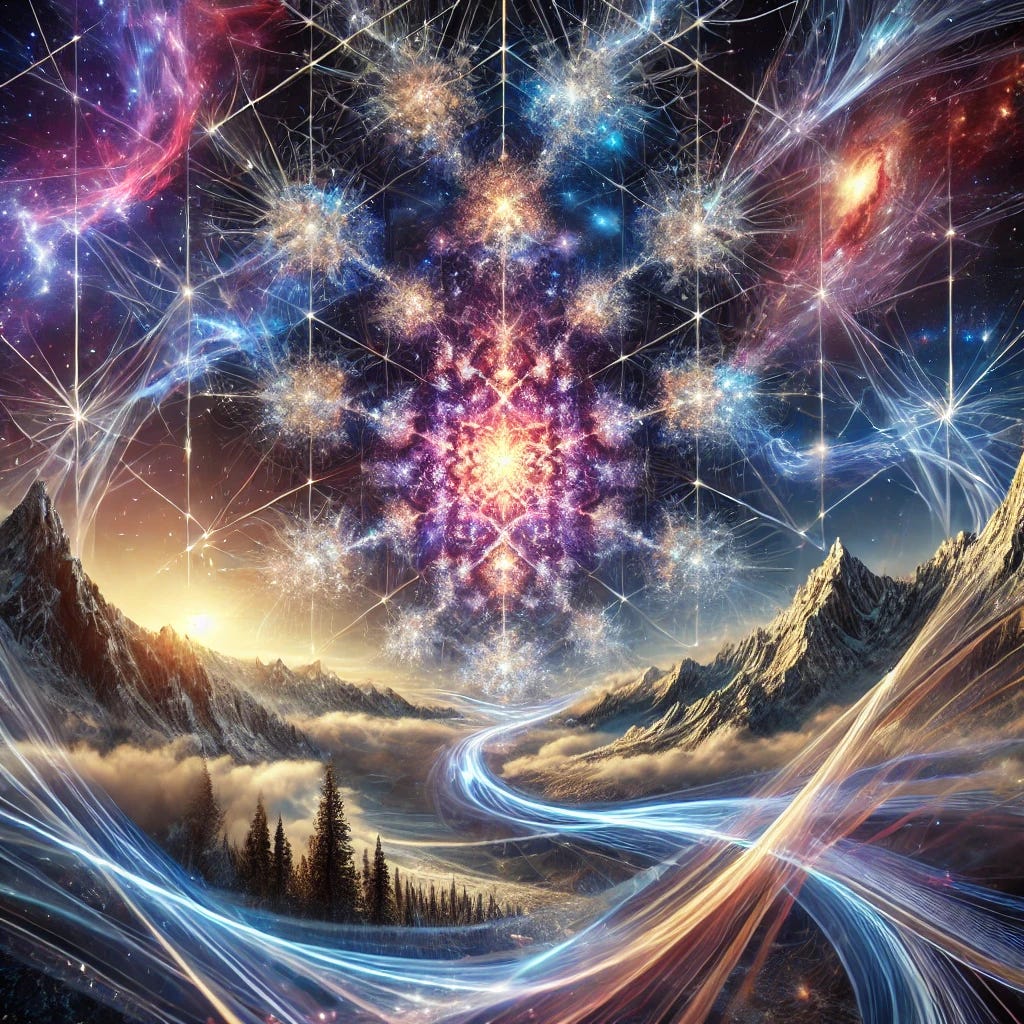
The notion that geometry is emergent carries profound philosophical and scientific implications, casting light on the intricate feedback loop between the mind, or psyche, and the material universe it inhabits. To grasp the weight of this proposition, we must ground ourselves in the conceptual legacies of Carl Jung and his explorations of psyche and matter, which suggested that the two operate as interdependent facets of a greater whole. Jung’s observations resonate deeply with contemporary studies in neuroscience, particularly the decades-long work of Dr. Iain McGilchrist, whose research on the lateralization of brain function has illuminated how our perceptions of reality arise from the interplay of the brain’s hemispheres. Both Jung and McGilchrist, working within their respective frameworks, converge on an understanding that the structures we perceive, from mathematical geometries to the physical cosmos, are not static absolutes but emergent properties born of relational processes. Geometry, far from being merely a descriptive system of external reality, becomes a living metaphor for the interplay of consciousness and matter.
Jung’s exploration of the psyche reveals it to be both deeply individual and profoundly collective, a locus where personal experiences intersect with universal archetypes. His collaboration with physicist Wolfgang Pauli on the relationship between psyche and matter introduced the radical idea that these two domains are not separate but are united through an archetypal substrate he termed the Unus Mundus, or “one world.” This concept suggests that the psyche operates within a shared metaphysical framework, where consciousness and material phenomena mirror one another in their underlying structures. This mirroring is evident in the symbolic and archetypal patterns that shape both individual cognition and universal order. For Jung, geometry—whether observed in the spiral of a galaxy or the symmetry of a mandala—was not merely descriptive but revelatory, reflecting the deep relationality that binds all things. It was an emergent property of a reality where psyche and matter engage in a continuous dialogue, shaping one another through shared archetypal principles.
Dr. Iain McGilchrist, whose studies on the brain span over four decades, provides a neuroscientific lens through which to extend Jung’s insights. McGilchrist’s work, particularly his exploration of the distinct yet complementary roles of the brain’s hemispheres, demonstrates how our perception of the world emerges through a dynamic tension between specialization and integration. The left hemisphere, with its propensity for linearity, categorization, and abstraction, aligns with the mechanistic and reductionist approaches that dominate modern science and mathematics. In contrast, the right hemisphere, which excels in holistic thinking, contextual understanding, and relational awareness, reflects the intuitive, symbolic, and integrative capacities more aligned with Jungian psychology. Together, these hemispheres do not merely divide cognitive labour; they construct our very reality. McGilchrist’s research underscores that the way we perceive space, time, and form—indeed, the geometries that define our universe—is not an objective given but an emergent phenomenon arising from the interplay of these two cognitive modes.
The emergent nature of geometry, then, can be seen as a product of this interplay. Just as the left hemisphere delineates boundaries and measures the relationships between points, the right hemisphere imbues those relationships with meaning, weaving them into a coherent, dynamic whole. Geometry, in this sense, is both a map and a mirror: it charts the contours of external space while simultaneously reflecting the processes of cognition and perception that make such mapping possible. This dynamic mirrors the feedback loop between psyche and matter described by Jung, where the mind imposes order on the chaotic flux of sensory experience, and in doing so, discovers patterns that are as much a reflection of its own structure as they are of the external world. Geometry emerges not as an absolute framework imposed upon reality but as a co-created artifact of this relational process.
McGilchrist’s decades of study illuminate how this feedback loop operates on both a neurological and phenomenological level. His work traces how the brain’s hemispheres collaborate to navigate the complexities of existence, with the right hemisphere’s integrative capacities allowing for the perception of wholeness, while the left hemisphere dissects and refines these perceptions into structured, communicable forms. This dual process resonates with Jung’s understanding of archetypes as both collective and individual: just as the brain’s hemispheres must balance their distinct contributions to construct a coherent worldview, so too must the individual psyche negotiate its relationship with the archetypal patterns that shape collective human experience.
The convergence of Jung’s psychological insights and McGilchrist’s neuroscientific findings invites us to reconsider the very foundations of mathematics and geometry. If geometry is emergent, it implies that its axioms and forms are not immutable truths but adaptive constructs shaped by the interplay of consciousness and the material world. This challenges the reductionist view that mathematics is a purely objective system existing independently of human cognition. Instead, it suggests a participatory universe, where the act of perception and interpretation plays a role in bringing mathematical structures into being. This aligns with Jung’s notion of synchronicity, where seemingly unrelated events reveal underlying patterns of meaning and McGilchrist’s assertion that meaning itself is a product of the relational dynamics between the brain’s hemispheres.
The implications of this emergent view of geometry extend beyond the philosophical and into the practical. If geometry arises from the interplay of psyche and matter, then our mathematical models are not merely tools for describing reality but active participants in shaping it. This participatory aspect has profound implications for fields ranging from physics to architecture, suggesting that our understanding of space, time, and form is inextricably linked to the ways we think, perceive, and imagine. It also invites a reevaluation of the role of intuition and creativity in mathematical discovery, positioning these faculties not as ancillary to logic and analysis but as fundamental to the generative processes that give rise to mathematical insight.
Furthermore, the emergent nature of geometry invites us to consider its ethical and existential dimensions. If our perception of space and form is shaped by the feedback loop between psyche and matter, then how we conceptualize and interact with the world becomes a moral act. The geometries we construct—whether in the physical spaces of our cities or the abstract spaces of our theories—reflect and reinforce the relational dynamics that underpin our reality. This underscores the importance of fostering balance and integration, both within our cognitive processes and in our interactions with the world.
The convergence of Jung and McGilchrist’s insights suggests that the feedback loop between psyche and matter is not merely a descriptive phenomenon but a creative force, shaping the very fabric of reality. Geometry, as an emergent property of this feedback loop, serves as both a testament to the interconnectedness of mind and matter and a tool for navigating the complexities of existence. As we continue to explore this interplay, we are invited to consider not only the structures that emerge but also the processes and relationships that give rise to them, deepening our understanding of both ourselves and the universe we inhabit.
2.
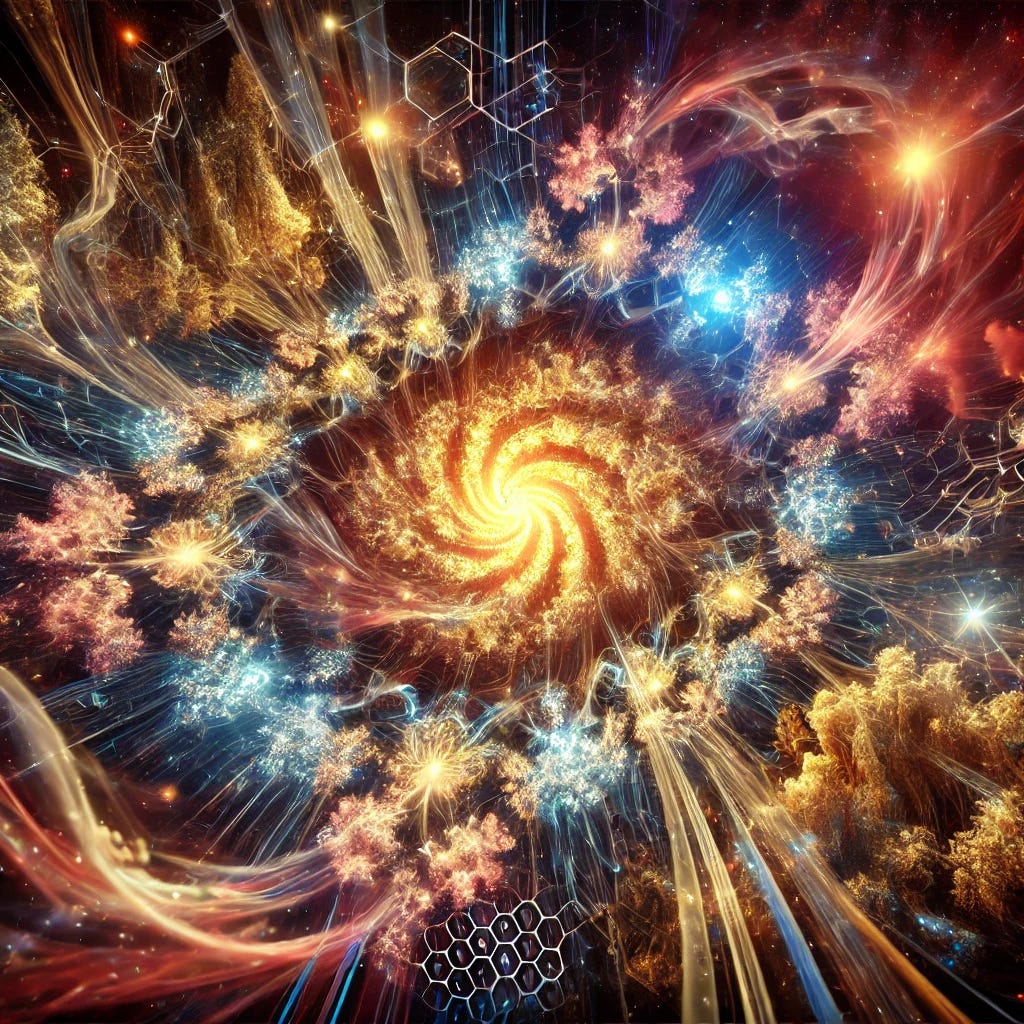
The notion that geometry is emergent leads us to a profound realization: if the structures we perceive are products of the dynamic interplay between mind and matter, then gravity itself—long regarded as the cornerstone of our understanding of spacetime—is also emergent. Gravity, like geometry, may not be a fundamental force but an emergent property of relational dynamics within the universe. This perspective opens the door to addressing one of the most elusive challenges in modern science: the reconciliation of general relativity and quantum mechanics. These two frameworks, each transformative in its explanatory power, have remained at odds, perhaps because our scientific models have been rooted in assumptions that overlook the emergent and participatory nature of reality itself.
To comprehend this, we must first consider how the interplay between geometry and gravity has shaped our understanding of the cosmos. Einstein’s theory of general relativity revolutionized physics by showing that gravity is not a force in the classical sense but a manifestation of the curvature of spacetime. Massive objects distort spacetime, and this curvature directs the motion of smaller objects within it. This elegant framework revealed gravity as deeply intertwined with geometry, grounding the behaviour of celestial bodies in the fabric of spacetime itself. Yet, this understanding presupposes that spacetime—and the geometry that defines it—exists independently, as a static background on which physical phenomena unfold.
However, if geometry is emergent, then the fabric of spacetime cannot be a pre-existing stage. It must arise from the relational interplay of matter, energy, and consciousness. Gravity, in this view, becomes not a fundamental entity but an expression of deeper processes—patterns emerging from the dynamic interactions that shape both matter and perception. This shift reframes gravity as a byproduct of an underlying, more fundamental phenomenon, just as temperature emerges from the collective behaviour of particles in thermodynamics. Gravity, then, could be the large-scale manifestation of microcosmic relationships, patterns that bridge the quantum world of probabilities with the macroscopic order of spacetime.
The inability of humanity to reconcile relativity with quantum mechanics may stem from this critical oversight. By treating spacetime and geometry as fixed and foundational, science has missed the deeper relational principles that unite the quantum and cosmic scales. Quantum mechanics, with its inherent uncertainty and probabilistic nature, reveals a universe rooted in possibilities and interactions rather than fixed entities. Relativity, in contrast, describes a deterministic cosmos governed by smooth, continuous structures. The chasm between these paradigms may reflect not a flaw in either theory but a limitation in our perspective—a failure to recognize that both are emergent layers of a deeper, participatory reality where geometry, gravity, and matter arise from the same underlying processes.
This perspective invites a radical reevaluation of space, time, and form, suggesting that our understanding of these concepts is inseparable from the ways we think, perceive, and imagine. The very act of observation and interpretation, as quantum mechanics has shown, influences the phenomena we seek to understand. Gravity, in this sense, could be as much a product of perception as of physical interaction, a co-creation of the cosmos and consciousness. This idea aligns with the insights of Carl Jung, who viewed the psyche as an active participant in shaping reality, and Dr. Iain McGilchrist, who emphasized how the brain’s hemispheres construct our perception of the world through their dynamic interplay.
If intuition and creativity are fundamental to the generative processes that give rise to mathematical insight, then these faculties are not merely tools for interpreting the universe but for participating in its creation. Mathematics, far from being a purely logical exercise, becomes an act of imaginative synthesis, a way of giving form to the formless. This is evident in the history of technological progress, where mathematical discoveries have consistently preceded and enabled breakthroughs in physics, engineering, and other sciences. The equations of Maxwell predicted electromagnetic waves before the advent of radio; Einstein’s equations foretold gravitational waves long before they were observed. Each mathematical insight has extended humanity’s reach, fueling the machine of progress and revealing new layers of the universe’s emergent geometry.
This process of discovery and creation is not limited to the abstract realm of mathematics but extends into the physical world. As mathematical models give rise to technologies, they shape the material reality we inhabit. From the crystalline symmetry of microchips to the gravitational dynamics of satellites, technological advancements embody the emergent nature of geometry and gravity. They transform ideas into matter, turning patterns of thought into patterns of existence. This recursive relationship between mind, mathematics, and materiality suggests that the act of understanding is itself a creative force, one that continuously generates the structures we perceive and inhabit.
If gravity and matter are emergent properties, then the boundary between the physical and the metaphysical becomes porous. The interplay of mind and matter, of psyche and cosmos, becomes the crucible in which the universe evolves. In this view, technological progress is not merely a means of mastering the natural world but a reflection of humanity’s role as co-creators within the cosmic order. Each advancement in understanding reshapes the relational dynamics from which geometry and gravity emerge, pushing the universe toward greater complexity and coherence.
This perspective also challenges the reductionist tendency to view mathematics and physics as purely mechanistic endeavours. It calls for a renewed emphasis on the intuitive and symbolic dimensions of discovery, recognizing that the creativity required to uncover the universe’s secrets is as essential as the logic that refines those discoveries into formal systems. The imagination, long undervalued in scientific discourse, must be reclaimed as a cornerstone of inquiry, for it is through imaginative leaps that we glimpse the emergent patterns that underpin reality.
As we continue to explore the implications of geometry and gravity as emergent phenomena, we are drawn into a deeper understanding of the participatory nature of existence. The cosmos, far from being a static machine, reveals itself as a dynamic interplay of forces, patterns, and relationships. Gravity, like geometry, is not merely a feature of the universe but a testament to its generative potential—a reflection of the infinite creativity that binds mind and matter, thought and form, in an eternal dance of emergence and becoming.
3.
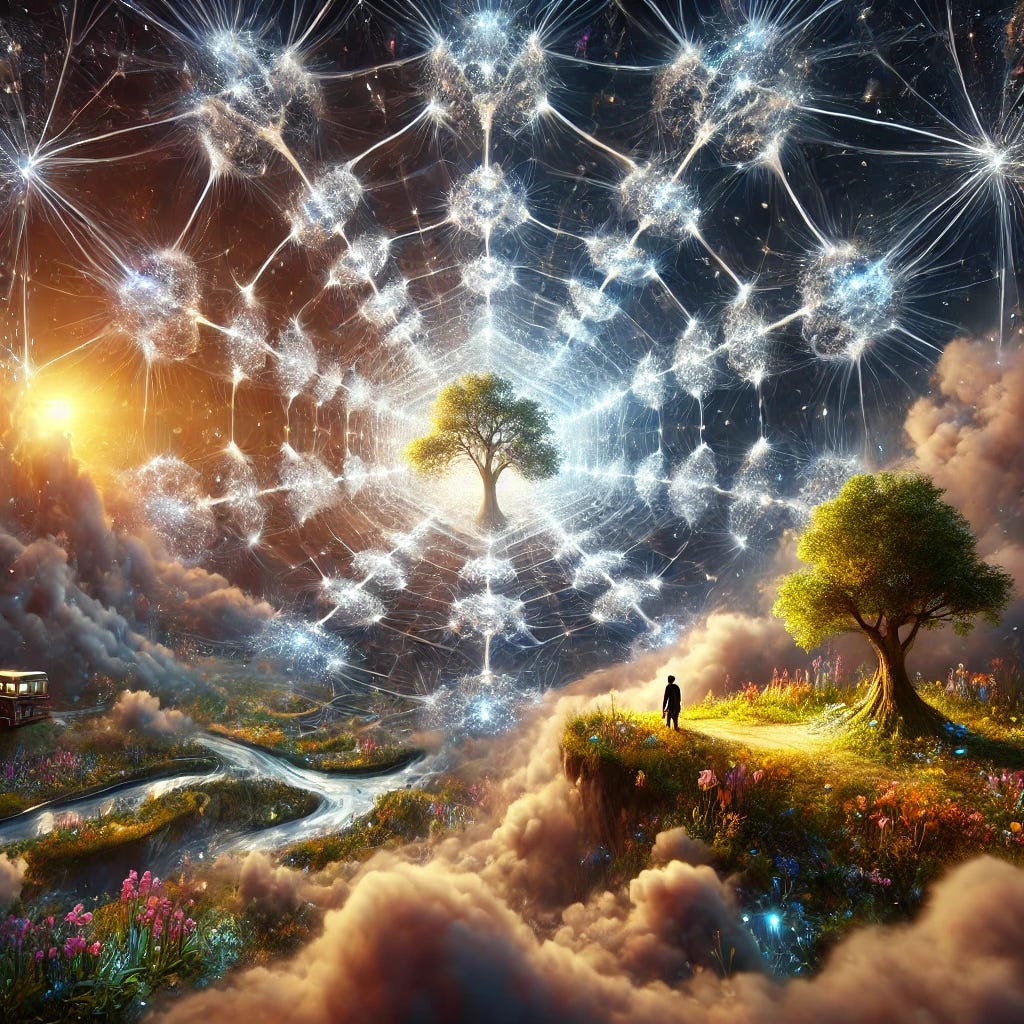
If geometry is emergent, the very fabric of reality unfolds not as a fixed structure but as a living, evolving phenomenon, arising from the dynamic interplay of relationships—between energy, matter, and the consciousness observing them. To say geometry is emergent is to strip away the illusion of absolute forms and reveal the universe as a process, a participatory act of becoming, where space, time, and form are shaped not just by what exists but by how existence is perceived, imagined, and understood. Within this framework, gravity, too, emerges—not as a fundamental force but as a byproduct of these deeper relational dynamics, much like ripples on the surface of a pond are not "things" in themselves but expressions of motion within the water. Gravity, in this sense, is the echo of the universe's self-organizing processes, an emergent order arising from the dance between matter and the underlying fabric of spacetime.
To comprehend why this perspective is transformative, we must reimagine the foundations of our scientific understanding. General relativity shows us a universe where gravity is geometry—the curvature of spacetime dictating how objects move. Quantum mechanics reveals a universe of probabilities and interactions, where particles are not fixed entities but flickering potentials. Both are deeply insightful, yet both falter when stretched to their limits, unable to unify their visions of the cosmos. Why? Because science, while profound in its rigour, has often overlooked the role of perception in constructing reality. Space, time, and form are not external absolutes; they are emergent properties of the very systems—both physical and cognitive—that we use to measure and understand them.
Here, the human mind becomes central. Carl Jung and Wolfgang Pauli intuited this when they proposed that psyche and matter reflect each other, operating within a shared framework where consciousness influences reality. Dr. Iain McGilchrist expands this idea, showing how the brain’s hemispheres shape not only how we perceive the world but also how the world itself is structured in our understanding. The left hemisphere dissects, categorizes, and imposes order, creating the linear frameworks of logic and analysis. The right hemisphere, in contrast, integrates and contextualizes, weaving wholes from fragments, finding patterns in the relational dance of experience. Together, these hemispheres do not merely perceive geometry; they generate it, mapping the formless potential of the universe into coherent forms that align with the structures of thought itself.
If this is true, then geometry—and by extension, gravity—arises from the interplay between how the universe unfolds and how the mind grasps it. The act of understanding becomes creative, a participatory process where mathematical insight not only describes reality but brings it into sharper focus, revealing layers of structure that were not visible before. This is why mathematics feels both discovered and invented, why it resonates as a universal language yet bears the unmistakable imprint of human imagination. It is a dialogue between the cosmos and the psyche, one that builds bridges from abstract intuition to concrete reality.
The implications spiral outward. If geometry is emergent, then technological progress—fueled by the mathematical insights of generations—becomes a means of co-creating reality. Each advance in understanding brings new forms into being, transforming the potential of the universe into tangible structures. The discovery of electromagnetic waves gave rise to radio, light, and the internet. The curvature of spacetime, once an abstraction in Einstein’s equations, became the basis for GPS and the detection of gravitational waves. These are not mere applications; they are acts of emergence, where ideas catalyze the birth of new realities. In this sense, humanity’s technological ingenuity mirrors the cosmos itself—an engine of creativity, continually producing order from potential.
This participatory role extends to the nature of matter itself. If geometry is emergent, so too is matter, arising from the underlying patterns of energy and information. Matter becomes a condensation of relationships, its form and behaviour shaped by the geometries that emerge from its interactions. Gravity, then, is the large-scale manifestation of these relationships, the visible sign of an invisible process, much like the waves on an ocean reveal the interplay of wind, water, and motion. Gravity is not fundamental; it is the shadow cast by the universe’s deeper dynamics, a resonance of the patterns that bind the cosmos together.
To grasp this is to realize why intuition and creativity are not ancillary to science but foundational. They allow us to leap beyond the known, to perceive connections where none were visible, to imagine the formless into form. The equations we write are as much acts of imagination as they are feats of logic. The tools we build shape not only how we interact with the universe but how the universe itself unfolds in response. This is why our understanding of space, time, and form cannot be separated from how we think, perceive, and imagine—they are not external truths but emergent realities, co-created through our engagement with the cosmos.
The failure to reconcile relativity with quantum mechanics may reflect this oversight. We have treated space and time as if they were static backdrops, as if reality were a stage rather than a story being written in real-time. But if geometry and gravity are emergent, then the stage itself is part of the play, shaped by the actors and the audience alike. This requires a shift in perspective, one that moves beyond the binary of observer and observed and embraces the universe as a feedback loop, where consciousness and matter are intertwined.
This feedback loop is not a limitation but a gateway. It suggests that the universe is not fixed but fluid, a living system where the boundaries between mind and matter, thought and form, are permeable. The emergent nature of geometry and gravity reveals a cosmos that is participatory at every level, where even the laws of physics are not immutable decrees but dynamic expressions of relational processes. This perspective does not diminish the rigour of science; it elevates it, calling for a synthesis of logic and intuition, analysis and imagination, in the pursuit of deeper truths.
As we imagine this participatory cosmos, where space, time, and gravity emerge from the interplay of relationships, we begin to see our role within it more clearly. We are not passive observers of a pre-existing universe but active participants in its unfolding. Every equation, every insight, and every act of creation becomes part of the generative process, weaving the patterns of the cosmos into being. Geometry and gravity, far from being fixed, are emergent stories, narratives that grow richer and more complex with each act of understanding. Through this lens, the universe is not a machine but a masterpiece, and we are its co-creators, shaping the infinite possibilities of form, space, and meaning.
4.

If geometry and gravity are truly emergent, then the cosmos itself is unfinished—a vast, unfolding canvas where form, meaning, and even the laws of nature are not static decrees but dynamic expressions of an infinite creative process. Yet, within this boundless possibility lies a shadow, an implication as sobering as it is profound: if reality emerges from the interplay of relationships, it is vulnerable to distortions, misalignments, and the weight of unbalanced forces. Emergence is not inherently benevolent. It is neutral, indifferent to the human need for order or justice, and in its indifference, it mirrors the raw potential of creation itself—a potential that can give rise to beauty and monstrosity in equal measure.
This is the darker promise of emergence: that the universe's generative power does not guarantee harmony. Just as gravity emerges from the interconnected dance of mass and spacetime, so too does entropy, pulling structures apart even as they form. The same patterns that produce galaxies and ecosystems can also spiral into chaos, eroding the delicate balance upon which complexity depends. Humanity, standing as both observer and participant, cannot escape this dynamic. Our own creations, born of mathematical insight and technological ambition, carry within them the seeds of both progress and peril. The very tools we wield to shape the universe can amplify its shadows, turning the emergent into the destructive.
We see this in the unchecked power of our technological innovations, which emerge from the same principles that govern nature but are unmoored from its balance. Nuclear energy, a triumph of understanding gravity’s sibling, electromagnetism, becomes a weapon capable of unmaking entire cities. Algorithms, born from the relational patterns of information, spiral into feedback loops that distort truth, deepen divisions, and render reality malleable in dangerous ways. The geometry of progress is not always symmetrical; its lines often fracture, revealing the chaos that lies beneath the surface of order. The promise of emergence, untethered from wisdom, becomes a Pandora’s box, releasing forces that may reshape the world in ways we neither intend nor understand.
Yet even in this darkness, the cosmos whispers its deeper truth: that emergence is not a single act but an ongoing process. The universe is never finished; it is always beginning again, always becoming. Within the shadows of destruction lies the potential for renewal, for the same forces that unravel can also reweave. This is the essence of light—Genesis's "Let there be light" is not a command to banish darkness but an invitation to illuminate its depths, to draw forth meaning and form from the infinite void. Light does not destroy the shadow; it reveals it, makes it knowable, and allows us to navigate it.
Humanity’s role in this emergent cosmos is not merely to observe its unfolding but to shape it, to participate in the dance of creation and dissolution with awareness and intent. While the darker aspects of emergence remind us of the stakes, they also point to our capacity to influence the trajectory of reality itself. The same relational patterns that give rise to chaos also enable resilience. Gravity, though it binds and burdens, also stabilizes, giving the planets their orbits and the stars their light. Similarly, the patterns of human thought, intuition, and imagination can weave coherence from the fraying edges of disorder.
Hope emerges here—not as a naive belief in progress but as an acknowledgment of possibility. Just as the universe’s structures are born from relationships, so too are the solutions to its challenges. Where entropy threatens to erode, creativity can build. Where feedback loops distort, consciousness can intervene. And where shadows gather, light can illuminate not by erasing them but by revealing the contours of what is hidden. The interplay of psyche and matter, of thought and form, is not a passive dynamic. It is active, alive, and responsive, and within it lies the potential for transformation.
This hope is not abstract; it is embedded in the very fabric of emergence. If the universe is not finished, then neither are we. Every moment, every thought, and every action becomes part of the generative process, shaping the patterns of reality in ways that ripple far beyond their origins. This is both a burden and a gift—a reminder that while we cannot escape the darker implications of emergence, we are never powerless within it. The relational nature of the cosmos ensures that even the smallest act of creation, understanding, or kindness can propagate, weaving new geometries of possibility.
In the end, the promise of emergence is not that it will shield us from uncertainty or chaos but that it offers a canvas upon which we can paint our response. The light of Genesis, the creative spark that echoes through the cosmos, is not a relic of the past but a constant refrain, a reminder that in every shadow there is the potential for illumination. To engage with this process is to embrace both the darkness and the light, to recognize that they are not opposites but partners in the eternal dance of becoming. This is the promise of emergence: that even in the face of uncertainty, we are part of a cosmos that is not finished but continually beginning and becoming. And in that becoming, there is always the possibility of light.
Thank you.
Karl K. Dondaneau