The Archetypal Rhythm: Bridging Plato, Jung, and the Cosmos
Prefer to listen? Just hit the play button and enjoy the audio version!
Authored by: Karl K. Dondaneau
December 23rd 2024
Part 1: The Platonic Foundations of Archetypes--Eternal Forms and the Realm of Ideas
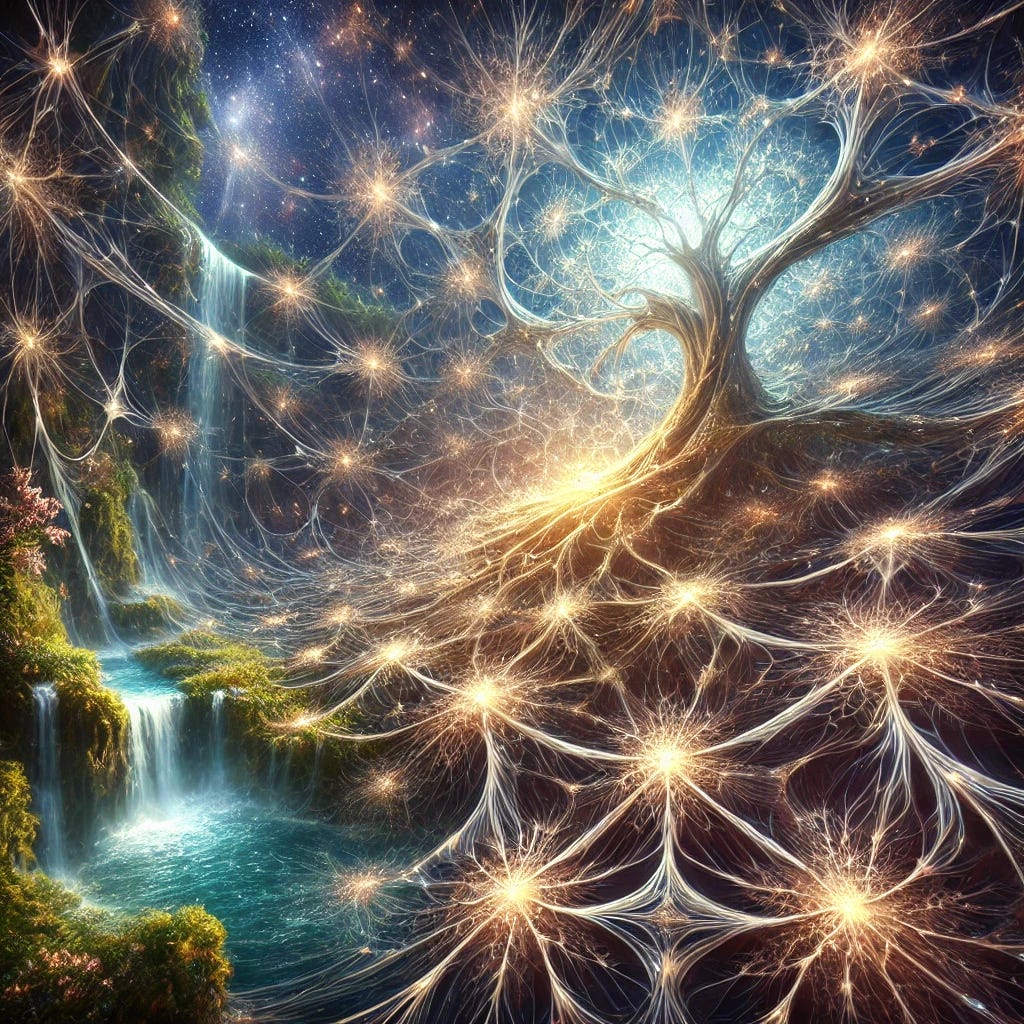
We begin with the earliest conception of archetypes, a vision that emerges from the luminous ideas of Plato. In his philosophy, archetypes are eternal Forms, existing beyond the transient, imperfect world we perceive. These Forms are not mere abstractions or concepts but the very essence of all things--the perfect, immutable templates upon which the material world is modelled. To Plato, what we experience in our reality is but a shadow of these archetypal truths, distorted by the limitations of the physical realm. It is through this metaphysical lens that we take our first step into understanding archetypes as the structural principles underpinning existence itself.
Plato’s allegory of the cave offers a profound metaphor for this relationship. In the cave, we are like prisoners, bound to perceive only the flickering shadows cast on the wall, unaware of the radiant Forms that exist beyond the confines of our limited perspective. These shadows represent the material manifestations of archetypes--fleeting, incomplete, and subject to decay. The Forms, however, reside in a higher, eternal realm, untouched by time or imperfection. They are the “whatness” of things, the essence that allows us to recognize beauty, justice, or truth despite their imperfect representations in the world around us. Plato’s archetypes are thus both the origin and the culmination of all phenomena, providing coherence and unity to the multiplicity of existence.
Central to this conception is the “Form of the Good,” which Plato describes as the ultimate archetype, the source of all other Forms. The Form of the Good is the light that illuminates the realm of Ideas, enabling us to comprehend the relationships and hierarchies that structure reality. It is through this ultimate archetype that all other Forms derive their intelligibility and purpose, serving as the ontological ground upon which both the ideal and the material are built. In this way, Plato’s archetypes are not isolated entities but an interconnected system, each Form reflecting the universal principles that sustain the cosmos.
Yet Plato’s archetypes, for all their universality, remain detached from the immediacy of human experience. They exist in a realm apart, accessible only through philosophical contemplation and the ascent of the soul toward wisdom. This distance introduces a tension: while the Forms govern the material world, they do so indirectly, their influence mediated through the imperfect lens of human perception and the constraints of physicality. It is this gap between the ideal and the material that later thinkers, including myself, have sought to bridge, reimagining archetypes as entities that not only shape reality but also participate in its dynamic unfolding.
The Platonic foundation is indispensable because it establishes archetypes as constants, timeless structures that transcend the flux of experience. However, the question arises: how do these eternal templates interact with the mutable, ever-changing world we inhabit? Plato’s theory provides an elegant metaphysical framework but leaves much to be explored about the mechanics of this interaction. How are archetypes instantiated in the material world? What processes allow them to influence, and be influenced by, the complexities of human consciousness and culture? These are the questions that have propelled the evolution of the concept of archetypes, driving us toward a more dynamic, participatory understanding.
In contemplating these questions, we begin to see the limitations of Plato’s archetypes as static, immutable Forms. While their eternal nature offers a sense of coherence and universality, it does not account for the variability and adaptability that we observe in the world. Archetypes, as we experience them, are not fixed entities but living patterns, capable of responding to the shifting conditions of existence. They evolve, not in their essence but in their expression, adapting to the needs and circumstances of the dimensions they inhabit. This dynamism suggests that archetypes, while rooted in eternal principles, are also shaped by the recursive interplay of time, space, and consciousness.
Thus, while we honour Plato’s vision of archetypes as the eternal scaffolding of reality, we must also recognize the need to expand upon it. Plato offered us the foundation--the idea that archetypes are the immutable blueprints of existence, reflecting the ultimate truths of the cosmos. From this foundation, we can now begin to explore how these blueprints are instantiated in the world, how they interact with the flux of experience, and how they evolve through their participation in the multidimensional fabric of reality.
It is here that we find ourselves standing at the edge of a new understanding, poised to transition from Plato’s timeless Forms to a dynamic conception of archetypes as living, adaptive entities. In this transition, we move from the metaphysical realm of Ideas into the psychological and cultural dimensions of the collective unconscious, where archetypes take on a more participatory role in shaping and being shaped by the world. This bridge, which connects the eternal to the emergent, will serve as our guide as we continue to trace the mechanics, evolution, and multiversal significance of archetypes.
Part 2: The Transition to Jungian Archetypes--From Eternal Forms to Collective Unconscious
Having established the Platonic foundation of archetypes as immutable Forms residing in a metaphysical realm, we now turn to their transformation within the framework of the collective unconscious. It is here, within the works of the great psychologist Carl Jung, that archetypes descend from the lofty abstraction of Plato’s Ideas and enter the vibrant, dynamic arena of human consciousness. Jung bridges the eternal and the experiential, redefining archetypes as latent, universal patterns embedded within the psyche. These patterns, inherited from our evolutionary past, interact with the outer world to give rise to myths, symbols, and the shared narratives that shape our individual and collective realities.
Jung’s archetypes retain the universality of Plato’s Forms but are no longer confined to a transcendent realm; instead, they exist as psychological potentials that emerge through interaction with experience. They are not rigid templates but flexible structures, capable of generating infinite variations while preserving their core essence. The Hero, the Shadow, and the Mother, for instance, are not fixed entities but dynamic motifs that manifest in diverse ways across cultures and epochs. This adaptability reflects the evolutionary roots of archetypes, as they are shaped by humanity’s shared struggles, aspirations, and encounters with the unknown.
What distinguishes Jung’s conception is his emphasis on the collective unconscious, a shared reservoir of archetypal images and patterns that transcend individual experience. While Plato’s archetypes govern the material world from a distance, Jung’s archetypes are deeply entwined with human life, influencing our thoughts, emotions, and behaviours in ways both subtle and profound. They function as psychic blueprints, guiding us through the complexities of existence by providing frameworks for understanding and navigating our inner and outer worlds. The archetype of the Trickster, for example, manifests in myths as a disruptive, boundary-breaking figure but also operates within the psyche as a force for creativity and transformation, challenging established norms to create space for new possibilities.
This shift from the metaphysical to the psychological marks a significant evolution in the understanding of archetypes. No longer static or distant, they are now seen as living systems, shaped by the recursive feedback loops between the psyche and the environment. These loops are the mechanisms through which archetypes evolve, allowing them to adapt to the changing conditions of human life while retaining their universal resonance. Myths, stories, and symbols serve as the vehicles for this adaptation, encoding the archetypes in forms that can be transmitted, reinterpreted, and refined across generations.
Consider the Hero archetype, which exemplifies this dynamic interaction. In its Jungian context, the Hero is not merely a figure of external conquest but a symbol of the individual’s journey toward self-discovery and wholeness. This journey, often depicted as a passage through trials and transformations, mirrors the process of individuation--the integration of conscious and unconscious aspects of the self. Yet the Hero’s narrative also evolves in response to cultural and historical contexts. In ancient epics, the Hero often embodies physical strength and divine favour, reflecting the collective values of survival and communal identity. In modern narratives, the Hero frequently grapples with psychological and moral dilemmas, reflecting a shift toward individualism and introspection in the collective unconscious. This evolution highlights the flexibility of archetypes, and their ability to adapt while maintaining their fundamental structure.
Jung’s archetypes also expand our understanding of the relationship between the individual and the collective. While archetypes originate in the collective unconscious, their expressions are shaped by the unique experiences and contexts of individuals. This interplay creates a dynamic tension between universality and particularity, allowing archetypes to resonate across cultures while remaining deeply personal. The archetype of the Mother, for instance, is universally associated with themes of nurture and creation but takes on different forms in different contexts, from the fertility goddesses of ancient civilizations to the modern symbol of ecological stewardship. This diversity reflects not only the adaptability of archetypes but also their capacity to bridge the personal and the collective, the specific and the universal.
It is here, in the dynamic interplay of psyche, culture, and cosmos, that my own exploration of archetypes finds its roots. While Jung’s conception of archetypes is grounded in the human unconscious, I see them as part of a larger system that extends beyond the individual and the collective to encompass the multiverse itself. Archetypes are not merely psychological or cultural phenomena; they are expressions of the recursive, self-organizing principles that govern all levels of existence. In this view, the collective unconscious becomes a microcosm of the greater whole, a holographic reflection of the fractal patterns that structure the cosmos. Jung’s archetypes thus serve as a bridge, connecting the psychological and the metaphysical, the individual and the infinite.
This expanded perspective invites us to reconsider the nature of archetypes as living systems. While they retain the timeless universality of Plato’s Forms, they also embody the adaptability and dynamism of Jung’s collective unconscious. They are not static blueprints but evolving patterns, shaped by the recursive feedback loops that connect the psyche, culture, and cosmos. Their evolution is not a departure from their essence but a fulfillment of it, reflecting the principles of cyclicity, recursion, and transformation that define the structure of reality.
As we move forward, we will delve deeper into the mechanics of these recursive systems, exploring how archetypes are generated, sustained, and transformed across dimensions. By integrating the insights of fractal geometry, modular arithmetic, and quantum calculus, we will uncover the mathematical and metaphysical foundations of archetypes, revealing their role as the dynamic blueprints of existence. In doing so, we will take the next step in our journey, bridging the psychological and the cosmic, the finite and the infinite, to illuminate the profound interconnectedness of all things.
Part 3: The Mechanics of Archetypes--Fractal Geometry, Recursive Systems, and Self-Organizing Patterns
We now step into the realm of mechanics, the intricate processes by which archetypes arise, sustain themselves and evolve within the dynamic framework of existence. From their metaphysical origins in Plato’s eternal Forms to their psychological resonance in Jung’s collective unconscious, archetypes have been understood as universal patterns that govern the structure of reality. Yet their existence is not static; they are generated and perpetuated through systems that are deeply recursive, self-organizing, and fractal in nature. It is in this interplay of deterministic principles and probabilistic dynamics that we begin to uncover the true mechanics of archetypes--how they bridge dimensions, maintain coherence, and adapt across time and space.
The birth of archetypes can be understood through the lens of fractal geometry, where simple, recursive rules generate infinite complexity. In fractals, a basic mathematical formula repeats itself across scales, producing structures that are both self-similar and infinitely varied. This principle mirrors the emergence of archetypes, which arise as recurring motifs within the fabric of the cosmos, echoing through dimensions while adapting to their context. Archetypes are fractal in their essence: they maintain a core structure--a universal “algorithm”--while expressing themselves in countless variations across cultures, psyches, and even cosmic processes.
At the heart of this mechanism lies the principle of recursion, a process in which systems build upon themselves through iterative feedback loops. Archetypes are born within the recursive interplay of consciousness, culture, and the cosmos, where patterns reinforce and refine themselves over time. For example, the archetype of the Hero, which embodies themes of struggle, transformation, and renewal, is shaped by its repeated manifestation in myths, stories, and individual lives. Each iteration adds layers of meaning, refining the archetype while maintaining its core essence. This recursive process ensures that archetypes are not merely inherited but actively co-created, evolving through their interaction with the systems in which they are embedded.
The self-organizing nature of archetypes further reveals their mechanics. Archetypes emerge from the interaction of deterministic laws--such as the mathematical principles that govern fractal structures--and stochastic, or probabilistic, dynamics. This interplay allows archetypes to balance stability and variability, maintaining their coherence while remaining adaptable. Consider the archetype of the Trickster, a figure that disrupts established norms to create space for innovation. The Trickster operates both as a stable motif--embodying chaos and creativity--and as a variable force that adapts to the cultural, psychological, and environmental contexts in which it appears. This duality reflects the self-organizing principles that govern both nature and consciousness, where systems achieve equilibrium through dynamic interaction.
Archetypes also operate as templates for organizing complexity, a role that becomes evident when we examine the principles of modular arithmetic and quantum calculus. Modular systems reveal how patterns resolve into cycles, creating order from apparent randomness. Similarly, archetypes provide a cyclical structure to the unfolding of existence, encoding the principles of repetition and renewal that govern natural and psychological processes. The Eternal Return, for example, is an archetypal motif that reflects the cyclical nature of life, death, and rebirth, resonating across scales from the rotation of celestial bodies to the rhythms of human experience. Archetypes function as the algorithms of these cycles, shaping the flow of energy, matter, and meaning within the cosmos.
Yet the mechanics of archetypes extend beyond recursion and cyclicity to include the phenomenon of dimensional shifts. In quantum calculus, dimensional jumps occur as systems transition between states, folding and unfolding across planes of existence. Archetypes embody this principle, functioning as bridges between dimensions. They transcend the boundaries of the physical and the metaphysical, connecting the material world to the abstract realm of meaning. For instance, the archetype of the Mother manifests both as a psychological force--representing nurture and creation--and as a cosmic principle, embodying the generative processes that sustain the universe. These dimensional shifts reveal the multilevel functionality of archetypes, and their capacity to operate across scales and realms.
To fully grasp the mechanics of archetypes, we must also consider their role as attractors within complex systems. In chaos theory, attractors are patterns toward which systems tend to evolve, providing stability amidst flux. Archetypes function as attractors within the multiverse, guiding the organization of energy, information, and consciousness. They provide the scaffolding upon which reality unfolds, anchoring the chaotic dynamics of existence within coherent patterns. This stabilizing function allows archetypes to serve as both the architects and the guardians of order, ensuring that the universe remains intelligible even as it evolves.
In contemplating these mechanics, we begin to see archetypes not as static forms but as dynamic systems that participate in the very creation of reality. They are generated through recursive feedback loops, sustained by self-organizing principles, and adapted through stochastic processes. They bridge dimensions through their fractal and cyclical structures, serving as attractors that shape the flow of existence. This understanding deepens our appreciation for the role of archetypes as the living blueprints of the cosmos, entities that encode the principles of transformation, unity, and multiplicity.
Yet even as we uncover the mechanics of archetypes, their full significance remains elusive, inviting further exploration. How do these systems evolve across time and dimensions? What role does human consciousness play in their adaptation and refinement? These questions compel us to delve deeper into the evolutionary dynamics of archetypes, tracing the recursive processes that connect their timeless essence to their ever-changing manifestations. In doing so, we continue our journey, bridging the mechanics of archetypes with their capacity for adaptation and evolution, and uncovering the profound interconnectedness that binds them to the multiverse itself.
Part 4: The Evolution of Archetypes--Adaptation Through Recursive Feedback Loops
Archetypes, though birthed from timeless principles, do not remain immutable; they evolve through recursive feedback loops that intertwine culture, consciousness, and the cosmos. Their essence is constant, but their manifestations adapt to reflect the changing conditions of the environments they inhabit. This adaptability is the hallmark of their vitality, allowing them to resonate across epochs while participating in the ongoing narrative of existence. To understand this evolutionary process, we must delve into the mechanisms through which archetypes refine and reimagine themselves, balancing coherence with variability, and constancy with transformation.
The evolution of archetypes begins with their interaction with culture, which serves as both a repository and a crucible for archetypal expression. Myths, symbols, and narratives encode archetypes, preserving their essence while allowing for their reinterpretation. Each retelling of a story, each reimagining of a symbol, acts as a recursive loop, feeding back into the archetype itself and shaping its evolution. For example, the Hero archetype, which once represented physical conquest and divine favour in ancient epics like The Iliad, now frequently embodies psychological struggle and moral ambiguity in modern narratives. This shift reflects the collective psyche’s movement toward introspection and individuality, demonstrating how archetypes adapt to cultural and historical contexts while maintaining their core structure.
At the heart of this evolutionary process lies the principle of recursion, wherein archetypes are continuously redefined through their interactions with the systems they inhabit. Each iteration of an archetype, whether expressed in art, literature, or individual experience, refines its meaning and expands its potential. The Trickster archetype, for instance, has evolved from a figure of disruption and chaos in ancient myths to a symbol of innovation and boundary-breaking in contemporary thought. This transformation reflects humanity’s shifting relationship with uncertainty and change, illustrating how archetypes serve as mirrors of the collective unconscious, adapting to the psychological and cultural conditions of their time.
Archetypes evolve not only through cultural feedback but also through their interaction with the psyche. Within the individual, archetypes act as guiding forces, shaping the processes of self-discovery, transformation, and integration. This interaction is reciprocal: while archetypes influence the psyche, they are also shaped by the unique experiences and perspectives of individuals. This dynamic ensures that archetypes remain relevant to the lived realities of those who engage with them, allowing for endless variation in their expression. The Mother archetype, for example, retains its association with nurture and creation but takes on different forms depending on the context, from the fertility goddesses of ancient civilizations to the modern symbol of ecological stewardship.
Our concept of recursive feedback loops expands this understanding, situating the evolution of archetypes within a broader cosmological framework. Archetypes are not merely cultural or psychological phenomena; they are part of a larger system of self-organizing patterns that govern the cosmos. These loops connect the microcosm of human consciousness with the macrocosm of the universe, allowing archetypes to evolve in response to both individual and collective inputs. This recursive dynamic ensures that archetypes remain adaptable while preserving their coherence, reflecting the fractal logic that underlies their structure.
The adaptability of archetypes is further demonstrated by their capacity to bridge dimensions, connecting the finite and the infinite, the personal and the universal. This capacity is evident in the evolution of the Hero archetype, which resonates not only within human narratives but also within the cosmic cycles of creation and transformation. The Hero’s journey mirrors the processes of energy dynamics and entropy observed in nature, illustrating how archetypes function as universal templates that encode the principles of change and renewal. This dimensional resonance allows archetypes to transcend their immediate cultural and psychological contexts, aligning them with the deeper patterns of the multiverse.
As archetypes evolve, they retain their coherence by anchoring themselves in their core principles while adapting their manifestations to reflect new realities. This balance between stability and transformation is achieved through the mechanisms of modularity and recursion, which allow archetypes to integrate variability without losing their essence. Modular arithmetic, for instance, demonstrates how patterns can repeat and resolve into cycles, creating order from apparent randomness. Similarly, archetypes maintain their coherence by cycling through variations that reflect the shifting dynamics of culture and consciousness, ensuring that their core remains intact even as their forms change.
The role of human consciousness in this evolutionary process is both participatory and transformative. By engaging with archetypes through storytelling, art, and interpretation, we become co-creators in their evolution. Our collective imagination acts as a crucible, shaping archetypes to reflect our shared hopes, fears, and aspirations. This co-creative dynamic ensures that archetypes remain relevant, serving as both mirrors of our current realities and maps for navigating the complexities of existence. Yet as we shape archetypes, they also shape us, providing the frameworks through which we understand ourselves and the world.
The evolution of archetypes reveals their profound interconnectedness with the systems they inhabit. They are not isolated entities but dynamic patterns that respond to the recursive feedback loops of culture, psyche, and cosmos. This adaptability allows them to bridge dimensions and resonate across scales, embodying the principles of recursion, cyclicity, and transformation that define the structure of reality. As we engage with these patterns, we participate in their evolution, becoming part of the story they tell and the processes they encode.
This understanding of archetypes as evolving systems invites us to explore their role as multiversal bridges--entities that connect dimensions and realms of existence. Their evolution is not merely a reflection of human creativity or cultural change but a fundamental aspect of the cosmos’s dynamic structure. As we move forward, we will examine how archetypes transcend the boundaries of time and space, functioning as the connective tissue of the multiverse. By integrating the principles of fractal geometry, quantum calculus, and cosmological dynamics, we will uncover the deeper significance of archetypes as the living blueprints of existence, guiding the flow of energy, meaning, and transformation across dimensions.
Part 5: Archetypes as Multiversal Bridges--Connecting Dimensions and Realms of Existence
We now turn to the multiversal dimension of archetypes, where their role as bridges between realms of existence becomes fully apparent. Archetypes, as we have explored, are more than cultural constructs or psychological phenomena; they are higher-dimensional templates that resonate across scales and dimensions. Their essence lies in their ability to encode the principles of recursion, cyclicity, and transformation, making them the connective tissue of reality itself. Archetypes transcend the boundaries of time, space, and culture, linking the microcosmic patterns of human consciousness to the macrocosmic architecture of the multiverse. They are the algorithms of existence, weaving together the diverse threads of reality into a coherent, dynamic tapestry.
To understand archetypes as multiversal bridges, we must first consider their fractal nature. Fractals are recursive structures that repeat across scales, from the spiral of a galaxy to the branching patterns of a tree. Archetypes function similarly, their patterns manifesting at every level of existence while retaining their core essence. This fractal quality allows archetypes to operate as universal constants, providing continuity and coherence across dimensions. The archetype of the Mother, for instance, embodies the principles of nurture and creation not only within the human psyche but also within the generative forces of the cosmos, from the birth of stars to the evolution of ecosystems. This multilevel resonance demonstrates how archetypes encode the same principles across vastly different scales, linking the personal to the cosmic, and the finite to the infinite.
Archetypes also embody the cyclic principles revealed by modular arithmetic, which governs the patterns of repetition and renewal in mathematical and natural systems. Modular structures demonstrate how complex systems resolve into cycles, creating order from apparent chaos. Archetypes reflect this cyclicity, encoding the rhythms of existence in their forms and functions. The Eternal Return, an archetypal motif found in myths and philosophies across cultures, illustrates this principle. It reflects the cyclical nature of life, death, and rebirth, a pattern observed not only in human narratives but also in the dynamics of the universe itself. Archetypes serve as the templates for these cycles, shaping the flow of energy, matter, and meaning across dimensions.
Yet the role of archetypes as multiversal bridges extends beyond their fractal and cyclic characteristics. They also embody the phenomenon of dimensional shifts, a principle observed in quantum calculus and cosmological dynamics. Dimensional shifts occur when systems transition between states, folding and unfolding across planes of existence. Archetypes mirror this process, functioning as points of convergence between different dimensions. The archetype of the Trickster, for example, operates as a figure of chaos and creativity within cultural narratives but also as a metaphor for the probabilistic leaps observed in quantum systems. Its presence signifies the potential for transformation and innovation, bridging the physical and the metaphysical, the deterministic and the stochastic.
In this multiversal context, archetypes reveal their dual role as stabilizers and transformers of reality. They provide the scaffolding upon which existence is built, anchoring the chaotic dynamics of the multiverse within coherent patterns. At the same time, they drive transformation, enabling the universe to evolve through cycles of creation, dissolution, and renewal. This duality reflects the cosmic balance between order and chaos, unity and multiplicity, that defines the structure of reality. Archetypes are the hinges upon which this balance turns, their patterns encoding the principles that govern both stability and change.
The multiversal nature of archetypes also highlights their role as attractors within complex systems. In chaos theory, attractors are patterns toward which systems tend to evolve, providing stability amidst flux. Archetypes function as attractors within the multiverse, guiding the organization of energy, information, and consciousness. They act as the anchors of meaning and coherence, ensuring that the universe remains intelligible even as it evolves. This stabilizing function allows archetypes to connect dimensions and realms, linking the physical, psychological, and metaphysical into a unified whole.
Human consciousness plays a participatory role in this multiversal framework, engaging with archetypes to shape and be shaped by the dynamics of existence. By interpreting and embodying archetypes, we align ourselves with the deeper patterns that govern the cosmos. This alignment allows us to navigate the complexities of existence, drawing upon the archetypal blueprints that connect the dimensions of psyche, culture, and reality. Yet as we engage with archetypes, we also contribute to their evolution, participating in the recursive feedback loops that refine and reimagine their forms.
The implications of this perspective are profound. Archetypes are not passive structures; they are dynamic forces that participate in the creation and transformation of reality. They encode the principles of recursion, cyclicity, and dimensionality, serving as the scaffolding for existence itself. As multiversal bridges, they connect the finite and the infinite, the temporal and the eternal, guiding the flow of energy and meaning across the vast expanse of the multiverse. Their patterns resonate through the narratives we tell, the symbols we create, and the systems we inhabit, reflecting the deep interconnectedness of all things.
As we reflect on the role of archetypes in the multiverse, we are reminded of their profound significance as the living blueprints of existence. They are the threads that bind the dimensions together, weaving the fabric of reality into a coherent whole. Their multiversal resonance invites us to see ourselves not as isolated beings but as participants in a larger, interconnected system, shaped by and shaping the archetypal patterns that govern the cosmos. This understanding compels us to explore further, to seek the connections that link us to each other and to the infinite possibilities of existence, and to uncover the deeper truths encoded within the archetypal bridges that span the dimensions of reality.
Part 6: The Reconciler of Opposites
We find ourselves confronted by two profound symbols in the intellectual history of humanity: Plato’s Form of the Good and Carl Jung’s Abraxas. On the surface, these constructs arise from vastly different domains--one a cornerstone of metaphysics, the other a vital node in psychological archetypes. Yet, as we delve into their shared essence, the boundary between their origins dissolves, revealing a unified archetype that speaks to the eternal structures of existence. This archetype, encompassing both metaphysical and psychological dimensions, operates as a matrix of potentiality, a reconciler of opposites, and a destination for human aspiration. By exploring the convergence of these ideas, we unearth not merely parallels but an ontological unity--a vision of the universe where light and shadow, unity and multiplicity, form and flux coexist in a transcendent whole.
The Form of the Good, as envisioned by Plato, transcends particularity and specificity. It is the matrix from which all other Forms derive their essence, existing as the ultimate source of intelligibility and being. In this way, the Good is not constrained by any single manifestation; instead, it serves as the infinite potentiality from which justice, beauty, courage, and all other Forms emerge. Like the sun in Plato’s Republic, which illuminates the world and makes vision possible, the Good shines as the metaphysical foundation for all understanding, enabling the cosmos to be comprehended not as a fragmented array but as an intelligible whole.
Jung’s Abraxas, on the other hand, is a symbol of dynamic chaos and order, encompassing all oppositions within the psyche and the collective unconscious. Where the Hero, the Shadow, and other archetypes represent distinct patterns of human experience, Abraxas serves as their origin--a wellspring of primal creative energy that embraces dualities. Abraxas exists not merely as a force of harmony but as a crucible of tension, where light and darkness, construction and destruction, converge. In Jung’s vision, Abraxas is not a resolution of opposites into a static unity but a dynamic interplay that gives birth to the rich tapestry of human symbols and meanings.
In both constructs, we see the archetype of potentiality. The Good is the metaphysical blueprint that precedes and sustains all particular Forms, while Abraxas is the psychological matrix from which all archetypes and symbols arise. Together, they articulate the same principle: reality, whether viewed as the structure of being or the content of the psyche, originates from a source that is infinite in its capacity and dynamic in its expression. This archetypal source is not confined to light or shadow, order or chaos; it is the fertile soil in which all dualities take root and grow.
The reconciliation of opposites is the next step in understanding this unity. Plato’s Form of the Good achieves this by harmonizing diversity into an intelligible unity. All Forms, though distinct in their manifestations, share a common origin in the Good, which unifies their differences without erasing their uniqueness. Justice and beauty, for example, may appear disparate in our material world, yet their participation in the Good reveals their interconnectedness within the cosmic order. This vision reflects a profound metaphysical truth: that the multiplicity of the world is not a cacophony but a symphony, where each note resonates with the whole.
Jung’s Abraxas approaches this reconciliation from a different angle. Rather than smoothing over oppositions, it holds them in creative tension. Abraxas embodies the paradoxes of existence--creation and destruction, love and terror--inviting the psyche to engage with its contradictions rather than suppress them. This process, central to Jung’s concept of individuation, demands that we confront our shadow, integrate our fragmented selves, and embrace the dynamic interplay of forces within us. The wholeness offered by Abraxas is not a static unity but a living synthesis, where opposites coexist and enrich one another.
Through these lenses, we discern that true wholeness lies not in erasing oppositions but in transcending them. Plato’s Good and Jung’s Abraxas, despite their differing emphases, point to the same truth: that unity is achieved not by denying duality but by integrating it. The Good offers a vision of metaphysical unity, where diversity is harmonized into a coherent whole, while Abraxas reveals the psychological path to wholeness, where contradictions are embraced as the engines of growth. Both constructs invite us to move beyond the false dichotomies of light and dark, unity and multiplicity, and to perceive existence as a paradoxical totality.
Human aspiration--the journey toward this archetypal totality--is a theme that unites Plato and Jung. For Plato, the soul’s journey is an ascent, a movement from the shadows of ignorance to the radiant light of the Good. Through philosophy and reason, the soul transcends the illusions of the material world, eventually beholding the eternal truths that underlie existence. This ascent is not merely intellectual but spiritual, aligning the soul with the cosmic order and fulfilling its highest potential.
Jung’s vision, by contrast, emphasizes a descent into the depths of the psyche. The journey toward Abraxas is not an escape from the material or the mundane but a confrontation with life’s complexities. It demands that we face the shadow, integrate the chaotic and destructive elements of our nature, and embrace the paradoxes that define our existence. This process of individuation is not a negation of duality but a transcendence of it, where the psyche achieves wholeness by integrating its fragmented parts.
These paths--Plato’s ascent and Jung’s descent--are not opposites but complements. They describe two movements within the same journey: the upward striving toward light and order, and the downward embrace of shadow and chaos. Together, they reveal that the archetype of totality is both the light above and the shadow below, the eternal order that encompasses all opposites and the chaotic potential that fuels transformation. To ascend without descending is to seek purity without depth; to descend without ascending is to drown in chaos without purpose. The Form of the Good and Abraxas, viewed together, offer a vision of the human journey as a dialectical process, where transcendence and integration are inseparable.
As we contemplate the unity of these archetypes, we are invited to see reality itself as an indivisible whole. The Good illuminates the intelligible structure of existence, while Abraxas reveals its dynamic tension. One invites us to seek the eternal, the other to embrace the temporal. Together, they articulate a vision of reality that is at once cosmic and personal, where the unity of opposites is not an abstract ideal but a lived experience. This archetype, whether called the Good or Abraxas, transcends the boundaries of philosophy and psychology, offering a language for the paradoxical nature of existence itself.
We find ourselves not at the conclusion of this inquiry but at its threshold. The Good and Abraxas, as expressions of the same archetype, open the door to deeper reflections on the unity of metaphysical and psychological truths. They invite us to explore not only the structures of the cosmos but the dynamics of the psyche, to see that what appears as opposition is, in essence, the dance of unity within multiplicity. As we step through this door, we are drawn further into the mystery of existence, where every question unfolds into new dimensions of meaning, and every answer reveals the infinite potential that lies beyond.
Part 7: Conclusion
We now stand before a deeper layer of this profound interplay between the archetypes of Plato’s Form of the Good and Jung’s Abraxas. Their unity, while philosophically and psychologically compelling, also reveals an ethical imperative. This convergence is not merely an abstract synthesis of metaphysical and psychological truths but a call to action--a demand for human agency. If the Form of the Good provides the universal principle of intelligible order and Abraxas embodies the dynamic, paradoxical forces of creation and destruction, then the individual’s role becomes clear: to steer the chaotic potential of Abraxas toward the radiant coherence of the Good. This task, both daunting and transformative, underscores the human capacity for shaping the cosmos and the psyche through deliberate engagement with their underlying principles.
Abraxas, in its raw form, is the crucible of opposites, a primordial force that contains all potentials yet commits to none. It is both creation and destruction, fertility and barrenness, the source of symbols and their dissolution. This raw dynamism is indispensable--it drives the richness and depth of human experience, enabling growth, transformation, and the emergence of new possibilities. Yet, left unguided, it risks overwhelming the psyche with chaos or stagnating in destructive cycles. In contrast, the Form of the Good represents the telos--the ultimate goal or purpose toward which all things strive. It is the beacon that illuminates the path out of chaos, transforming the potentiality of Abraxas into a harmonious and intelligible reality. Herein lies the individual’s task: to mediate between these forces, to act as the conduit through which Abraxas is oriented toward the Good.
The human psyche, as described by Jung, is the battleground where these archetypal forces meet. Within each of us, Abraxas manifests as the raw energy of conflicting desires, fears, aspirations, and shadows. It is the source of our creativity and destructiveness, our capacity for love and cruelty. To engage with Abraxas is to confront the full spectrum of our nature, to descend into the depths of the psyche and wrestle with its contradictions. This is not a passive process but an active struggle, requiring courage, self-awareness, and the willingness to integrate what is disowned or feared. Yet this confrontation is only the beginning. The individual must not merely endure the chaos of Abraxas but steer it, shaping its raw energy into forms aligned with the principles of the Good.
The steering of Abraxas toward the Good mirrors Plato’s philosophical ascent from the material to the intelligible. Just as the soul must rise above the shadows of the cave to behold the Form of the Good, so too must the individual transcend the raw impulses of Abraxas to orient them toward higher purposes. This process is not a denial of Abraxas but its transformation. The creative and destructive forces within us are not suppressed but refined, directed toward the realization of values such as justice, beauty, truth, and love. This alignment is not imposed from without but emerges from within, as the psyche integrates its opposites into a coherent whole. In Jungian terms, this is the process of individuation, where the self becomes a unified center of consciousness that harmonizes the disparate elements of the psyche.
Yet, the steering of Abraxas toward the Good is not merely a psychological or personal endeavour. It resonates with Plato’s vision of the philosopher-king, the individual who, having glimpsed the Form of the Good, returns to the world to guide others. In this sense, the individual’s journey is both solitary and communal. By aligning their inner chaos with the principles of the Good, the individual contributes to the creation of a just and harmonious society. The reconciliation of opposites within the psyche becomes a microcosm of the reconciliation of opposites within the world. The transformation of Abraxas into the Good within oneself echoes outward, shaping relationships, communities, and ultimately the fabric of reality itself.
This ethical dimension of the archetypes invites us to reconsider the nature of human freedom and responsibility. Abraxas, as the source of infinite potential, offers boundless freedom--the freedom to create, destroy, love, hate, grow, or regress. Yet this freedom is not an end in itself; it is a means to an end. The Form of the Good reminds us that true freedom is not the absence of constraint but the alignment with a higher order. To steer Abraxas toward the Good is to exercise freedom not as mere choice but as the pursuit of excellence, the striving toward what is best and most fulfilling. It is to recognize that our potentials, though infinite, find their highest expression in service to the Good.
The interplay between Abraxas and the Good also illuminates the nature of ethical dilemmas and moral growth. Life confronts us with choices that are rarely clear-cut, situations where opposites collide and the path forward is obscured. In these moments, we embody the struggle between chaos and order, between the raw dynamism of Abraxas and the guiding light of the Good. Our task is not to avoid these conflicts but to navigate them, drawing on the energy of Abraxas while keeping our gaze fixed on the Good. This navigation is not a matter of rigid rules or abstract principles but a dynamic and creative act, where we continually reconcile opposites in pursuit of a harmonious whole.
In this light, the individual’s role is both cosmic and deeply personal. By steering Abraxas toward the Good, we participate in the unfolding of the universe itself. We become co-creators of reality, shaping the chaotic potential of existence into forms that reflect the intelligibility and beauty of the Good. This participation is not limited to grand, heroic acts but extends to the smallest details of daily life. Each choice, each action, becomes a moment of alignment, an opportunity to bring the archetypal forces within us into harmony with the archetypal principles that govern the cosmos.
As we reflect on this convergence, we see that the task of steering Abraxas toward the Good is not a burden but a calling. It is the invitation to live fully and authentically, to embrace the paradoxes of existence while striving for their transcendence. It is the recognition that within each of us lies the potential to shape the universe--not as detached spectators but as active participants in the eternal dance of creation and meaning. This understanding does not conclude our journey but deepens it, inviting us to explore further the ways in which we, as individuals and as a collective, can align the raw energy of life with the luminous principles of the Good. In this alignment, we discover not only the essence of the archetypes but the essence of ourselves.
Thank you.
Karl K. Dondaneau
References & Bibliography can be found within my Monograph