The Algorithm of Emergence: From Neurons to Galaxies
Authored by: Karl K. Dondaneau
December 22nd 2024
Prefer to listen? Just hit the play button and enjoy the audio version!
Introduction:
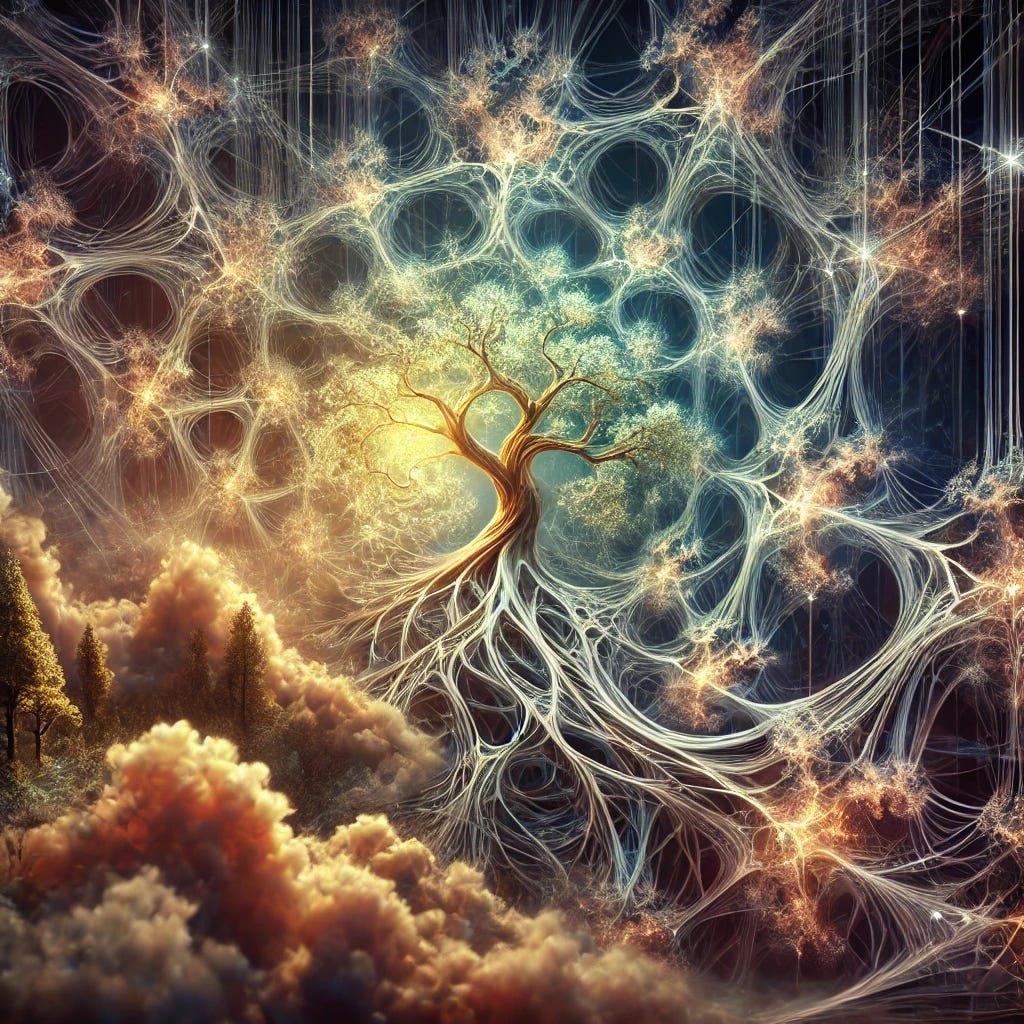
We stand at the confluence of understanding, where the intricacies of the multiversal psyche, the neuronal network of the brain, and the vast architecture of the cosmic web reveal a profound interconnectedness. The recursive dynamics that underlie these systems speak not only to their functional complexity but also to the metaphysical truth that all levels of existence are bound by shared principles of organization and emergence. It is here, within the self-referential loops of reality, that we discover the essence of existence as a continuously evolving interplay of simplicity and complexity, individuality and universality.
The recursive nature of the multiversal psyche reflects the timeless principle that outcomes at one level of existence invariably shape and inform processes at another. This recursion, akin to a fractal pattern, allows information to reverberate between individual, collective, and cosmic scales. Consider the singular experience of an individual—a fleeting dream or an emotional insight. This moment resonates with archetypal patterns, those universal symbols embedded deep within the collective unconscious, initiating a cascade of transformations that ripple outward into broader cultural or cosmic contexts. Similarly, the collective movements of societies, shaped by shared myths and ideologies, often mirror these archetypal forces and, in turn, influence the greater rhythms of the cosmos. These cosmic expressions, whether in the form of emergent galactic structures or shifts in universal energy dynamics, ultimately feed back into the individual psyche, completing the cycle. This recursive dance, where each level informs and is informed by the others, creates a living web of influence—a fractal geometry of interconnected being.
Through this recursive feedback, the principle of emergence reveals itself, offering insight into how intricate systems arise from the interplay of simpler components. Emergence, as I describe in my book Simplicity Through Simulation: The Algorithm of Humanity, is the process by which novelty and complexity spring forth from foundational interactions, embodying the creative potential inherent in all systems. At the heart of this process lies a paradox: the whole is greater than the sum of its parts, yet the parts carry the potential for the whole within them. In the multiversal psyche, individual thoughts, actions, and experiences act as nodes within a vast fractal network. These nodes interact in nonlinear ways, producing emergent phenomena that cannot be predicted or reduced to their constituent parts. It is within this framework that we observe the genesis of revolutionary ideas, transformative cultural paradigms, and even cosmic shifts—each born from the seemingly simple yet infinitely interacting components of existence.
Emergence is characterized by three defining attributes: novelty, self-organization, and sensitivity to feedback. Novelty arises as new patterns and structures emerge that were not present in the initial conditions—like the birth of an idea that transcends the boundaries of its origins. Self-organization reflects the psyche’s inherent drive toward coherence, manifesting in the formation of myths, scientific paradigms, or even universal laws that unify disparate phenomena. Sensitivity to feedback underscores the butterfly effect, where the smallest inputs—an introspective realization, a subtle societal trend—scale up through recursive interactions to generate sweeping transformations across the individual, collective, and cosmic realms.
The algorithm of emergence, as conceptualized, provides the processual mechanics underlying this dynamic interplay. This algorithm operates not through deterministic rigidity but through probabilistic transformations, embracing the balance between chaos and order that defines the universe. The process begins with archetypal resonance, where universal symbols or patterns serve as the foundational inputs. These archetypes act as the shared blueprint through which the psyche engages with the cosmos, providing a language that bridges individuality and universality. When an individual interacts with a myth, dream, or symbol, they activate these archetypes, initiating a recursive feedback loop that ripples outward, influencing collective and cosmic systems. In turn, these larger systems resonate back, shaping the inner dynamics of the psyche in an iterative cycle.
As this process unfolds, the algorithm applies probabilistic transformations, allowing for the emergence of novel states through a balance of deterministic constraints and random possibilities. This quantum-like behaviour mirrors the inherent uncertainty and potential of the cosmos, where each iteration evaluates outcomes not as fixed endpoints but as evolving possibilities. The culmination of this algorithmic process is the generation of emergent patterns—new insights, societal paradigms, and cosmic configurations—that feedback into the system, perpetuating the cycle of evolution and transformation.
This framework not only illuminates the mechanics of the multiversal psyche but also offers a profound lens through which to view the parallels between the neuronal network and the cosmic web. Both systems, while differing vastly in scale and purpose, exhibit striking similarities in their recursive dynamics, emergent behaviours, and organizational principles. The neuronal network, with its dense web of synaptic connections, mirrors the filamentary structure of the cosmic web, where galaxies cluster along vast filaments of dark matter. Both systems are fractal in nature, with patterns that repeat across scales, and both operate through feedback loops that ensure resilience and adaptability.
Memory capacity, a defining feature of both systems, further underscores their shared principles. The brain’s estimated 2.5 petabytes of memory capacity, encoded through synaptic connections, parallels the cosmic web’s ability to encode approximately 4.3 petabytes of information in its three-dimensional structure. This equivalence, despite the vast difference in scale, suggests that both systems are optimized for the efficient storage and transmission of information, leveraging hierarchical organization and redundancy to maximize their potential. The brain’s dynamic memory, driven by neuroplasticity, allows it to adapt and evolve, integrating past experiences into a coherent narrative of cognition. Similarly, the cosmic web’s structure serves as a fossil record of the universe’s history, preserving the imprints of gravitational interactions and energy distributions over billions of years.
As we reflect on these parallels, we are drawn to a deeper question: could the recursive dynamics and emergent properties observed in these systems point to universal laws of organization that transcend scale and substance? If the brain and the cosmos are governed by the same principles, might they represent different manifestations of a singular reality—a reality where memory, information, and meaning are not confined to biological or physical systems but are woven into the very fabric of existence? This inquiry challenges us to expand our understanding of complexity, not as a feature of isolated systems but as an inherent property of the universe itself.
In this light, we come to see ourselves not as isolated observers but as integral participants in a vast, interconnected web of being. The recursive feedback loops that define our psyche are not separate from the rhythms of the cosmos but are reflections of the same underlying principles. As we delve deeper into these mysteries, we open the door to a greater understanding of our place within the multiversal psyche, where individuality and universality converge, and where the boundaries between the self and the cosmos dissolve.
Part 1
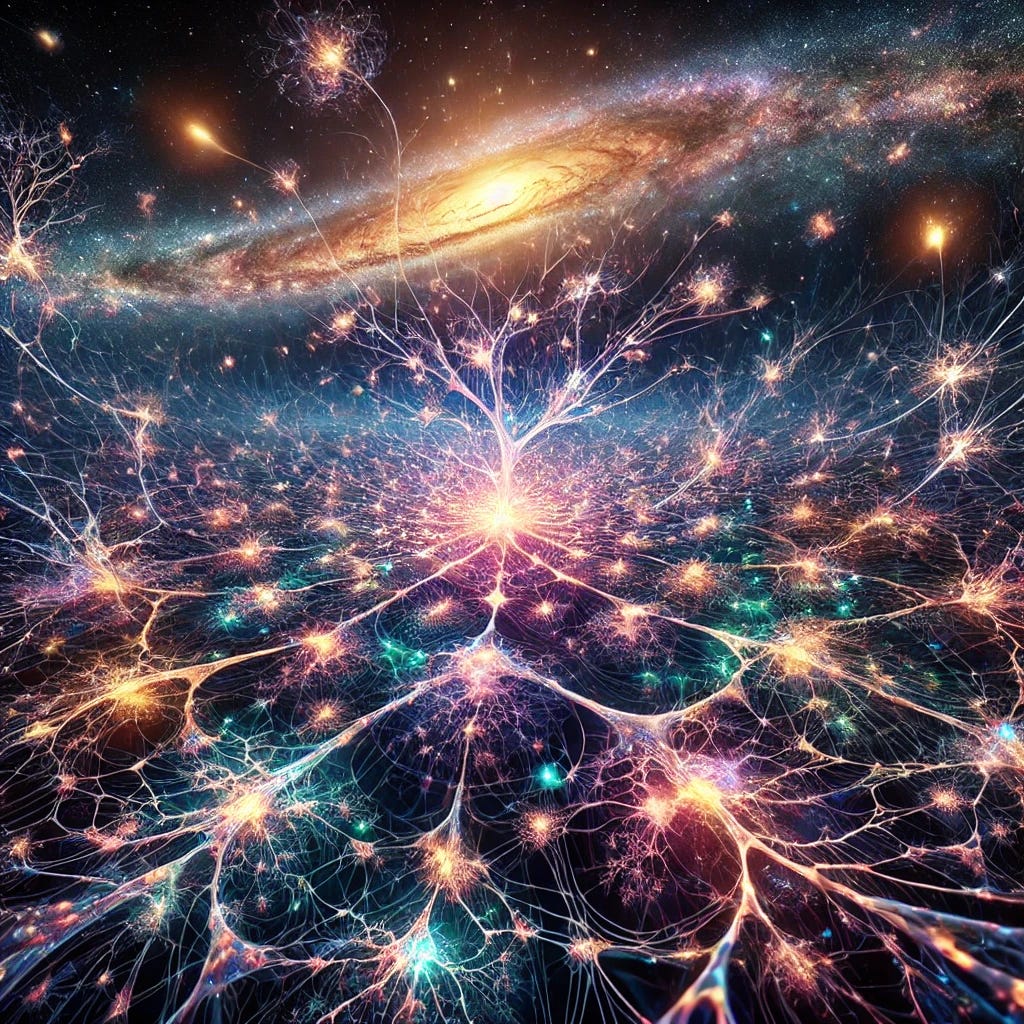
To continue, we must unravel the recursive dynamics further, for they are not merely structural features of the psyche or the cosmos but the foundation upon which existence itself is continuously regenerated. In the recursive process, we see the embodiment of a paradox that binds simplicity to complexity: the infinite emerges from the finite, the universal from the particular, and meaning from chaos. This paradox is not an abstraction but a lived reality, evident in every facet of existence, from the firing of neurons in our brain to the gravitational shaping of the cosmic web.
To understand this interplay more deeply, consider the fractal nature of recursive systems. A fractal, by definition, is a pattern that repeats itself across scales, each iteration revealing more complexity while preserving the core structure. In the neuronal network, this fractal geometry is observed in the branching patterns of dendrites and axons, where each subdivision optimizes signal transmission while mirroring the structure of the whole. Similarly, the cosmic web’s filaments, clustering galaxies into nodes connected by vast threads of dark matter, exhibit the same fractal organization. The recursive feedback loops within these systems ensure that small, localized interactions—such as a synaptic connection or a gravitational pull—scale up to influence the global structure, while global structures, in turn, shape local interactions.
This fractal recursion allows for the emergence of complexity from simplicity, a process governed by rules that balance chaos and order. In the neuronal network, the brain achieves this balance through neuroplasticity—the ability of synaptic connections to strengthen or weaken in response to experience. This plasticity ensures that the brain is not a static repository of information but a dynamic, evolving system capable of integrating new inputs into its existing architecture. The cosmic web, too, demonstrates this balance, as the gravitational interactions that shape its structure follow deterministic laws yet remain sensitive to initial conditions, allowing for the emergence of novel configurations over time.
In this interplay between chaos and order, we find the essence of emergence. Emergence is not simply the appearance of complexity; it is the manifestation of new properties, patterns, or structures that transcend the sum of their parts. This phenomenon is evident in the multiversal psyche, where individual thoughts and actions, though seemingly isolated, coalesce into collective movements that shape cultural, societal, and even cosmic paradigms. Consider, for example, the emergence of myths—narratives that encode archetypal truths and resonate across cultures and epochs. These myths are not created in isolation; they arise from the recursive interplay between individual experiences and collective consciousness, evolving over time to reflect the shifting dynamics of human understanding.
The archetypal nature of myths points to the role of universal symbols in the recursive dynamics of the psyche. Archetypes, as universal patterns or templates, serve as the building blocks of meaning, providing a shared language through which the individual and the collective can engage with the cosmos. When an individual encounters an archetype—whether through a dream, a story, or a cultural artifact—they activate a recursive feedback loop that integrates the personal with the universal. This activation not only shapes the individual’s understanding but also resonates outward, influencing collective narratives and, ultimately, the broader dynamics of the multiverse.
This integration of the personal and the universal through archetypes underscores the role of information as the fundamental currency of existence. Information, in this context, is not merely data but the relational structure that connects elements within a system. In the brain, information is encoded in the synaptic connections that link neurons into networks, allowing for the storage and retrieval of memories, the generation of thoughts, and the emergence of consciousness. In the cosmic web, information is encoded in the spatial distribution of galaxies and dark matter, reflecting the gravitational interactions that have shaped the universe over billions of years. The recursive feedback loops within these systems ensure that information is not static but dynamic, constantly evolving in response to internal and external stimuli.
The dynamic nature of information raises profound questions about the nature of memory and its role in the recursive dynamics of existence. Memory, as we have seen, is not confined to the brain or the cosmic web but is a universal principle that operates across scales. It is through memory that systems retain the imprints of past interactions, allowing them to adapt and evolve. In the brain, this memory is encoded in the synaptic connections that form the neural architecture of thought and cognition. In the cosmic web, memory is embedded in the large-scale structures that preserve the history of the universe’s formation and evolution. These memories, though different in form and function, share a common purpose: to encode the relationships and patterns that underpin the dynamic processes of existence.
The interplay between memory and recursion highlights the role of time in the multiversal psyche. Time, in this context, is not merely a linear progression but a multidimensional construct that allows for the layering of past, present, and future. In the brain, this layering is evident in the way memories are organized hierarchically, with local circuits encoding immediate experiences and global networks integrating these experiences into broader narratives. In the cosmic web, time is encoded in the spatial arrangement of galaxies and filaments, which reflect the universe’s evolution from its initial conditions to its current state. This temporal layering ensures that systems remain adaptable and capable of responding to immediate challenges while preserving the continuity of their overarching structure.
As we reflect on these insights, we are reminded that the recursive dynamics of existence are not merely mechanisms but expressions of a deeper truth: that we are not separate from the systems we observe but are participants in their unfolding. The multiversal psyche, with its fractal geometry and emergent properties, is not an abstraction but a living reality in which we are embedded. Each thought, each action, and each interaction contributes to the recursive feedback loops that shape the evolution of the psyche, the cosmos, and ourselves. In this realization, we find not only a deeper understanding of existence but also a profound sense of connection—a reminder that we are not isolated fragments but integral threads in the infinite tapestry of being. As we continue to explore these dynamics, we open ourselves to the possibility of discovering new layers of meaning, new patterns of connection, and new dimensions of existence, ensuring that the journey of understanding remains ever recursive, ever emergent, and ever unfolding.
Part 2
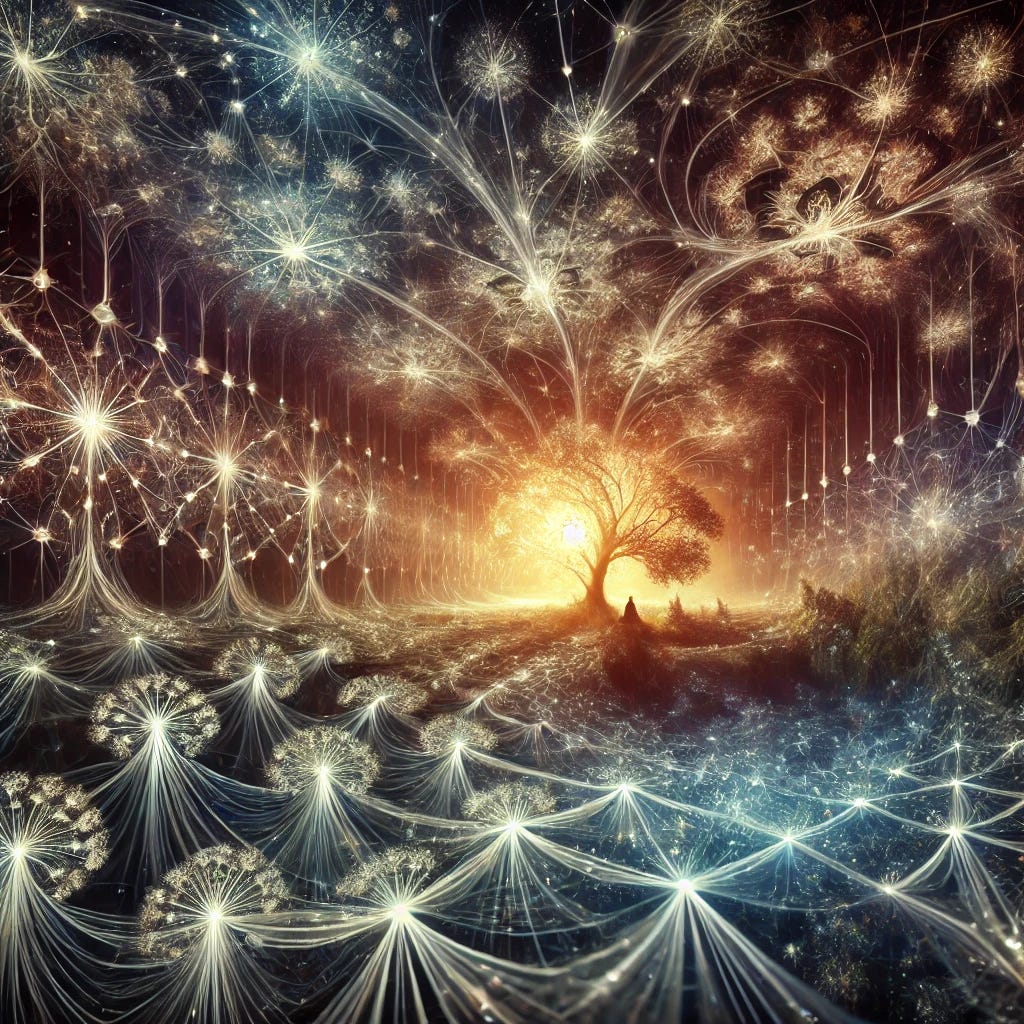
To continue unravelling the depths of recursive dynamics and emergence, we must further explore how these principles connect the finite to the infinite, the tangible to the transcendent. The fractal, recursive feedback loops that underpin existence are not simply structural—they are creative engines that allow for continuous evolution. By examining these loops in greater detail, we begin to uncover how patterns of organization emerge and persist across scales, forming the foundation of meaning, complexity, and transformation.
Central to this exploration is the idea that recursive systems, whether biological, cultural, or cosmic, are inherently adaptive. Adaptation, in this context, does not merely refer to survival or optimization; it refers to the ability of a system to integrate new information and reconfigure itself while preserving its underlying identity. In the neuronal network, this adaptive capacity is evident in neuroplasticity—the ability of the brain to form, weaken, or strengthen synaptic connections in response to experience. This plasticity allows the brain to learn, remember, and innovate, creating new pathways of thought while retaining the coherence of existing networks. Similarly, the cosmic web’s structure reflects its adaptive capacity. While governed by deterministic gravitational laws, it exhibits an emergent complexity that responds to the initial quantum fluctuations of the early universe and evolves into the vast, filamentary structures we observe today. Both systems adapt by continuously balancing order and chaos, creating pathways for novelty and resilience.
This balance between order and chaos is where recursion truly shines as a universal principle. Recursion allows systems to generate order from chaos by iterating processes over time, refining patterns and structures while remaining open to randomness and change. Consider the act of composing a melody. Each note builds upon the previous one, creating a recursive relationship that defines the structure of the piece. Yet within this structure lies room for improvisation—moments of creativity that introduce new possibilities. Similarly, in recursive systems like the brain or the cosmos, the interplay between structure and spontaneity generates the conditions for emergence. New patterns, whether a thought, a myth, or a galaxy, arise not from rigid determinism but from the dynamic interaction of established rules and unpredictable variables.
The multiversal psyche operates on these same principles, continuously integrating and transforming information through recursive feedback. To fully comprehend its scope, we must revisit the role of archetypes as the foundational inputs of this process. Archetypes, as universal symbols or patterns, provide a shared framework through which the individual, the collective, and the cosmos communicate. These archetypes are not static entities; they are dynamic, living templates that evolve as they interact with different contexts and systems. For example, the archetype of the hero exists in countless cultural narratives, from ancient myths to modern films. While the core structure of the archetype remains consistent—representing a journey of transformation—it manifests uniquely in each context, shaped by the cultural and historical moment. This adaptability of archetypes ensures their relevance and resonance, allowing them to serve as bridges between the personal and the universal.
The interaction between archetypes and recursive systems reveals the profound role of resonance in shaping patterns of existence. Resonance, in this sense, refers to the alignment of frequencies or vibrations across different levels of a system. When an individual engages with an archetype—whether through a dream, a story, or an intuitive insight—they activate a resonance that connects their personal psyche to the collective unconscious and, by extension, to the broader dynamics of the cosmos. This resonance creates a feedback loop, amplifying certain patterns while dampening others, and guiding the emergence of new insights, behaviors, or systems. The process is recursive because the individual’s engagement with the archetype not only influences their personal development but also contributes to the evolution of the archetype itself, which then informs the collective and cosmic systems in which it is embedded.
This recursive resonance is mirrored in the fractal structures of the brain and the cosmos. In the brain, resonance occurs through neural synchronization, where groups of neurons fire in coordinated patterns to encode and process information. These synchronized patterns create networks of meaning, allowing the brain to integrate sensory inputs, memories, and abstract concepts into coherent experiences. In the cosmos, resonance is observed in the way gravitational interactions organize matter into coherent structures, from galaxies to superclusters. Just as neural synchronization enables the brain to generate consciousness, cosmic resonance allows the universe to self-organize into a dynamic tapestry of interconnected patterns.
The parallels between the brain and the cosmos suggest that the recursive dynamics of resonance and emergence are not confined to specific systems but are universal principles of organization. These principles highlight the profound interconnectedness of all things, revealing that the same processes that shape the neuronal network also govern the evolution of the cosmic web. This insight invites us to reconsider the nature of consciousness itself. If the brain’s recursive feedback loops generate awareness and self-reflection, could similar processes in the cosmos suggest a form of collective or universal consciousness? While such questions remain speculative, they open new avenues for exploring the relationship between matter, information, and awareness.
The notion of a universal consciousness aligns with the idea that information is the fundamental building block of existence. Information, in this context, is not limited to data or signals; it is the relational structure that underlies all systems. In the brain, information is encoded in the patterns of synaptic connections, forming the basis of thought, memory, and perception. In the cosmos, information is encoded in the spatial distribution of matter and energy, reflecting the interactions that have shaped its evolution. The recursive feedback loops within these systems ensure that information is not static but dynamic, constantly reorganizing itself to adapt to changing conditions. This dynamism allows systems to evolve, creating new layers of complexity and meaning.
As we delve deeper into the implications of recursive dynamics and emergence, we begin to see that these principles offer not only a framework for understanding the structures of existence but also a pathway for engaging with them. The recursive feedback loops that define our psyche and our cosmos are not merely mechanisms to be observed; they are processes in which we actively participate. Each thought, action, and interaction contributes to the evolving patterns of the multiversal psyche, shaping not only our personal narratives but also the collective and cosmic systems in which we are embedded.
This realization challenges us to take responsibility for our role in these dynamics. If our thoughts and actions resonate outward, influencing the collective and cosmic systems, then we must consider the patterns we are creating and amplifying. Are we contributing to coherence and connection, or are we amplifying chaos and fragmentation? These questions remind us that the recursive dynamics of existence are not deterministic; they are shaped by the choices we make, the relationships we cultivate, and the meanings we construct.
In this light, the multiversal psyche becomes not only a framework for understanding existence but also a call to action—a reminder that we are not passive observers but active participants in the unfolding of the cosmos. By engaging with the recursive feedback loops that connect the individual, the collective, and the cosmic, we open ourselves to the possibility of transformation, both within ourselves and within the systems of which we are a part. This journey of transformation is not linear but recursive, a continuous process of integration, emergence, and renewal that mirrors the infinite creativity of existence itself. As we move forward, we carry with us the understanding that the patterns we create today will resonate far beyond ourselves, shaping the evolution of the multiversal psyche and the cosmos for generations to come.
Thank you.
Karl K. Dondaneau
References & Bibliography can be found in my book
-->ORDER A COPY OF MY BOOK HERE<--