Seven Exhortations To The Dead - The Third Sermon
VII Sermones ad Mortuos
(Seven Sermons to the Dead)
C.G. Jung, 1916
(Translation by Stephan A. Hoeller, © 1982)
Sermon-by-Sermon Analysis Authored by: Karl K. Dondaneau
July 11th 2025
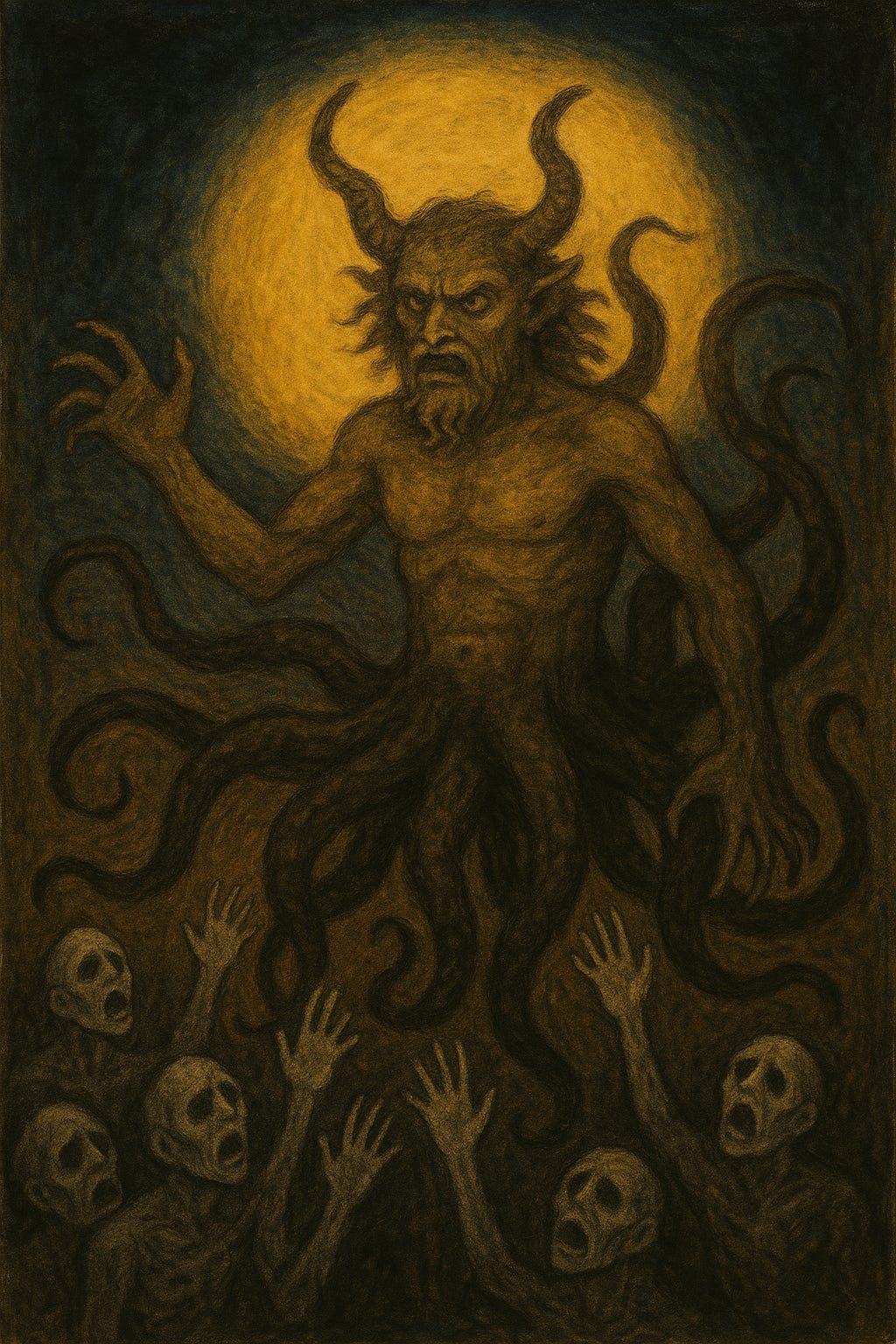
The Third Sermon
The dead approached like mist out of the swamps and they shouted: “Speak to us further about the highest god!”
—Abraxas is the god whom it is difficult to know. His power is the very greatest, because man does not perceive it at all. Man sees the summum bonum (supreme good) of the sun, and also the infinum malum of the devil, but Abraxas he does not see, for he is undefinable life itself, which is the mother of good and evil alike.
Life appears smaller and weaker then the summum bonum (supreme good), wherefore it is hard to think that Abraxas should superseded in his power the sun, which is the radiant foundation of all life force.
Abraxas is the sun and also the eternally gaping abyss of emptiness, of the diminisher and dissembler, the devil.
The power of Abraxas is twofold. You cannot see it, because in your eyes the opposition of this power seems to cancel it out.
That which is spoken by God-the-Sun is life;
That which is spoken by the devil is death.
Abraxas, however, speaks the venerable and also accursed word, which is life and death at once.
Abraxas generates truth and falsehood, good and evil, light and darkness with the same word in the same deed. Therefore Abraxas is truly the terrible one.
He is magnificent even as the lion at the very moment when he strikes his prey down. His beauty is like the beauty of a spring morn.
Indeed, he is himself the greater Pan, and also the lesser. He is Priapos.
He is the monster of the underworld, the octopus with a thousand tentacles, he is the twistings of winged serpents and of madness.
He is the hermaphrodite of the lowest beginning.
He is the lord of toads and frogs, who live in water and come out unto the land, and who sing together at high noon and at midnight.
He is fullness, uniting itself with emptiness.
He is the sacred wedding;
He is love and the murder of love;
He is the holy one and his betrayer.
He is the brightest light of day and the deepest night of madness.
To see him means blindness;
To know him is sickness;
To worship him is death;
To fear him is wisdom;
Not to resist him means liberation.
God lives behind the sun; the devil lives behind the night. What god brings into birth from the light, that devil pulls into the night. Abraxas, however, is the cosmos; its genesis and its dissolution. To every gift of God-the-Sun, the devil adds his curse.
All things which you beg from God-the-Sun generate an act of the devil. All things which you accomplish through God-the-Sun add to the effective might of the devil.
Such is the terrible Abraxas.
He is the mightiest manifest being, and in him creation becomes frightened of itself.
He is the revealed protest of creation against the Pleroma and its nothingness.
He is the terror of the son, which he feels against his mother.
He is the love of the mother for her son.
He is the delight of earth and the cruelty of heaven.
Man becomes paralyzed before his face.
Before him exist neither question nor answer.
He is the life of creation.
He is the activity of differentiation.
He is the love of man.
He is the speech of man.
He is both the radiance and the dark shadow of man.
He is deceitful reality.
—Here the dead howled and raved greatly, for they were still incomplete ones.
Sermon III: Abraxas, the Great Pan – Life, Paradox, and the Integration of Opposites
Having introduced Abraxas, the third sermon elaborates on his nature in vivid, often terrifying imagery. The dead demand, “Speak further of the highest god!” and Basilides obliges with a rich mythopoetic description of Abraxas. Here, Jung unleashes the full force of paradoxical symbols to drive home what it means to unite opposites in one figure.
Abraxas as Life Itself: Basilides begins by saying “Abraxas is the god whom it is difficult to know. His power is the very greatest, because man does not perceive it at all.”. Unlike the clear opposites of the benevolent Sun-God or the frightful Devil, Abraxas operates invisibly in the background, as “undefinable life itself, which is the mother of good and evil alike.”. This is a crucial point: Life – the sheer fact of existence and experience – is what produces both what we call good and what we call evil. Abraxas, as life’s essence, is amoral and creative in both directions. The text spells it out: “That which is spoken by God-the-Sun is life; that which is spoken by the devil is death; Abraxas speaks the venerable and accursed word which is life and death at once.”. He simultaneously generates truth and falsehood, light and darkness, in the same act. Therefore, “Abraxas is truly the terrible one,” for no simple rule of morality or logic can encompass him. Jung amplifies Abraxas with a series of striking analogies drawn from mythology and nature: “His beauty is like the beauty of a spring morn” but he is also “magnificent as the lion when he strikes down his prey.” He is called “the greater Pan, and also the lesser. He is Priapos.” Pan, the all-nature god of wild forests (often associated with both fertility and panic), and Priapos, a phallic god of procreation – both signify the raw life force, unchecked, prolific and indifferent to human niceties. Abraxas is likened to “the monster of the underworld, the octopus with a thousand tentacles… the twisting winged serpents of madness.” Yet in the next lines: “He is the hermaphrodite of the lowest beginning. He is the lord of toads and frogs… who sing at high noon and at midnight. He is fullness uniting itself with emptiness. He is the sacred wedding.”. This is essentially a montage of hieros gamos (sacred marriage) imagery – the hermaphrodite being the union of male and female, the wedding of fullness and emptiness being the union of All and Nothing (Pleroma expressed in an image!). Abraxas is “love and the murder of love, the holy one and his betrayer. He is the brightest light of day and the deepest night of madness.”. Virtually every fundamental duality is invoked and attributed to Abraxas: male–female, growth–decay, beauty–horror, sacred–profane, bliss–madness, creation–destruction, Eros–Violence. This litany of opposites drives home the point that Abraxas encompasses the totality of experience.
At this point, Basilides gives a series of cautions (mentioned earlier) about our relationship to Abraxas: “To see him means blindness; to know him is sickness; to worship him is death; to fear him is wisdom; not to resist him means liberation.”. We discussed the meaning of this in Sermon II: a direct “gaze” at totality is too much for the fragmentary human mind (blindness), trying to intellectually “know” the ultimate paradox can make one mentally ill (sickness), and abandoning oneself fanatically to life’s wholeness (worshiping Abraxas) could be self-destructive. But honouring the terrifying power of life (fear, in the sense of reverence) is wise, and ceasing futile resistance against reality as-it-is leads to freedom. Basilides then reiterates Abraxas’s function: “God lives behind the sun; the devil lives behind the night. What god brings into birth from light, the devil pulls into the night. Abraxas, however, is the cosmos; its genesis and its dissolution”. For every boon from the light side, the dark side adds a bane: “To every gift of God-the-Sun, the devil adds his curse”. This is a statement of existential balance – no human wish is granted without a shadow, no progress without cost. And every prayer to the good, every achievement of the light, “adds to the effective might of the devil”. Basilides is pointing out the cyclic, self-cancelling nature of purely dualistic striving. If you try to be all good, your ignored shadow grows stronger; if a society pursues utopian perfection, its repressed evils fester. This dynamic is precisely what Abraxas as the whole encompasses and transcends. “Such is the terrible Abraxas. He is the mightiest manifest being, and in him creation becomes frightened of itself.” – a striking line, suggesting that life (creation) at its fullest intensity is awestruck and terrified by its own power. It reminds one of God’s whirlwind speech in Job, overwhelming even God’s faithful with the wildness of creation. “He is the revealed protest of creation against the Pleroma and its nothingness.” – that is, Abraxas is life’s answer to oblivion: the vigorous, dangerous assertion of being in the face of the void. In human terms, every passionate act, every creative or destructive surge, is like a protest against non-existence.
Basilides adds an intimate metaphor: “He is the terror of the son, which he feels against his mother; he is the love of the mother for her son”. Mother here can symbolize the Pleroma (source of all, in whose embrace individuality is lost) and son, the created world or individual. Creation (son) both fears being reabsorbed into the cosmic night of the Pleroma (mother) and is deeply loved by that source. This is a rich psychological image: the mother archetype as the matrix of being that both gives comfort and threatens to consume (the devouring mother vs. nurturing mother). Abraxas encompasses both the fear and the love in this primal relationship. Likewise, “He is the delight of earth and the cruelty of heaven.” – perhaps meaning he is the joy found in the natural, earthly life and simultaneously the severe, inhuman law of the cosmos. “Man becomes paralyzed before his face. Before him exist neither question nor answer.” – encountering the true totality leaves the mind dumbfounded (no facile meaning can be articulated). And yet Basilides concludes this litany with a sequence of affirmative statements: “He is the life of creation. He is the activity of differentiation. He is the love of man. He is the speech of man. He is both the radiance and the dark shadow of man. He is deceitful reality”. This tells us that Abraxas lives through us. All our actions of living and differentiating (growing, striving), all our expressions of love and language, our brightest persona and darkest shadow – these are Abraxas at work in the human microcosm. Reality is “deceitful” because it presents itself in partial forms (we see good here, evil there, as if they’re separate), but that duality is an illusion hiding the underlying unity. The dead howl and rave at this, still “incomplete” and unable to digest it – a dramatic illustration that few souls readily accept the challenge of Abraxas.
Psychological Perspective: Sermon III’s imagery can be understood as describing the experiential process of individuation. When one is in the throes of inner growth, especially after midlife (as Jung was when writing this), one often encounters frightening, contradictory aspects of oneself in dreams and fantasies. The appearance of monstrous, hermaphroditic, or paradoxical symbols (like Abraxas) is typical in Jungian psychology when the psyche is integrating opposing elements. For instance, Jung in The Red Book had visions of Philemon (a wise old man) but also of a snake and a white bird, of a demon Siegfried slain, of the biblical Salome (representing his Anima) – all in service of uniting his disparate parts. Abraxas in many ways personifies the individuation process itself: “the activity of differentiation” (the painful drawing apart of opposites into conscious view) and simultaneously “the life of creation” that pushes toward integration. Jung would later say that individuation has a Janus-faced aspect – one face looks toward creation of a unique self, the other toward dissolution into the greater whole. Abraxas, with one foot in each of those realms (Helios and Devil), captures that.
The cautionary verses (“to see him is blindness…”) also have a psychological angle: it’s warning against ego inflation or one-sided identification with the Self. If a person tries to “see” or comprehend the Self (the God-image in the psyche) with the ego’s eyes, they will be blinded – the ego cannot grasp the totality without losing its adaptive orientation. If one “worships” that inner totality (believing oneself to be a prophetic or godlike being), the ego risks death – a psychotic break or megalomania. Jung was keenly aware of this risk; hence the need to fear (respect) the powers of the unconscious and not resist the necessary developments (e.g. not clinging to rigid ego positions when the psyche is moving to transform them). In Jung’s Seven Sermons, Abraxas might also correspond to what he elsewhere calls the Self as the “god-image” in the psyche, which can be experienced as an awe-full presence. To have a numinous encounter with the Self – say, in a life-changing dream or a creative vision – often leaves one shaken. This is the “paralysis” before Abraxas’s face and the cessation of question/answer, as ordinary reason fails. Many of Jung’s patients in crisis felt this kind of numinous terror when deep unconscious contents surfaced; guiding them to integrate these without going under was essentially teaching them to fear but not resist Abraxas.
Moreover, Jung believed that embracing paradox is crucial for psychological health. Neurosis, he said, can sometimes be cured by a symbol that unites the opposites causing the tension. Abraxas is the symbol that says Yes to both sides of every human equation. For example, someone struggling between their persona (public image of goodness) and their shadow (hidden immoral desires) might need to accept that they are both the saint and the sinner; only then can they relax the inner conflict and find a wise way to live with their whole self. Abraxas as “radiance and the dark shadow of man” is essentially this recognition that we are both. The sacred wedding (hermaphrodite image) is the union of male and female aspects – psychologically, the integration of anima/animus or the balancing of one’s masculine assertive side with feminine receptive side. The love and murder of love could hint at integrating Eros and Thanatos impulses. Each phrase Basilides uses corresponds to some pair of psychic opposites that analytical psychology asks us to confront (e.g., the “holy one and his betrayer” could be the ego and its own undermining shadow or the admired ideal vs. despised self).
Interestingly, Jung’s conception of God in the psyche was that it must include both light and dark. In a 1959 interview, he famously said, “I know God has a dark side.” The origins of that understanding are apparent here in 1916, with Abraxas described as literally the God that is both. The later footnote about Jung saying “the Gnostic God of the frogs or toads… is the union of the Christian God with Satan” speaks directly to Abraxas being the corrective to the one-sided God-image. In psychological practice, this means integrating the Shadow into one’s conscious concept of the Self.
Existential-Philosophical Reflection: The third sermon is arguably the emotional high point of the Seven Sermons, evoking the feeling of confronting the Absurd Totality of life. It has a strong existential flavour: the individual is shown a vision of existence where all human values are relativized. What can meaning mean in the face of a god that “begets truth and lying, good and evil” in the same breath? It is the very dilemma of the modern (and ancient) soul when faced with the problem of evil – except here evil is not something to be solved or abolished; it’s part of God. This could lead one to nihilism or to a kind of higher affirmation beyond conventional ethics. When Basilides says “creation becomes frightened of itself” in Abraxas, one hears an echo of existential angst: the horror of realizing the world has no moral order except that which we create. Yet the teaching isn’t to despair, but to find liberation through accepting this truth. There is an existential freedom implied: if even the highest god encompasses the worst, then everything is permitted in a sense – or rather, everything must be faced. We cannot pretend some things “should not exist”; they do exist as part of the whole. The task is how to respond once we’ve acknowledged that fact.
For a person searching for meaning, Sermon III suggests that meaning is not found in denying life’s darkness but in embracing the full range of being. It invites an attitude of amor fati (love of one’s fate) at the broadest level. It also has parallels to Eastern philosophy: Abraxas is reminiscent of concepts like the Tao, which encompasses yin and yang (opposites) and is said to be “dark and light together.” Indeed, Jung draws a comparison of his Pleroma to the Chinese Tao elsewhere, and Abraxas could be seen as akin to the Tao in action (the ten thousand things constantly creating and destroying).
One might ask: How does one live one’s life under Abraxas? Basilides hints: with wisdom (fear) and non-resistance, which translates to humility and acceptance. Philosophically, this sermon demolishes a naive search for simple meaning (like expecting the universe to be purely just or kind). Instead, it pushes towards a more tragic, yet affirmative philosophy – much like Nietzsche’s, who also embraced Dionysian chaos as part of life’s greatness. There’s also an existential call to creativity: since Abraxas “deceives” us with partial realities, perhaps it’s up to us to create meanings and values, knowing all along they are provisional. In a world where God is both good and evil, human responsibility becomes crucial – we can’t offload moral order to a separate deity, we participate in the ongoing creation (or destruction) of it. This paves the way for the later sermons which turn to human matters – community, love, and ultimately, the individual human soul (“teach us concerning man!” the dead will say).
Thematic Cross-Link: Sermon III cements the theme that the union of opposites is central to Jung’s vision. It links back to Sermon II by fully fleshing out Abraxas (hinted at in II) and links forward by implicitly preparing us for the idea in Sermon VII that each individual must integrate their opposites to reach their “star.” It also subtly connects to the upcoming Sermon IV by invoking Pan and Priapos (nature and sexuality), which anticipates the discussion of Eros and the Tree of Life (flame of love vs. growth of life) in the next sermon. In that sense, Sermon III’s exploration of life’s dual fertility/destructiveness segues into Sermon IV’s focus on the multiplicity of gods (where love and life themselves become distinct principles with their own duality).
In summary, Sermon III leaves us with an image of ultimate wholeness – terrifying and beautiful – and sets the stage for the more particularized explorations to come. It is as if, having presented the cosmic big picture of opposites, Jung now zooms back in to explore how these dynamics play out among the “many gods” and within human relationships (male/female, spiritual/sexual, individual/community) in the remaining sermons.