Seven Exhortations To The Dead - The Second Sermon
VII Sermones ad Mortuos
(Seven Sermons to the Dead)
C.G. Jung, 1916
(Translation by Stephan A. Hoeller, © 1982)
Sermon-by-Sermon Analysis Authored by: Karl K. Dondaneau
July 10th 2025
The Second Sermon
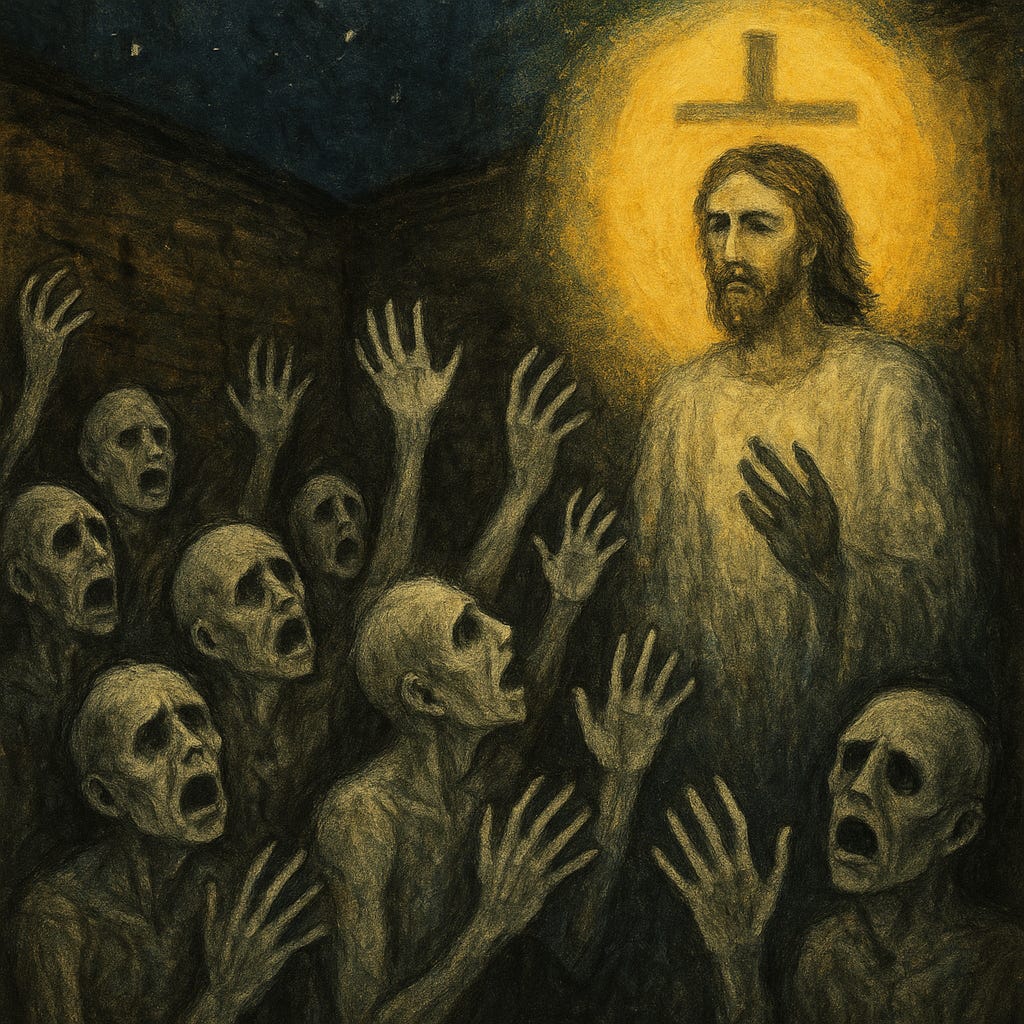
During the night the dead stood along the walls and shouted: “We want to know about God! Where is God? Is God dead?”
—God is not dead; he is as much alive as ever. God is the created world, inasmuch as he is something definite and therefore he is differentiated from the Pleroma. God is a quality of the Pleroma and everything that I have stated in reference to the created world is equally true of him.
God is distinguished from the created world, however, inasmuch as he is less definite and less definable than the created world in general. He is less differentiated than the created world, because the ground of his being is effective fullness; and only to the extent that he is definite and differentiated is he identical with the created world; and thus he is the manifestation of the effective fullness of the Pleroma.
Everything we do not differentiate falls into the Pleroma and is cancelled out along with its opposite. Therefore if we do not discern God, then the effective fullness is cancelled out for us. God also is himself the Pleroma, even as the smallest point within the created world, as well as within the uncreated realm, is itself the Pleroma.
The effective emptiness is the being of the Devil. God and Devil are the first manifestations of the nothingness, which we call the Pleroma. It does not matter whether the Pleroma is or is not, for it cancels itself out in all things. The created world, however, is different. Inasmuch as God and Devil are created beings, they do not cancel each other out, rather they stand against each other as active opposites. We need no proof of their being; it is sufficient that we must always speak about them. Even if they did not exist, the created being would forever (because of its own differentiated nature) bring them forth out of the Pleroma.
All things which are brought forth from the Pleroma by differentiation are pairs of opposites; therefore God always has with him the Devil.
This interrelationship is so close, as you have learned, it is so indissoluble in your own lives, that it is even as the Pleroma itself. The reason for this is that these two stand very close to the Pleroma, in which all opposites are cancelled out and unified.
God and Devil are distinguished by fullness and emptiness, generation and destruction. Activity is common to both. Activity unites them. It is for this reason that activity stands above both, being God above God, for it unites fullness and emptiness in its working.
There is a God about whom you know nothing, because men have forgotten him. We call him by his name: ABRAXAS. He is less definite than God or Devil. In order to distinguish God from him we call God HELIOS, or the Sun.
Abraxas is activity; nothing can resist him but the unreal, and thus his active being freely unfolds. The unreal is not, and therefore cannot truly resist. Abraxas stands above the sun and above the devil. He is the unlikely likely one, who is powerful in the realm of unreality. If the Pleroma were capable of having a being, Abraxas would be its manifestation.
Although he is activity itself, he is not a particular result, but result in general.
He is still a created being, inasmuch as he is differentiated from the Pleroma.
The sun has a definite effect and so does the devil; therefore they appear to us more effective that the undefinable Abraxas.
For he is power, endurance, change.
—At this point the dead caused a great riot, because they were Christians.
Sermon II: God, the Devil, and Abraxas – The First Opposites and the Unknown God Above Them
Core Concepts – Opposites Emerge: In the second sermon, the dead cry out for knowledge of God, asking, “Where is God? Is God dead?” – an echo of the modern crisis of faith. Basilides responds that God is “as alive as ever”, but radically redefined: “God is the created world, inasmuch as he is something definite and therefore differentiated from the Pleroma.” In other words, what we call God is not the Pleroma’s transcendent void, but the firstborn quality out of it – the Sum of all definite being. However, this God (Helios) does not stand alone. Alongside God arises the Devil – the principle of emptiness, negation, and destruction. Basilides explains that all differentiation from the Pleroma produces pairs of opposites. Thus, God (the ultimate Good, fullness, creator) is accompanied by the Devil (the ultimate Evil, emptiness, destroyer) as an indissoluble pair. “God and Devil are the first manifestations of the nothingness which we call the Pleroma,” he teaches, being “created beings, they do not cancel each other out”, but rather “stand against each other as active opposites”. The text emphasizes that as soon as you have a concept of a supreme good (“summum bonum”), you automatically have its counterpart, a deepest evil (“infinum malum”). Indeed, Jung observed that traditional Christianity’s one-sided insistence on God as all-good paradoxically brought forth a powerful counterpole of evil. The sermon explicitly states that “even if [God and Devil] did not exist, the created being would forever bring them forth out of the Pleroma” – meaning that as long as there is a world of form and distinction, it will always generate polar opposites like light and dark, order and chaos, life and death. Basilides goes so far as to chide the living for “substituting the oneness of God for the diversity that cannot be resolved into one”, calling it a source of torment and incomprehension. This is a bold critique of monotheistic absolutism: by denying the Devil (evil, darkness) any reality of its own, one creates an unbalanced worldview that “mutilates the essence of the created world, which is diversity”. We see here Jung’s firm conviction that opposites are both real and necessary. God (as ultimate meaning, goodness, life) needs the Devil (meaninglessness, evil, death) in order for either to exist at all. They are “so close” as to be nearly one, distinguished only by polarity (fullness vs. emptiness, creation vs. destruction). What unites them is Activity: both God and Devil act, creating and destroying, and “activity unites them”. Here, Basilides introduces a mysterious third term – an unknown God that stands above even God and Devil, embodying this uniting activity itself.
The God Abraxas – Beyond Good and Evil: The second sermon’s climax is the revelation of Abraxas, “the god whom men have forgotten”, described as “God above God”. Abraxas is less definite than the Christian God or the Devil; indeed, Basilides says, “if the Pleroma could have a being, Abraxas would be it”. By naming Abraxas as the only deity higher than the familiar duality of Heaven and Hell, Jung resurrects an ancient Gnostic concept to represent the ultimate unity of all opposites. Abraxas is characterized as pure Activity – the creative process itself, rather than any particular result or form. “Nothing can resist him but the unreal,” since only non-existence does not eventually yield to the force of life and change that Abraxas embodies. He is called “the unlikely likely one, who is powerful in the realm of unreality”. These paradoxical epithets imply that Abraxas rules over the threshold between being and non-being, making the impossible possible. Abraxas “stands above the sun (God) and above the devil”, encompassing both. We might say Abraxas is the Whole to which God and Devil are parts or aspects. In Jung’s psychological language, Abraxas personifies the Self – the totality of the psyche that includes both conscious light and unconscious darkness. Indeed, commentators note that “Abraxas serves as a powerful symbol of the Self, the totality of the psyche that transcends the dualistic categories of the ego.” He reconciles what we normally experience as irreconcilable: “the union of opposites, the reconciliation of good and evil, masculine and feminine, conscious and unconscious.” This is why Basilides calls him “the god about whom you know nothing”: human beings do not naturally perceive the unity behind opposites – our eyes see either the bright Helios (God-the-Sun) or the dark Devil, and our minds tend to split reality into either/or. We miss the both/and, the third thing that encompasses the pair. Abraxas is that third thing, the coincidentia oppositorum (coincidence of opposites). Jung later commented that the figure of Abraxas is “exceedingly paradoxical, always yea and nay… it means the beginning and the end, it is life and death”, and it is depicted as a monstrous being because it symbolizes the union of all that we fear and adore.
It is significant that Jung chose the name Abraxas, which in Gnostic lore was associated with the Supreme Archon or even a cosmic creator above Jehovah. The word’s letters famously add up to 365 (the days of the year), linking Abraxas to the wholeness of the solar cycle. Jung knew these historical connotations, and in 1932 he described Abraxas as “the Gnostic symbol… a time god… an expression of the same idea” as Bergson’s élan vital or creative evolutionary force. In Jung’s Red Book mandalas, Abraxas appears as a fusion of disparate elements (often illustrated with a rooster’s head, human torso, and serpent legs) – an image of total integration. Philosophically, Abraxas represents a monistic reality in which the dialectical tension of opposites is resolved by being held together. Whereas conventional thinking (and moral theology) demand we choose one side (worship God, reject the Devil), Basilides presents Abraxas as “the whole cosmos; its genesis and its dissolution”. This means that everything – both creation and destruction, joy and terror – is part of a single grand process. It is a view that can be both awe-inspiring and frightening in its implications.
Psychological Perspective: In Jungian terms, the appearance of Abraxas signals the need to integrate the Shadow and other opposites into a higher unity. Jung believed that Western consciousness was one-sided – identifying with “God-the-Sun” (the bright, good, rational side) and repressing the “Devil” (the dark, evil, irrational side). The result of such repression is often a dissociation of the personality and a loss of wholeness. Abraxas, as the forgotten god, is essentially the forgotten wholeness of the psyche – that which includes our Shadow (all we fear or reject) along with our light. The text explicitly says “Abraxas stands above the sun[-god] and above the devil”, uniting fullness and emptiness. This anticipates Jung’s later arguments (in Aion and Answer to Job) that the Self (often symbolized by a God-image) must include both goodness and its dark counterpart for true psychic integration. In effect, Basilides is teaching the dead (and us) that divinity is not exclusively light – the divine totality is light-dark, creative-destructive. This is a direct challenge to naive or orthodox views of God. It carries an implicit psychological advice: do not seek one-sided perfection. One must confront and accept the reality of evil and chaos as inherent aspects of life. Jung’s concept of the transcendent function – the process by which a new unifying symbol or attitude emerges from the tension of opposites in the psyche – is exemplified in Abraxas. We can see Abraxas as the outcome of holding the tension between God and Devil until a new resolution forms. He is the “third” that transcends the pair, much as the transcendent function produces a new insight that reconciles a neurotic conflict between opposed thoughts/impulses. “Activity is the god above both God and Devil, for it unites fullness and emptiness in its working,” the sermon says. This “activity” is essentially the psyche’s self-regulating drive toward wholeness – Jung’s individuation impulse. In fact, a commentary in The Red Book archives notes: “Abraxas [is] a representation of the driving force of individuation (synthesis, maturity, oneness),” whereas Helios (God) and the Devil represent the forces of differentiation (the emergence of opposites and conflict in consciousness). In Jungian therapy, one often experiences a period where the ego is torn between irreconcilable opposites (say, duty vs. desire, or persona vs. shadow). Resolution comes not by choosing one or eliminating the other, but by a creative leap to a larger perspective that holds both – symbolized by, perhaps, a meaningful dream image or a unifying idea. Abraxas is exactly such a “meaningful symbol” of unity arising from conflict.
Philosophical and Existential Reflection: The introduction of Abraxas carries profound existential implications. It posits that the ultimate reality of life is amoral and paradoxical – a terrifying and sublime mixture of all that we call good and all that we call evil. Basilides even says, “to truly see Abraxas means blindness; to know him is sickness; to worship him is death – to fear him, however, is wisdom, and not to resist him is liberation.”. This dramatic admonition suggests that a direct encounter with totality is overwhelming for the human mind (hence blindness, madness, or ego-death), but recognizing the existence and power of that totality is the beginning of wisdom. And rather than resisting the interplay of opposites (which is futile, since they generate each other), we find freedom by yielding to the reality of their coexistence. In practical terms, this might mean accepting that life will inevitably bring sorrow with joy, loss with gain – and that one’s soul grows not by clinging to one pole but by experiencing and integrating both. This existential stance resonates with the concept of amor fati (love of fate) in Nietzsche or the “acceptance of the Absurd” in Camus. It calls for a courageous acceptance of life’s dualities. Basilides calls Abraxas “the terrible one”, describing images of predation and chaos – “the lion who strikes down its prey,” “the monster of the underworld… madness,” “the hermaphrodite of the lowest beginning”. Yet in the same breath, Abraxas is “magnificent” and “like the beauty of a spring morn”. This juxtaposition of horror and beauty captures the sublime nature of reality: creation is both cruel and wondrous. Philosophically, this challenges simplistic ethical or religious narratives. It suggests a kind of pantheistic or panentheistic view: everything that happens – even the most accursed things – are part of God/Abraxas. For a human seeking meaning, this is a double-edged sword. On one hand, it can lend meaning to suffering (“it’s all part of the Whole”); on the other, it removes the guarantee of an all-good providence (since God itself has a dark side). The dead, being Christians, riot at this teaching, implying how scandalous it is to conventional morality. Jung is exploring the shadow of God here, a theme he would address explicitly in Answer to Job. From an existential perspective, one might hear echoes of Nietzsche’s Dionysian worldview in Abraxas – the idea that true affirmation of life means saying “Yes” not only to its light aspects but to the “whole catastrophe” of existence.
Importantly, Basilides does not advise worshiping Abraxas (which he equates to death). Instead, “fear him” (have the respectful awe that acknowledges his power) and “do not resist him” (do not futilely fight the nature of reality) – these lead to wisdom and liberation. This attitude sounds akin to a balanced spirituality that neither cringes from life’s darkness nor naively embraces it, but stands in awe and acceptance of the Whole. In practical life, it might mean: do not reject your suffering or your darker impulses out of hand (that’s resisting Abraxas), but learn from them; equally, do not be so entranced by life’s pleasures and ideals that you deny the existence of their opposites. The dialectic between opposites is to be understood and respected. Abraxas thus invites a holistic approach to meaning: meaning is not found in a one-sided pursuit of goodness or rational order alone, but in the integration of the chaotic, painful, or irrational elements of life into a larger understanding of what it is to be alive.
Thematic Cross-Link: Sermon II sets up the fundamental triad that will underlie the remaining sermons: the dynamic between a thesis (God/light), its antithesis (Devil/dark), and a synthesis or reconciling symbol (Abraxas). We will see this theme of opposites seeking unity recur in different guises. For instance, in later sermons Jung will personify other dualities (love vs. life, male vs. female, spirit vs. flesh) and hint at their ultimate union in the human soul. Already in Sermon II-III, Basilides has given us the grand cosmic version of this pattern. We should also note that the figure of Abraxas – bridging the divine and diabolic – foreshadows the final sermon’s “solitary star”, which represents each individual’s personal unity and guiding divinity. Jung is planting the idea that above the pairs of opposites stands a higher wholeness, and that the path of individuation is about moving toward that wholeness (one’s Self). In the next sermon, he will delve even deeper into the character of Abraxas, further illuminating how this principle manifests in our psychology and experience.