Seven Exhortations To The Dead - The Fourth Sermon
VII Sermones ad Mortuos
(Seven Sermons to the Dead)
C.G. Jung, 1916
(Translation by Stephan A. Hoeller, © 1982)
Sermon-by-Sermon Analysis Authored by: Karl K. Dondaneau
July 12th 2025
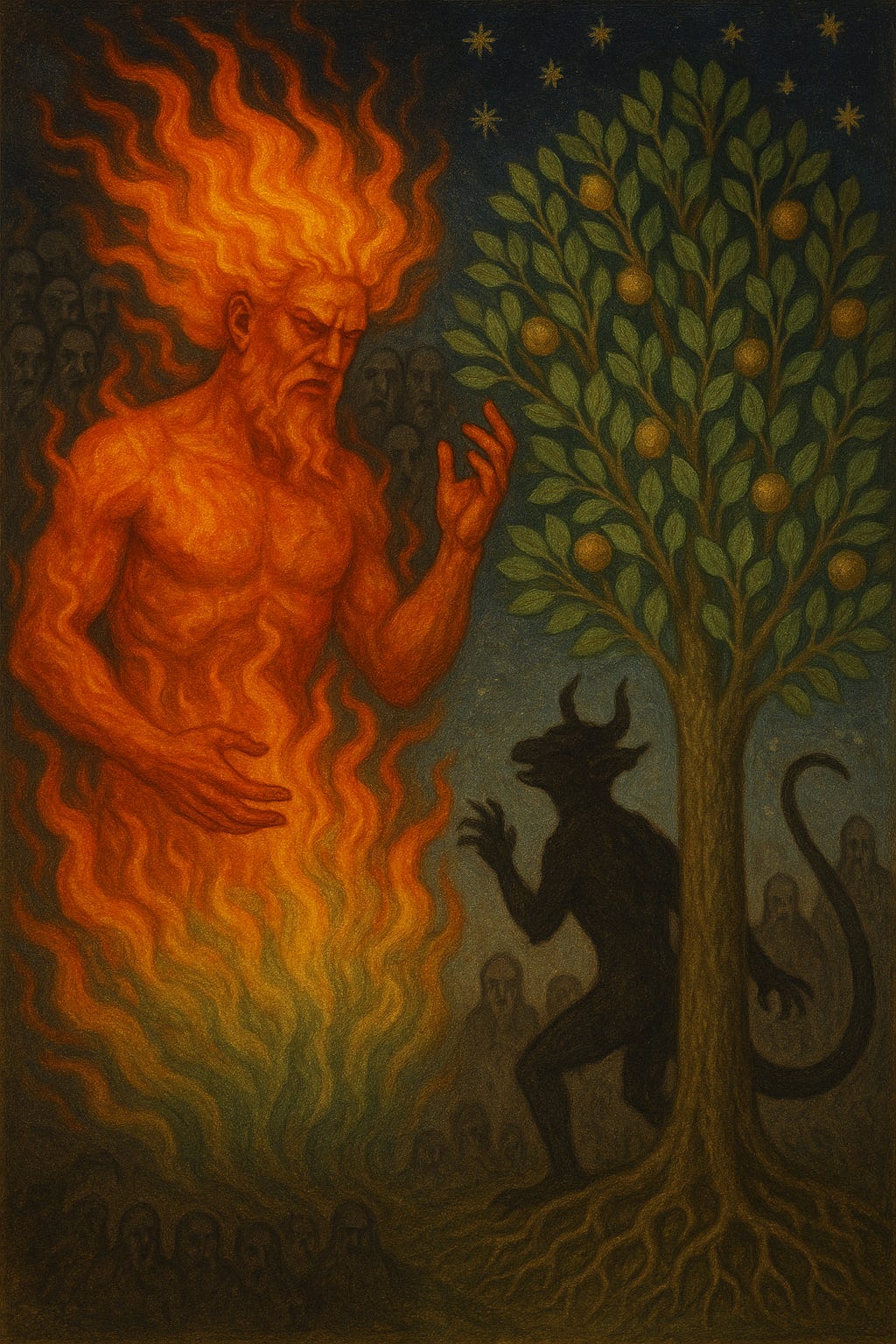
The Fourth Sermon
Grumbling, the dead filled the room and said: “Speak to us about gods and devils, thou accursed one!”
—God-the-Sun is the highest good, the devil is the opposite; thus you have two gods. But there are many great goods and many vast evils, and among them there are two god-devils, one of which is the BURNING ONE, and the other the GROWING ONE.
The burning one is EROS in his form as a flame. It shines and it devours. The growing one is the TREE OF LIFE; it grows green, and it accumulates living matter as it grows. Eros flames up and then dies away; the tree of life, however, grows slowly and reaches stately stature throughout countless ages.
Good and evil are united in the flame.
Good and evil are united in the growth of the tree.
Life and love oppose each other in their divinity.
Immeasurable, like the host of the stars, is the number of gads and devils. Every star is a god, and every space occupied by a star is a devil. And the emptiness of the whole is the Pleroma. The activity of the whole is Abraxas; only the unreal opposes him. Four is the number of the chief deities, because four is the number of the measurements of the world. One is the beginning: God-the-Sun. Two is Eros, because he expands with a bright light and combines two. Three is the Tree of Life, because it fills space with bodies. Four is the devil, because he opens everything which is closed; he dissolves everything that is formed and embodied; he is the destroyer, in whom all things come to nothing:
Blessed am I, for it is granted to me to know the multiplicity and diversity of the gods. Woe unto you, for you have substituted the oneness of god for the diversity which cannot be resolved into the one. Through this you have created the torment of incomprehension, and the mutilation of the created world, the essence and law of which is diversity. How can you be true to your nature when you attempt to make one out of the many? What you do to the gods, that also befalls you. All of you are made thus the same and in this way your nature also becomes mutilated.
For the sake of man there may reign unity, but never for the sake of god, because there are many gods but only few men. The gods are mighty and they bear their diversity, because like the stars they stand in solitude and are separated by vast distances one from the other. Humans are weak and cannot bear their own diversity, because they live close to each other and are desirous of company, so that they cannot bear their own distinct separateness. For the sake of salvation do I teach you that which is to be cast out, for the sake of which I myself have been cast out.
The multiplicity of the gods equals the multiplicity of men. Countless gods are waiting to become men. Countless gods have already been men. Man is a partaker of the essence of the gods; he comes from the gods and he goes to God.
Even as it is useless to think about the Pleroma, so is it useless to worship the number of the gods. Least of all is it of any use to worship the first God, the effective fullness and the highest good. Through our prayer we cannot add to it and we cannot take away from it, because the effective emptiness swallows everything. The gods of light compose the heavenly world, which is multiple and stretches into infinity and which expands without end. Their highest lord is God-the-Sun.
The dark gods constitute the underworld. They are uncomplicated and they are capable of diminishing and shrinking into infinity. Their deepest lord is the devil, the spirit of the moon, the serf of the earth, who is smaller, colder and deader than the earth.
There is no difference in the power of the heavenly and the earthly gods. The heavenly ones expand, the earthly ones diminish. Both directions stretch into infinity.
Sermon IV: The multiplicity of Gods – Diversity, the Four Chief Deities, and the Problem of One-Sided Unity
After the overwhelming vision of Abraxas, the fourth sermon brings the focus to the manifold of divine powers and pointedly critiques the human tendency to reduce plurality to unity. The dead demand, “Speak to us of gods and devils, you accursed one!” – indicating their struggle with the shocking pluralism Basilides preaches. In response, Basilides spells out a polytheistic metaphysic: the cosmos is populated by countless gods and devils, and trying to collapse them into One is a grave error.
Multiplicity vs. Oneness: Basilides declares that good and evil are not just two, but innumerable. He starts with familiar dualism: “God-the-Sun is the highest good, the devil is the opposite; thus you have two gods.” But quickly adds: “But there are many great goods and many vast evils.” For every shining star of a god, there is a corresponding dark space (devil). “Immeasurable, like the host of the stars, is the number of gods and devils. Every star is a god, and every space occupied by a star is a devil. And the emptiness of the whole is the Pleroma”. This beautiful metaphor says: each point of light in the night sky is a deity, a distinct focus of creative force or value, and the darkness around it is the counter-force, the absence or negation of that specific light. The Pleroma itself underlies as the total emptiness/fullness in which all these points exist. Meanwhile, “The activity of the whole is Abraxas” – meaning Abraxas is like the dynamic interplay of all these little lights and darknesses, the engine of the cosmos. Only “the unreal” opposes him, implying that nothing real can escape being part of that interplay.
Basilides then identifies “four chief deities”, tying divinity to the structure of the world’s fourfold measure. This reflects Jung’s fascination with the number 4 as symbolizing wholeness (e.g., four elements, four directions, four psychological functions). The four principal gods he lists are:
(1) Helios (God-the-Sun) – the beginning, principle of effective fullness and light (ultimate good);
(2) Eros, the Burning One – represented as flame that “shines and devours,” the principle of passion and uniting ardour;
(3) The Tree of Life, the Growing One – ever-growing, accumulating living matter slowly over ages; and
(4) The Devil, the Destroyer – who “opens what is closed, dissolves everything formed,” the principle of breaking down into nothingness.
In short: Light, Love, Life, and Death are personified as four deity forces. Basilides notes that good and evil are paired in each: “Good and evil are united in the flame” (Eros can be creative or consuming), and “Good and evil are united in the growth of the tree” (life brings joy and suffering through its growth and decay). “Life and love oppose each other in their divinity.” Here we see a new duality: Eros vs. Life – perhaps meaning intense passion versus slow natural growth are in tension. Indeed, Eros (fire) flares and dies, while the Tree (life) grows slowly and endures. Jung might be hinting at an opposition between a principle of creative entropy (fire transforms but consumes) and a principle of creative order (life organizes and builds). Regardless, Basilides is emphasizing that even within the realm of “good” or “divine,” there is diversity and opposition.
He then delivers a scathing rebuke to the idea of a single, all-encompassing god: “Blessed am I, for it is granted me to know the multiplicity and diversity of the gods. Woe unto you, for you have substituted the oneness of God for the diversity which cannot be resolved into one”. This directly addresses the monotheistic mindset: by insisting “God is One” in an absolute sense, people have mangled their understanding of reality. “Through this you have created the torment of incomprehension, and the mutilation of the created world, the essence and law of which is diversity”. In other words, forcing unity where there is naturally multiplicity leads to psychological torment and a broken worldview. Humans struggle to comprehend life when they deny its inherent complexity (hence “torment of incomprehension”). And by saying “there is only one God (and one truth),” we mutilate the world’s richness, cutting off all the other gods (which might be seen as the many aspects of reality or of our own psyche). Jung is alluding here to the repression of plurality – akin to repressing the many subpersonalities or archetypes within us in favour of one ego-ideal or one doctrinal truth. “How can you be true to your nature when you attempt to make one out of the many?” he asks pointedly. Our nature, as established earlier, is differentiation, not uniformity.
He follows with a profound warning: “What you do to the gods, that also befalls you. All of you are made thus the same, and in this way your nature also becomes mutilated”. Psychologically, projecting oneness outward (demanding one God, one creed) leads to enforced oneness inward (conformity, loss of individuality). In Jungian terms, denying the many archetypes in favour of one (say, only valuing the “hero” archetype or the “saint” archetype) results in a one-dimensional personality, with the repressed aspects causing neurosis. Culturally, monotheism attempted to enforce a single worldview, which Jung felt had come at the cost of denying the feminine divine, the chthonic and chaotic aspects of life, etc., thus impoverishing the Western psyche. Basilides acknowledges that for the sake of human society, some unity is useful (“for the sake of man there may reign unity”) but “never for the sake of god”. There are “many gods but only few men,” he quips, meaning reality has far more facets than any individual or community can embody. Humans are weak (limited) and “cannot bear their own diversity” – we live crowded together and crave companionship, so we tend to conform and smooth out our differences to get along. The gods, by contrast, are mighty and stand alone like stars separated by vast distance – each fully themselves without needing to fuse. This poetic observation captures a deep truth: psychological wholeness is capable of holding many distinct parts, but most people identify with a narrow slice and prefer others to do likewise to avoid conflict. Jung saw this in the modern “mass man” who loses individuality in collective identity. Basilides himself, as the gnostic knower, says he teaches what must be “cast out” (the insistence on one) and is therefore cast out by society – a fate Jung might have felt as his own ideas were often unorthodox.
The Many Gods as Archetypes: When Basilides says, “The multiplicity of the gods equals the multiplicity of men. Countless gods are waiting to become men. Countless gods have already been men”, we can interpret this through Jung’s theory of archetypes. Each human life can be seen as an instance of an archetypal story or pattern (“a god becoming man”). Likewise, after we die, perhaps the pattern returns to the collective psyche (a god among gods) – “man comes from the gods and goes to God.” This line hints at a transmigration of souls or the eternal return of archetypes. It resonates with Jung’s view that archetypal figures (like the hero, the mother, the trickster) continually incarnate in individuals across time. Also, it subtly suggests each person has a unique configuration of the divine: you are one particular combination of archetypal influences (one unique god-man), and your task is to live that out. This will come full circle in Sermon VII with the idea of one’s personal star/god.
Basilides continues: “Even as it is useless to think about the Pleroma, so is it useless to worship the number of the gods.” – i.e. We shouldn’t become literal polytheists in the sense of praying to every force. Recognizing diversity doesn’t mean idolizing each part in a chaotic way. And “Least of all is it of any use to worship the first God, the effective fullness and highest good, for we cannot add to it nor take away from it; the effective emptiness swallows everything”. This is a pointed commentary on traditional worship of the summum bonum (the all-good God). Jung argues elsewhere that viewing God as only the summum bonum led to ignoring the reality of evil. Here, Basilides says praying to only the highest good is futile – whatever you ask will be neutralized by the corresponding emptiness (the Infimum Malum). It’s a caution that one-sided spirituality (all light, no shadow) is ultimately self-defeating. The “effective emptiness” (Devil) devours our unbalanced efforts. In essence, the dark side will always nullify pretend-purity.
He then paints a cosmology of Light Gods vs. Dark Gods: “The gods of light compose the heavenly world, which is multiple and stretches into infinity, expanding without end. Their highest lord is God-the-Sun. The dark gods constitute the underworld. They are uncomplicated (perhaps meaning more uniform or simple in purpose) and capable of diminishing into infinity (inward). Their deepest lord is the devil, the spirit of the moon, the serf of the earth, smaller, colder and deader than the earth”. This contrasts two kinds of infinity: the heavenly expansion outward into complexity (light multiplicity) and the underworld contraction inward into simplicity and entropy (dark singularity). Importantly, “There is no difference in the power of the heavenly and the earthly gods. The heavenly ones expand, the earthly ones diminish. Both directions stretch into infinity”. So the drive toward complex being (order, life, differentiation) and the drive toward simple non-being (chaos, death, integration into void) are equal and opposite, both endless in their scope. This is essentially a metaphysical expression of the Second Law of Thermodynamics vs. Evolutionary Complexity, or in mythological terms, the battle of light and dark that is never won by either – they just keep balancing the equation. For Jung, this was key: evil (dark) is just as real and potent as good (light), even if in different ways. In psychological experience, one might say our psyche can expand in consciousness and richness, but there’s an equally powerful pull toward unconsciousness and dissolution – both are part of existence.
Psychological Perspective: The polytheism of Sermon IV corresponds to acknowledging the many autonomous facets of the psyche. Each god can be seen as an archetypal force within us: e.g, Helios as our spiritual striving for perfection, Eros as our passion and desire, the Tree of Life as our physical growth and grounded being, the Devil as our drive to break and change (or our capacity for destruction and rebellion). Jung often referenced modern man’s need to re-find a connection to the plurality of the unconscious that was lost with the decline of pagan symbolic life. In The Red Book and elsewhere, he suggests that the “gods” (archetypes) have not vanished just because we don’t worship Zeus or Isis anymore – they have become psychological. When not honoured, they manifest as symptoms or compulsions. For instance, a repressed Eros might surface as erotic obsession, a disregarded Death principle might appear as depression or nihilism. Thus, Basilides’ advice not to “worship” the multitude (which could lead to disintegration or inflation) doesn’t mean ignore them; rather, one should acknowledge them without literal idolization – in Jungian practice, one engages with the various parts of the psyche (through active imagination, creative expression, etc.) to give them their due place, rather than letting one dominate.
The critique of monotheism here is also a critique of a one-sided ego or a one-sided value system in an individual. If a person insists on a single identity (e.g. “I am nothing but a rational intellect”), they deny the many “gods” in their psyche (emotions, instincts, intuitions, etc), which leads to a stunted, “mutilated” self and eventually a collapse (as the repressed parts rebel). Jung wrote that we each have to come to terms with the “polytheistic” aspect of our psyche – analogous to allowing many voices at the table rather than one tyrant. He noted, for example, that dreams are inherently polytheistic: one night you dream of a wise old man (the Sage archetype), another night a playful child (the Puer archetype), another night a frightening shadow figure – your psyche spontaneously presents a pantheon of figures. The healthy approach is to listen to and learn from all, integrating their messages, rather than trying to impose a single narrative that some don’t fit into.
Jung also emphasized the significance of the quaternity (groups of four) as symbols of wholeness. The four chief gods Basilides lists can be paralleled to psychological quaternities like the four elements or Jung’s own four psychological functions (Thinking, Feeling, Sensation, Intuition). It’s tempting to align them loosely: Helios (clarity, perhaps Thinking or Intuition of meaning), Eros (Feeling, value, relationship), Tree of Life (Sensation, physical reality), Devil (the negating power, perhaps akin to a shadow function). While not an exact map, the Spirit is that true wholeness requires acknowledging all four corners of reality. Jung often pointed out that the Christian Trinity (3) was missing a fourth (the Devil or the feminine) and thus not a true totality. Basilides’ inclusion of the Devil as the fourth chief deity is exactly in line with Jung’s insistence that any model of wholeness must include the dark/evil as an integral part. Jung equated this to achieving the “One” through the Four – meaning the true One (Self) is only reached by encompassing the total quaternity of opposites, not by denying any quarter.
Existential-Philosophical Reflection: Sermon IV is a defence of pluralism and individuality as opposed to dogmatic unity. Philosophically, it resonates with a Henotheistic or Polycentric view of meaning: there is not one single meaning of life, but many possible gods/meanings. Each person (each “star”) may follow a different guiding principle. Trying to enforce one absolute meaning leads to violence against human nature. This is a very modern idea (one could compare it to existentialist notions that each must find their own meaning, or to pluralist ethics). Basilides effectively says uniformity is for convenience, not truth. Humans adopt unity for “the sake of man” (perhaps societal order), but the cosmos itself is irreducibly diverse. This anticipates the later note that “as much community as the gods force upon you is necessary, but more is evil” – meaning some collective agreement is needed, but beyond a point it becomes oppressive and soul-killing.
So the existential lesson: dare to be diverse. “How can you be true to your nature when you attempt to make one out of many?” speaks to the authenticity of embracing one’s inner diversity (and the world’s). It implies that the search for The meaning of life is misguided; instead, one should acknowledge the “many meanings” (gods) and perhaps find the specific configuration that is authentic to oneself. Each star (person) might have their own god (as Sermon VII will explicitly state) – a very individualistic idea.
There’s also an implicit tolerance message: if there are many gods (values) and they are all real, then no single one should tyrannize. This undercuts fanaticism and encourages understanding differences as natural. Basilides is basically advocating a psychological polytheism that honours multiplicity. This idea was later picked up by archetypal psychologist James Hillman, who argued for a “polytheistic psyche” viewpoint where one doesn’t force unity prematurely but dialogues with the many inner figures.
The dialectic of opposites is still here but broadened: not only pairs, but a network of interrelated forces. Light vs. dark is one axis, but love vs. life is another, and so on – it’s a web of dialectics. The human condition is to navigate this web. The existential challenge is that we often desire the simplicity of One (because we’re “weak and desirous of company”), but growth demands facing the complexity of Many. Basilides basically says: mankind, grow up and face multiplicity without despair. In a way, this sermon philosophically underpins modern pluralistic and systemic thinking – recognizing the world as a complex system rather than a monolith.
Thematic Cross-Link: Sermon IV ties back to Sermon I’s notion that differentiation is essential, and to Sermon II’s introduction of pairs of opposites by expanding it to a plurality. It sets the stage for Sermon V and VI by shifting focus from cosmic gods to more human-scale dualities (spirituality vs. sexuality, male vs. female, etc.) The mention of Eros (god of love) and the Tree of Life in this sermon is directly picked up in the next sermon, which talks about Mater Coelestis (Heavenly Mother) and Phallos (Earthly Father) – essentially the domains of spirituality and sexuality. So think of Sermon IV as saying: “There are many gods; among them are Love and Life and also many lesser spirits.” Sermon V will zoom in on two key daemonical forces for humans (spirit and sex) and how they need to be balanced. Also, Sermon IV’s admonition about community vs. solitude differences preludes Sermon V and V’s discussion on community. In that sense, Sermon IV bridges the grand cosmic narrative to the specifics of human social and psychic life.
In summary, Sermon IV celebrates the pluribus over the unum. It champions a worldview (and soul-view) of rich diversity, warning that any attempt to enforce a singular order (externally as dogma or internally as rigid ego control) will harm the living essence of the world and the self. True wholeness is not homogeneity but the harmonious interplay of many parts – a theme Jung returns to in his idea of individuation as integrating the many into a meaningful unity (not a flattening unity, but a unity-in-diversity). This is the key to moving forward: after accepting the necessity of opposites in Sermon II-III, we now accept the necessity of multiplicity in general, which becomes particularly important when looking at the next sphere: human life, with its polar forces of sex and spirit, its need for both solitude (individuation) and community.