Seven Exhortations To The Dead - The First Sermon
VII Sermones ad Mortuos
(Seven Sermons to the Dead)
C.G. Jung, 1916
(Translation by Stephan A. Hoeller, © 1982)
Sermon-by-Sermon Analysis Authored by: Karl K. Dondaneau
July 9th 2025
Carl Jung’s Seven Sermons to the Dead: A Sermon-by-Sermon Analysis
Introduction:
Written under the pseudonym Basilides of Alexandria, Carl Jung’s "Seven Sermons to the Dead" (1916) is a visionary, symbolic text emerging from his deep self-exploration during the composition of The Red Book. It is structured as seven mystical “sermons” delivered to the restless dead who return from Jerusalem, seeking spiritual insight they could not find in orthodox religion. In these sermons, Jung (as Basilides) uses gnostic metaphors – the Pleroma, the God Abraxas, a pantheon of gods and devils, and personified forces like Eros and the Tree of Life, the serpent and the white bird – to convey profound truths about the psyche and the human condition. Each sermon layers metaphysical concepts with psychological meaning, illustrating Jung’s emerging ideas about individuation, archetypes, the collective unconscious, and the necessity of reconciling opposites. Below, we break down each sermon, highlighting its core symbols, relating them to Jung’s broader framework, and reflecting on their philosophical and existential implications. Throughout, we draw thematic links between the sermons – particularly the thread of opposites and their ultimate unity – and compare the figure of Abraxas with Jung’s notion of the Self and the transcendent function.
Seven Exhortations To The Dead
Written by Basilides of Alexandria,
The city where East and West meet.
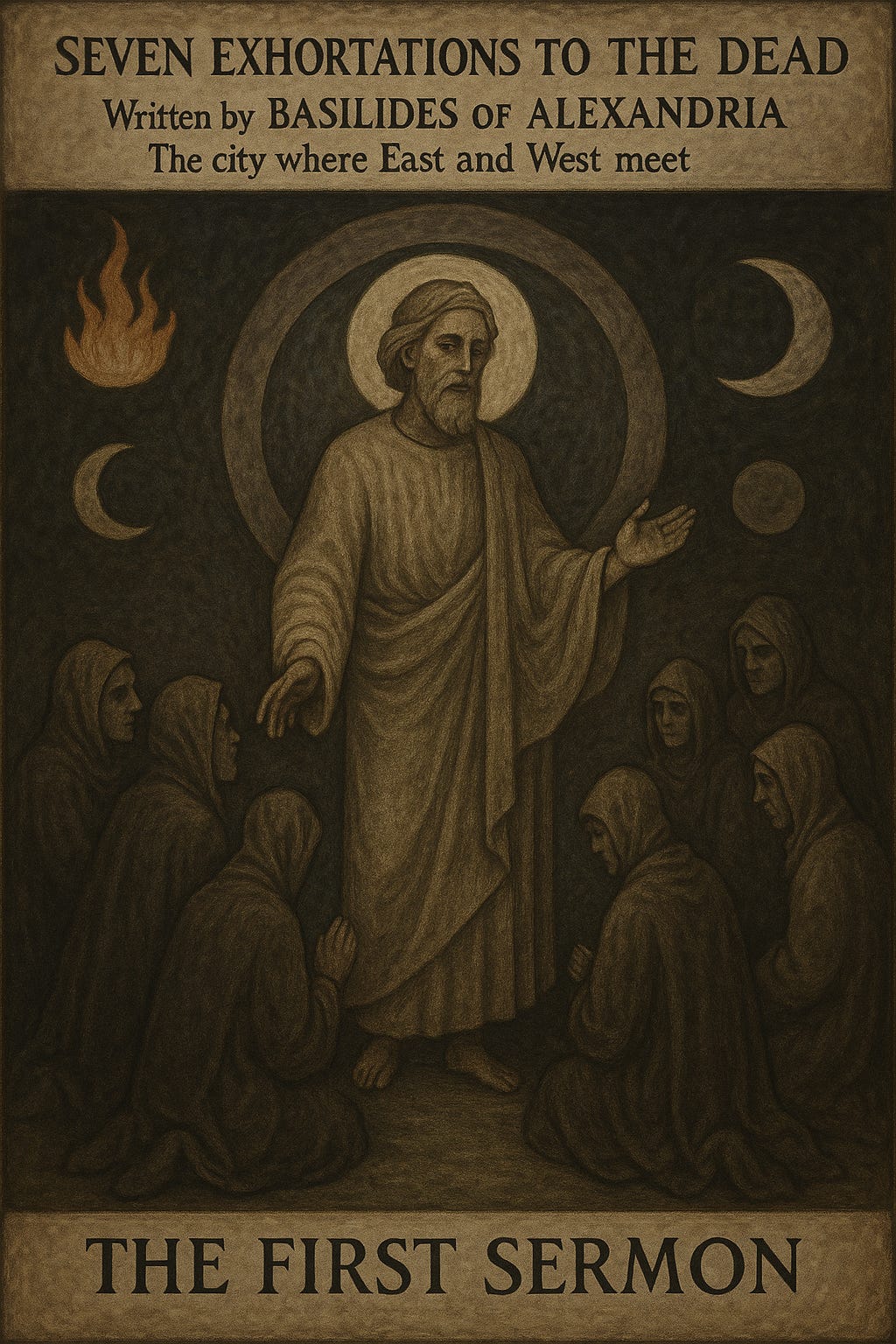
The First Sermon
The dead came back from Jerusalem, where they did not find what they were seeking. They asked admittance to me and demanded to be taught by me, and thus I taught them:
Hear Ye: I begin with nothing. Nothing is the same as fullness. In the endless state fullness is the same as emptiness. The Nothing is both empty and full. One may just as well state some other thing about the Nothing, namely that it is white or that it is black or that it exists or that it exists not. That which is endless and eternal has no qualities, because it has all qualities.
The Nothing, or fullness, is called by us the PLEROMA. In it thinking and being cease, because the eternal is without qualities. In it there is no one, for if anyone were, he would be differentiated from the Pleroma and would possess qualities which would distinguish him from the Pleroma.
In the Pleroma there is nothing and everything: it is not profitable to think about the Pleroma, for to do that would mean one’s dissolution.
The CREATED WORLD is not in the Pleroma, but in itself. The Pleroma is the beginning and end of the created world. The Pleroma penetrates the created world as the sunlight penetrates the air everywhere. Although the Pleroma penetrates it completely, the created world has no part of it, just as an utterly transparent body does not become either dark or light in color as the result of the passage of light through it. We ourselves, however, are the Pleroma, so it is that the Pleroma is present within us. Even in the smallest point the Pleroma is present without any bounds, eternally and completely, for small and great are the qualities which are alien to the Pleroma. The Pleroma is the nothingness which is everywhere complete and without end. It is because of this that I speak of the created world as a portion of the Pleroma, but only in an allegorical sense; for the Pleroma is not divided into portions, for it is nothingness. We, also, are the total Pleroma; for figuratively the Pleroma is an exceedingly small, hypothetical, even non-existent point within us, and also it is the limitless firmament of the cosmos about us. Why, however, do we discourse about the Pleroma, if it is the all, and also nothing?
I speak of it in order to begin somewhere, and also to remove from you the delusion that somewhere within or without there is something absolutely firm and definite. All things which are called definite and solid are but relative, for only that which is subject to change appears definite and solid.
The created world is subject to change. It is the only thing that is solid and definite, since it has qualities. In fact, the created world is itself but a quality.
We ask the question: how did creation originate? Creatures indeed originated but not the created world itself, for the created world is a quality of the Pleroma, in the same way as the uncreated; eternal death is also a quality of the Pleroma. Creation is always and everywhere, and death is always and everywhere. The Pleroma possesses all: differentiation and non-differentiation.
Differentiation is creation. The created world is indeed differentiated. Differentiation is the essence of the created world and for this reason the created also causes further differentiation. That is why man himself is a divider, inasmuch as his essence is also differentiation. That is why he distinguishes the qualities of the Pleroma, yea, those qualities which do not exist.
You say to me: What good is it then to talk about this, since it has been said that it is useless to think about the Pleroma?
I say these things to you in order to free you from the illusion that it is possible to think about the Pleroma. When you speak about the divisions of the Pleroma, we are speaking from the position of our own divisions, and we speak about our own differentiated state; but while we do this, we have in reality said nothing about the Pleroma. However, it is necessary to talk about our own differentiation, for this enables us to discriminate sufficiently. Our essence is differentiation. For this reason we must distinguish individual qualities.
You say: What harm does it do not to discriminate? Then we reach beyond the limits of our own being; we extend ourselves beyond the created world, and we fall into the undifferentiated state which is another quality of the Pleroma. We submerge into the Pleroma itself, and we cease to be created beings. This we become subject to dissolution and nothingness.
Such is the very death of the created being. We die to the extent that we fail to discriminate. For this reason the natural impulse of the created being is directed toward differentiation and toward the struggle against the ancient, pernicious state of sameness. The natural tendency is called Principium Individuationis (Principle of Individuation). This principle is indeed the essence of every created being. From these things you may readily recognize why the undifferentiated principle and lack of discrimination are all a great danger to created beings. For this reason we must be able to distinguish the qualities of the Pleroma. Its qualities are the PAIRS OF OPPOSITES, such as:
-The effective and the ineffective
-Fullness and emptiness
-The living and the dead
-Light and dark
-Hot and cold
-Energy and matter
-Time and space
-Good and evil
-The beautiful and the ugly
-The one and the many
and so forth.
The pairs of opposites are the qualities of the Pleroma: they are also in reality non-existent because they cancel each other out.
Since we ourselves are the Pleroma, we also have these qualities present within us; inasmuch as the foundation of our being is differentiation, we possess these qualities in the name and under the sign of differentiation, which means:
First—that the qualities are in us differentiated from each other, and they are separated from each other, and thus they do not cancel each other out, rather they are in action. It is thus that we are the victims of the pairs of opposites. For in us the Pleroma is rent in two.
Second—the qualities belong to the Pleroma, and we can and should partake of them only in the name and under the sign of differentiation. We must separate ourselves from these qualities. In the Pleroma they cancel each other out; in us they do not. But if we know how to know ourselves as being apart from the pairs of opposites, then we have attained to salvation.
When we strive for the good and the beautiful, we thereby forget about our essential being, which is differentiation, and we are victimized by the qualities of the Pleroma which are the pairs of opposites. We strive to attain to the good and beautiful, but at the same time we also to the evil and the ugly, because in the Pleroma these are identical with the good and the beautiful. However, if we remain faithful to our nature, which is differentiation, we then differentiate ourselves from the good and the beautiful, and thus we have immediately differentiated ourselves from the evil and the ugly. It is only thus that we do not merge into the Pleroma, that is, into nothingness and dissolution.
You will object and say to me: Thou hast said that differentiation and sameness are also qualities of the Pleroma. How is it then that we strive for differentiation? Are we not then true to our natures and must we then also eventually be in the state of sameness, while we strive for differentiation?
What you should never forget is that the Pleroma has no qualities. We are the ones who create these qualities through our thinking. When you strive after differentiation or sameness or after other qualities, you strive after thoughts which flow to you from the Pleroma, namely thoughts about the non-existent qualities of the Pleroma. While you run after these thoughts, you fall again into the Pleroma and arrive at differentiation and sameness at the same time. Not your thinking but your being is differentiation. That is why you should not strive after differentiation and discrimination as you know these, but strive after your true nature. If you would thus truly strive, you would not need to know anything about the Pleroma and its qualities, and still you would arrive at the true goal because of your nature. However, because thinking alienates us from our true nature, therefore I must teach knowledge to you, with which you can keep your thinking under control.
Sermon I: The Pleroma – Fullness, Emptiness, and the Need for Differentiation
Core Concept – The Pleroma: The first sermon begins at the absolute beginning: Nothingness and Fullness, which Basilides calls the Pleroma. This is an all-encompassing totality – infinite and eternal, beyond all qualities. Jung describes it paradoxically: “Nothing is the same as fullness. In the endless state, fullness is as good as emptiness. The Nothing, or fullness, is called by us the Pleroma”. In the Pleroma, “there is nothing and everything”, and all opposites cancel out into unity. Because it contains all qualities, it effectively has no distinct qualities – no distinctions, no forms, no individuals. It is undifferentiated being, akin to an absolute void that is paradoxically complete. We are told that thinking about the Pleroma is fruitless and even dangerous: to identify with this infinite Nothingness means the dissolution of the self. Thus Basilides “begins with Nothingness” as a way to dispel the illusion that there is any fixed, eternal thing we can grasp – in the Pleroma, all things merge into oneness. This idea closely parallels mystical concepts like Meister Eckhart’s Godhead (an unmanifest, quality-less divinity beyond God) and the Tao, as well as the alchemical notion of the unum mundus – a unified world of potentiality underlying all manifestation. Jung himself noted that the Gnostics’ Pleroma represents a state “of fullness where the pairs of opposites – yea and nay, day and night – are together; then when they ‘become,’ it is either day or night”. In modern terms, we might liken the Pleroma to a boundless collective unconscious or quantum vacuum of being, wherein all possibilities exist in latency but none in actuality.
Differentiation and Creation: If the Pleroma is the undifferentiated All, then creation arises through differentiation – the carving out of particular qualities from that fullness. “Creation is not in the Pleroma, but in itself. The Pleroma is the beginning and end of creation… Differentiation is its essence,” the text explains. In other words, to bring anything into existence (to create a world, a being, a thought) requires drawing distinctions – this versus that – out of the primordial unity. Thus, “man differentiates, since his essence is differentiation”. This statement anticipates Jung’s concept of individuation. Just as creation splits off distinct entities from the Pleromic oneness, individuation is the psychological process of becoming a distinct, individual self separate from the undifferentiated collective. Jung would later define individuation as “the process of the formation and particularization of individual beings… the development of the psychological individual as a being distinct from the general, collective psychology” We see the seeds of that idea here: Basilides warns that if we fail to differentiate ourselves – if we remain dissolved in the “allness” of the Pleroma or lose ourselves in collective identities – we lose our essence. The sermon pointedly says that it is our very nature to differentiate, and “if we are not true to this nature, we do not differentiate ourselves enough”. In Jungian terms, one who does not differentiate (for example, someone who identifies entirely with the collective norms or with the unconscious) never achieves a conscious, individual identity – they remain in a state of latent potential, essentially nobody. The human task, then, is to leave the undifferentiated fullness and enter the finite world of distinctions, where meaning and personal identity can exist.
Psychological Perspective: The Pleroma can be understood as a symbol for the unconscious totality of the psyche – the uroboric wholeness that precedes ego-consciousness. Jung indeed saw the Pleroma as mirroring the unconscious: a state of “pure potentiality that exists beyond opposites, much like the unconscious holds the full spectrum of psychic content before it is differentiated by consciousness”. Just as the Pleroma contains all pairs of opposites unified, the unconscious contains all opposing psychological tendencies (love and hate, light and dark, etc.) in a chaotic whole. Only when contents emerge from the unconscious into consciousness do they become either one thing or another. The sermon’s warning that pondering the Pleroma leads to self-dissolution speaks to the psychological danger of identifying with the limitless unconscious. Jung knew well that a person flooded by the archetypal images of the collective unconscious (the “eternal and endless” psyche) could lose grip of reality – a state akin to psychosis or ego disintegration. Thus Basilides advises that it is “not profitable to think about the Pleroma”; instead, we must focus on our own nature, which is to live as finite, differentiated beings. In Jungian terms, the ego must separate itself from the oceanic unconscious (the “participation mystique” or primal oneness) in order to establish a healthy personality. The text explicitly aims to “remove from you the delusion that somewhere, without or within, there is something fixed or definite” – everything absolute lies in the Pleroma and is thus no thing. What is real for us is relative, changing things, and we must find our footing there.
Philosophical Reflection: Sermon I sets a profoundly existential tone. It confronts us with the idea that ultimate reality (the Pleroma) is beyond human comprehension and value. In this void of undifferentiation, meaning as we know it cannot exist – for meaning arises only through distinction and relationship (good vs. evil, self vs. other, etc.). This is essentially a confrontation with the abyss of meaninglessness that underlies existence. The dead came back from Jerusalem – the holy city – unsatisfied, implying that conventional religious meaning (the promise of one absolute God or Truth) failed them. Basilides begins his teaching by wiping away the comfort of any such simplistic absolute: nothing in the Pleroma is differentiated or “firm,” thus “somewhere within or without there is [no] something absolutely firm”. This has a parallel in modern existential thought: just as Nietzsche declared the death of any single objective truth, Basilides declares that in the ultimate scheme (the Pleroma) there is no solid ground to cling to. This might sound despairing, but the message is ultimately one of liberation: meaning must be created in the relative world of experience. We must not dissolve into the formless All; instead, we choose our values and make distinctions despite the underlying unity. In effect, the first sermon invites us to embrace our role as creators of meaning. “Every so-called fixed and certain thing is only relative,” we are told, and “that alone is fixed and certain which is subject to change.”. This is a paradox, but it speaks to the human condition: the only constant in life is change, and only by engaging in life’s flux – not seeking an impossible, absolute permanence – can we be true to our nature. Thus, philosophically, Sermon I humbles us before the infinite (the void/fullness from which we come) while urging us to step out of it and become somebody. It presents the dialectic of being and non-being: from the fullness of Nothing we must draw forth our something. This dialectic will underlie the rest of the sermons, as Basilides proceeds to describe how differentiation unfolds in the form of pairs of opposites and what that means for the human quest for meaning.