Participatory Morality --> 3. A Living Geometry
3. A Living Geometry
Authored by: Karl K. Dondaneau
December 6th 2024
Audio Reader Available! Click the play button!
3.1 Participatory Observation:
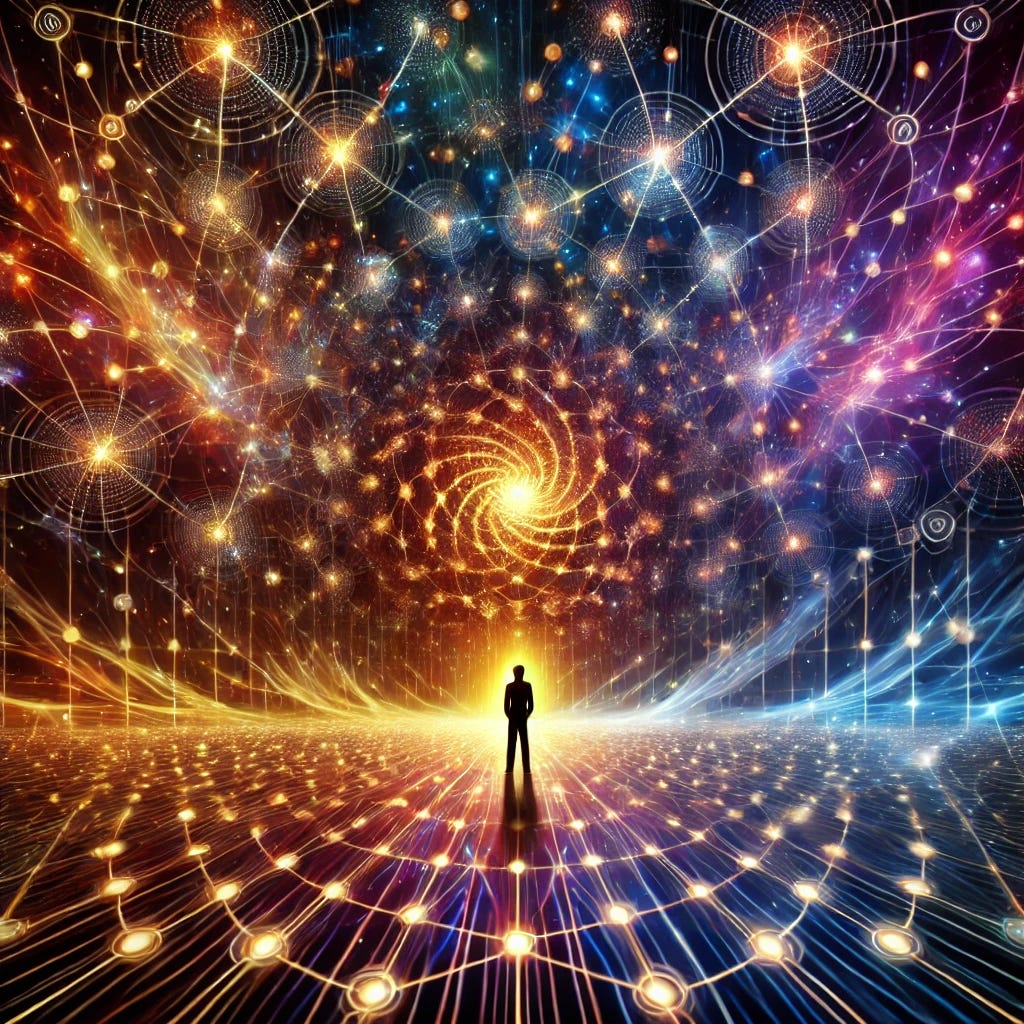
To see the world through the fractal hypergraph is to recognize that observation is not a passive act but a form of participation. The observer does not stand apart from the system they observe; instead, they are an integral part of its dynamics, shaping it through their presence, perspective, and engagement. This principle, which finds its roots in both quantum mechanics and philosophical inquiry, is central to the fractal hypergraph. It transforms the observer from a detached spectator into an active participant, revealing the interconnectedness of all things and the recursive nature of reality itself.
In the classical paradigm, observation was often framed as an act of detachment—a process of examining the world from a neutral vantage point, unaffected by the phenomena being observed. This perspective was foundational to the scientific revolution, enabling the development of models that emphasized objectivity and reproducibility. But as the frontiers of science expanded, this notion of detachment began to unravel. In quantum mechanics, for instance, the observer effect shattered the illusion of separation, revealing that the act of measurement alters the state of the observed system. A particle, when unobserved, exists in a superposition of states; when measured, it collapses into one. The observer, in this framework, is not a neutral presence but a co-creator of reality.
The fractal hypergraph draws deeply from this insight, treating observation as an inherently participatory act. Within the hypergraph, every node represents not just an entity but a point of engagement—a moment where the observer’s perspective and actions influence the connections and resonances of the system. Observation, in this context, is not a process of fixing relationships into static states but of engaging with their dynamism, of entering into the recursive cycles that shape the whole. To observe is to create; to measure is to reshape; to engage is to resonate.
Consider, for example, the act of observing a conversation. At first glance, it might seem that the words spoken exist independently of the listener, and that the exchange is a self-contained process. But the fractal hypergraph reveals otherwise. As a listener, your presence influences the speaker—their tone, their choice of words, even the emotions they express. The connections between ideas and emotions in the conversation are shaped by your reactions, your body language, and your silent or spoken contributions. Observation is not passive; it is an active thread in the hypergraph, weaving new connections and transforming the existing ones.
This participatory nature extends beyond human systems into the natural world. Imagine observing a forest. The act of walking through it, of breathing its air, alters its dynamics in subtle but significant ways. Your footsteps compress the soil, your presence may startle an animal or scatter seeds, and your gaze itself is part of the system’s unfolding. Through the lens of the fractal hypergraph, the forest is not a static backdrop but a living network, constantly reshaped by the interactions of its participants—including you. Your observation becomes a node in the hypergraph, linked to the myriad relationships that define the ecosystem.
Philosophically, participatory observation invites a profound shift in perspective. It challenges the dualism that separates subject and object, self and other, observer and observed. The fractal hypergraph dissolves these boundaries, showing that all entities are nodes within a single, interconnected web. To observe is to acknowledge one’s place within this web, to see oneself not as separate from the system but as an integral part of its dynamics. This recognition carries both epistemological and ethical implications, reminding us that our presence and actions have ripple effects, shaping the world in ways both seen and unseen.
In the fractal hypergraph, the participatory role of the observer is captured through its recursive and relational structure. Every node is a microcosm of the larger system, and every connection is shaped by the interactions it enables. This means that when an observer engages with the system—whether by measuring, interpreting, or interacting—they are not simply mapping it; they are reshaping it. This dynamic interplay between observer and observed mirrors the feedback loops found in nature, where actions and reactions continually transform the system.
To ground this idea in practice, consider the example of scientific inquiry. A researcher studying an ecosystem does more than catalogue its components; they alter the system by their very presence. The act of sampling a population, installing sensors, or analyzing data affects the dynamics of the system being studied. The fractal hypergraph captures this interplay, showing that the researcher is a node within the hypergraph, linked to the phenomena they study through relationships that are recursive and participatory. Their observations are not merely records; they are acts of creation, contributing to the system’s ongoing evolution.
Participatory observation also plays a critical role in human creativity. When an artist observes the world, they do not merely replicate it; they transform it, infusing their work with their perspective, emotions, and insights. A painting, a poem, or a piece of music is not a mirror of reality but a node in the hypergraph, connected to the artist’s experiences, the audience’s interpretations, and the cultural context in which it is created. Through this lens, art becomes an act of participation, a way of engaging with the world and reshaping its patterns.
The fractal hypergraph reveals that participation is not an exception but the rule. It invites us to see every act of observation as a moment of engagement, a point where the system and the observer converge to create something new. This perspective transforms our understanding of knowledge, creativity, and existence, showing that to know is to participate, to create is to observe and to exist is to be part of the infinite web of relationships that defines reality.
In embracing participatory observation, the fractal hypergraph offers more than a model of systems; it offers a way of being in the world. It reminds us that our presence matters, that our actions resonate, and that our connections shape the systems we inhabit. To see through the fractal hypergraph is to recognize that we are not separate from the web of existence but integral threads within it, co-creators of its endless patterns. Through this lens, observation becomes an act of creation, and participation becomes the essence of understanding.
3.2 Nodes and Connections:
Within the fractal hypergraph, the concepts of nodes and connections transcend static representation, evolving into dynamic entities that pulse with the lifeblood of relationships. Every node is not merely a point on a map but a nexus of activity, a microcosm of the larger system it inhabits. Likewise, connections are not inert links; they are active pathways, alive with the recursive flow of influence, interaction, and transformation. This dynamic interplay reveals a profound truth: at every scale of existence, relationships are the essence of reality, the threads that weave the intricate fabric of being.
A node in the fractal hypergraph is far more than a discrete object. It is a fractal entity, containing within it the echoes of the whole. Imagine a single cell in the human body. It is a distinct unit, yet it reflects the complexity of the organism to which it belongs. Within the cell are networks of molecules, organelles, and genetic material, all interacting in recursive patterns that sustain life. Zoom out, and the cell is part of a tissue, an organ, a body. Zoom further, and the body becomes a node in a social network, a cultural system, and an ecosystem. At every level, the node is both a participant in and a reflection of the larger system.
Connections, too, are dynamic. They do not merely link nodes; they shape and are shaped by the interactions they enable. Consider the relationship between a pollinating bee and a flower. This connection is not a static line but a living interaction, influenced by the availability of nectar, the behaviour of the bee, and the environmental context. Over time, this relationship evolves, as the flower adapts to attract the bee and the bee’s foraging patterns shift in response to the flower’s offerings. The connection is alive, a recursive pathway that changes with each iteration, reflecting the dynamism of the system it inhabits.
This interplay of nodes and connections becomes even more profound when viewed across scales. In a neural network, for example, a single neuron is a node connected to others through synapses. These connections are not fixed; they strengthen or weaken based on activity, creating pathways that are both adaptive and resilient. Zoom out, and the neural network becomes a part of the brain, where regions interact in complex patterns to produce thought, emotion, and consciousness. Zoom further, and the brain is a node within a social network, influencing and being influenced by the relationships it shares. At every scale, the connections are dynamic, recursive, and participatory, shaping the emergent properties of the whole.
The fractal hypergraph captures this dynamism by treating nodes and connections as active participants in the system. A node is not a static point but a fractal entity, containing layers of complexity that mirror the system at large. Its connections are not mere lines but recursive pathways, alive with feedback loops that transform both the node and the network. This dynamic structure allows the fractal hypergraph to represent not only the relationships within a system but also the processes through which those relationships evolve, adapt, and resonate.
Philosophically, this perspective challenges the reductionist view of reality as a collection of discrete objects and linear interactions. The fractal hypergraph reveals that existence is fundamentally relational, and that entities are defined not by their intrinsic properties but by their connections. A star is not merely a ball of plasma but a node in a cosmic web, linked to planets, galaxies, and the gravitational and electromagnetic fields that pervade space. A human being is not an isolated self but a nexus of relationships, shaped by family, culture, history, and the environment. Even the smallest particle is not a singular object but a node in a quantum network, its properties emerging from its entanglements with others.
This relational view has profound implications for how we understand and engage with the world. It suggests that the boundaries we perceive—between self and other, mind and body, individual and society—are not fixed but fluid, shaped by the dynamics of connection. It invites us to see the world not as a collection of parts but as a living web, where every node and every connection contributes to the emergent patterns of the whole. And it challenges us to recognize our own role within this web, as nodes whose actions resonate across scales, shaping the systems we inhabit.
To illustrate this, consider the global climate system. A single tree is a node in this system, absorbing carbon dioxide, releasing oxygen, and influencing local weather patterns. Its connections extend to the soil, where microbial networks interact with its roots, and to the atmosphere, where its transpiration contributes to cloud formation. Zoom out, and the tree is part of a forest, a regional ecosystem, and a planetary carbon cycle. Every connection in this system is dynamic, from the flow of nutrients to the exchange of gases, creating feedback loops that sustain or disrupt the balance of the whole. The fractal hypergraph maps these relationships, showing how nodes and connections interact across scales to shape the global climate.
This interplay of nodes and connections is not limited to natural systems; it extends into human creativity and culture. Consider a work of art—a painting, for example. The painting is a node, but its meaning emerges from its connections: to the artist’s intentions, the cultural context in which it was created, the viewer’s interpretation, and the broader traditions of art and philosophy. Each of these connections is dynamic, evolving as the painting is viewed, discussed, and integrated into new contexts. Through the fractal hypergraph, we can see the painting not as an isolated object but as a living node in a network of relationships, its significance shaped by the interplay of connection and resonance.
Reflecting on nodes and connections through the lens of the fractal hypergraph transforms our understanding of reality. It reveals that the world is not static but dynamic, not fragmented but interconnected, not fixed but fluid. Every node is alive with potential, every connection pulses with influence, and every relationship contributes to the emergent patterns of the whole. This perspective challenges us to see ourselves as part of this living web, and to recognize that our actions and interactions are threads in the infinite tapestry of existence.
To view the world through the fractal hypergraph is to embrace a relational ontology, one that honours the dynamism of nodes and connections at every scale of existence. It invites us to see the universe not as a collection of objects but as a symphony of relationships, where every note resonates across the whole. Through this lens, we can begin to navigate the complexities of life with a deeper understanding, a greater sense of connection, and a renewed appreciation for the infinite interplay of being.
3.3 The Dance of Light and Shadow
The fractal hypergraph reveals a profound truth: creation and destruction are not opposites, but complementary forces, woven together in the endless dance of light and shadow. This interplay is not merely a feature of existence but its essence, the rhythm that drives the cycles of life, thought, and being. Through the fractal hypergraph, we can see this dynamic not as a source of conflict but as the engine of transformation, a recursive process where light and shadow continuously shape and define one another.
Creation is the act of bringing something into being, of forging new connections, patterns, and possibilities. It is the force that generates complexity, builds relationships, and expands the boundaries of what is known. In the fractal hypergraph, creation manifests in the formation of new nodes and connections, in the recursive branching of pathways that reflect and amplify the structure of the whole. Every act of creation adds to the richness of the hypergraph, embedding new layers of meaning and interaction.
But creation cannot exist without destruction, the force that clears space, dismantles old structures and breaks down the barriers to renewal. Destruction, often feared and misunderstood, is not merely a negation but a necessary precursor to growth. In nature, this principle is evident in the cycle of seasons: the decay of autumn and the dormancy of winter make way for the rebirth of spring. In the fractal hypergraph, destruction is the dissolution of outdated connections, the pruning of relationships that no longer serve the system’s vitality. It is the shadow that allows the light to shine more clearly, the emptiness that makes room for new forms to emerge.
This interplay of creation and destruction is mirrored across scales, from the cosmic to the personal. In the life cycle of stars, creation takes the form of nuclear fusion, where atoms collide to generate light and energy. Over time, this process exhausts its fuel, leading to the destruction of the star in a supernova—a cataclysmic event that scatters elements across space, seeding the birth of new stars and planets. On Earth, volcanic eruptions destroy landscapes, but their ash enriches the soil, fostering new ecosystems. In human lives, the end of one chapter—a relationship, a career, a belief system—can be the fertile ground for the beginning of another.
The fractal hypergraph captures this dance of light and shadow by representing systems as dynamic, recursive, and participatory. Every node and connection is subject to cycles of growth and decay, formation and dissolution. A node that thrives in one context may fade in another, its energy redistributed to strengthen other parts of the hypergraph. Similarly, connections that once resonated may weaken or disappear, creating space for new pathways to emerge. This constant flux ensures that the system remains adaptive, resilient, and alive.
Philosophically, the interplay of creation and destruction challenges the linear narratives that dominate much of human thought. These narratives often frame progress as a unidirectional ascent, a march toward ever-greater complexity or perfection. But the fractal hypergraph reveals a more nuanced reality: progress is cyclical, a process of continuous rebalancing where light and shadow are inextricably linked. Creation brings forth new possibilities, but without destruction, these possibilities stagnate, becoming rigid and lifeless. Similarly, destruction clears the way for renewal, but without creation, it leads to emptiness and despair.
This perspective invites us to embrace the shadow as an integral part of the whole. In Jungian psychology, the shadow represents the aspects of the self that are hidden, repressed, or denied. These aspects, though often seen as negative, are sources of immense potential. By integrating the shadow, we gain access to the full spectrum of our being, becoming more complete, dynamic, and authentic. The fractal hypergraph reflects this integration by showing that light and shadow are not separate but interwoven, each shaping and being shaped by the other.
To ground this idea in practice, consider the creative process. A writer crafting a story must confront the blank page, a void that demands to be filled. In this void lies the shadow of uncertainty, self-doubt, and fear of failure. Yet it is precisely this shadow that spurs the act of creation, forcing the writer to forge connections between ideas, characters, and themes. As the story takes shape, it becomes a node in the fractal hypergraph, connected to the writer’s experiences, the audience’s interpretations, and the broader tradition of storytelling. But even as the story is created, parts of it are destroyed—words that no longer fit, characters that fail to resonate, and drafts that are discarded. This dance of creation and destruction is what gives the story its life, its depth, and its power.
The same dynamic plays out in relationships. The formation of a new connection—a friendship, a partnership, a community—requires the dissolution of old patterns and boundaries. To truly connect with another, one must let go of defences, assumptions, and habits that hinder intimacy. This process is not without pain, but it is also a source of profound growth. The fractal hypergraph shows that every relationship is a node in a larger web, influenced by and influencing the connections around it. As relationships evolve, some strengthen, others fade, and new ones emerge, creating a dynamic balance that sustains the system.
Reflecting on the dance of light and shadow, I see it as a call to embrace the full spectrum of existence. To create is to risk destruction, to step into the unknown and reshape the patterns of the hypergraph. To destroy is to make way for new possibilities, to clear the pathways for the next iteration of the whole. Together, these forces drive the cycles of life, weaving the threads of connection, resonance, and transformation.
The fractal hypergraph invites us to see this dance not as a source of conflict but as a harmonious interplay. It reveals that light and shadow are not opposites but partners, each necessary for the other’s existence. Through this lens, we can begin to navigate the complexities of life with greater understanding and compassion, recognizing that every moment of creation carries the seeds of destruction, and every act of destruction holds the potential for renewal. It is through this endless dance that the infinite web of relationships unfolds, shaping the living geometry of the universe.
3.4 Nature as Hypergraph
When seen through the lens of the fractal hypergraph, nature transforms into a living map of recursive systems—a dynamic interplay where the forest, the tree, and the cosmos reveal themselves as fractal expressions of interconnectedness. Each is a hypergraph in its own right, a vast web of relationships that mirrors the recursive principles of creation, destruction, and renewal. These systems are not isolated phenomena but reflections of a universal logic, where every part contains the whole and every connection pulses with the energy of participation and transformation.
The forest provides one of the most evocative examples of nature as a hypergraph. At first glance, it appears as a collection of trees, plants, and animals, each occupying its niche. But a deeper examination reveals that the forest is a network of relationships—a hypergraph where every node interacts with countless others. The trees are not solitary entities; their roots form symbiotic connections with fungi, creating mycorrhizal networks often called the "wood wide web." Through these networks, trees share nutrients, warn one another of pests, and even nurture saplings. The forest is not a collection of individuals but a living system, where every node reflects and reinforces the vitality of the whole.
Zooming in, the tree itself becomes a recursive system. Its branches split into smaller and smaller segments, following fractal patterns that optimize light capture and energy distribution. Within the tree, cells form networks of xylem and phloem, transporting water and nutrients from roots to leaves and back again. Even its leaves, with their intricate veins, mirror the branching patterns of the whole. The tree is not a single node but a nested hypergraph, where every level of structure—from the macroscopic to the microscopic—resonates with the others. It embodies the recursive logic of nature, where patterns repeat across scales, creating coherence amidst complexity.
Beyond the forest and the tree lies the cosmos, the ultimate hypergraph. The universe is a vast web of galaxies, stars, planets, and particles, all interconnected by gravitational, electromagnetic, and quantum forces. A single galaxy is itself a fractal system, with spiralling arms composed of stars, each orbited by planets and moons. Zoom in further, and the particles that form these celestial bodies are nodes in quantum networks, linked by entanglement and fields that extend across space and time. The cosmos is not a static expanse but a living geometry, where every connection contributes to the emergent patterns of existence.
The fractal hypergraph captures the recursive nature of these systems, showing that they are not merely collections of parts but dynamic wholes. Each node is a microcosm, containing within it the patterns of the larger system, while each connection is a recursive pathway that shapes and is shaped by the relationships it enables. This perspective transforms our understanding of nature, revealing that the forest, the tree, and the cosmos are not separate entities but interconnected expressions of the same underlying principles.
Philosophically, this vision challenges the anthropocentric view of nature as something external to humanity, a resource to be exploited or a backdrop to our lives. The fractal hypergraph shows that we are not observers standing apart from nature but participants within it, nodes in its infinite web of relationships. The forest breathes life into the air we inhale; the tree shelters and nourishes countless other species; the cosmos shapes our very existence through the forces and patterns that govern its vast expanse. To see nature as a hypergraph is to recognize our place within it, to understand that our actions resonate across its networks, influencing its cycles of growth and decay.
This perspective also highlights the resilience and fragility of these systems. In the forest, the loss of a single species can ripple outward, disrupting the balance of relationships and threatening the vitality of the whole. Similarly, in the cosmos, small perturbations can cascade into profound transformations, as seen in the birth and death of stars or the evolution of galaxies. The fractal hypergraph reminds us that every node and connection matters, and that the health of the system depends on the integrity of its relationships.
Practically, understanding nature as a hypergraph has profound implications for how we engage with the world. In ecology, it encourages us to protect not just individual species but the networks of relationships that sustain them. In climate science, it reveals the interconnectedness of systems—how deforestation affects carbon cycles, how ocean currents influence weather patterns, and how human actions ripple across the planet. And in cosmology, it deepens our appreciation for the universe as a dynamic, interconnected whole, where every discovery is a node in the ever-expanding web of knowledge.
Reflecting on nature as a hypergraph also invites us to consider our role as stewards of these systems. To live within the fractal hypergraph is to recognize that our choices matter and that our actions contribute to the dance of creation and destruction that shapes the world. It is to see the forest not just as a resource but as a living network, the tree not just as an organism but as a fractal entity, and the cosmos not just as a backdrop but as a hypergraph of infinite relationships. Through this lens, we can cultivate a deeper connection to the natural world, one that honours its complexity, respects its rhythms and embraces our place within its web.
The forest, the tree, and the cosmos are not merely metaphors but manifestations of the fractal hypergraph, each revealing the recursive logic that underlies existence. They remind us that nature is not a static object to be studied but a living system to be engaged with, a hypergraph where every node and connection contributes to the emergent patterns of life. By seeing the world through this lens, we can begin to navigate its complexities with greater understanding, compassion, and reverence, embracing the infinite interplay of relationships that defines the living geometry of the universe.
Thank you.
Karl K. Dondaneau