Participatory Morality --> 2. Foundations of the Fractal Hypergraph
2. Foundations of the Fractal Hypergraph
Authored by: Karl K. Dondaneau
December 4th 2024
2.1 Geometry as Language:
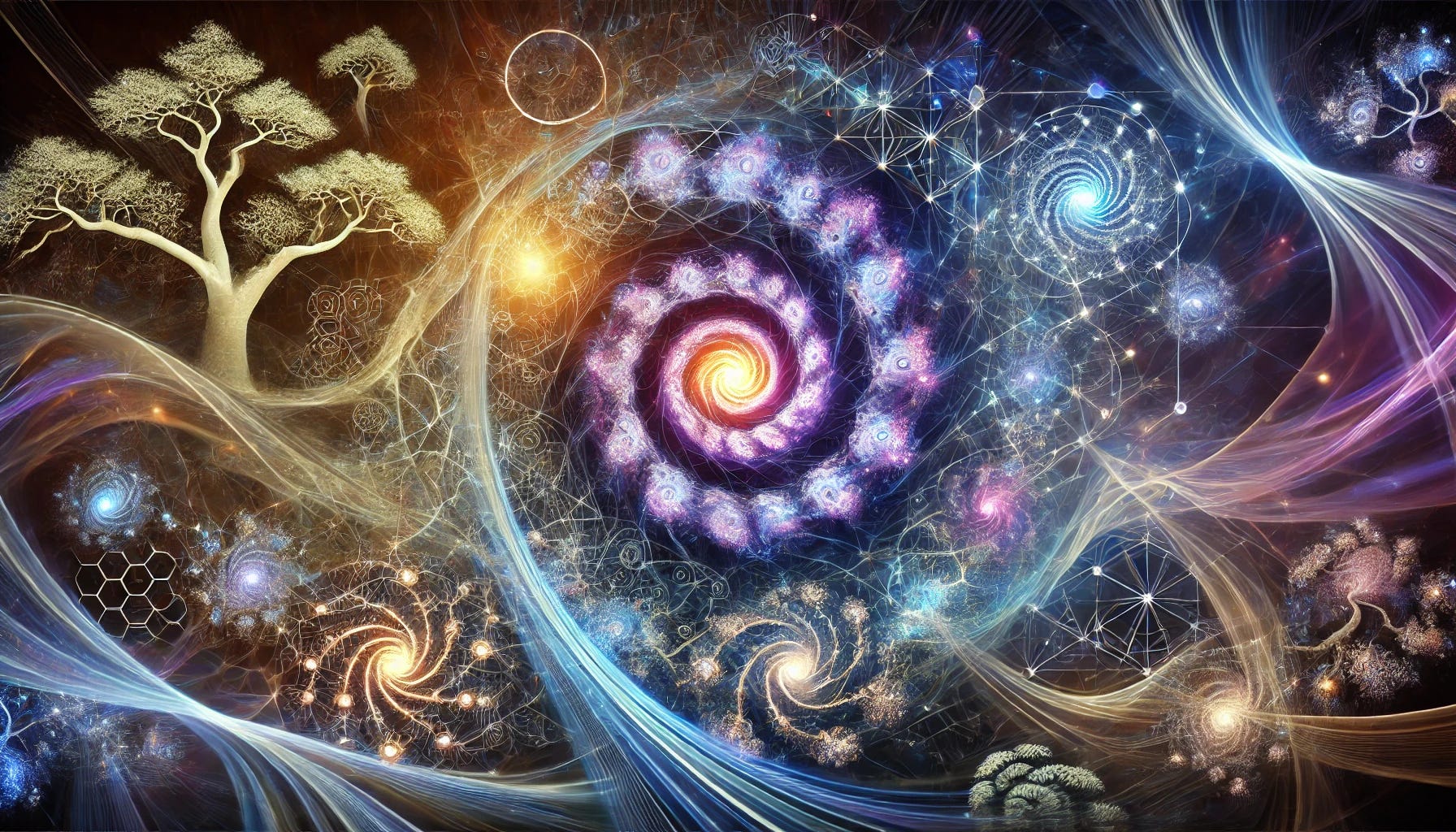
To understand the foundations of the fractal hypergraph, one must begin with geometry, the language Plato regarded as the ultimate framework of reality. For Plato, geometry was more than a tool for measurement; it was a bridge to the eternal, a way of uncovering the hidden order that underlies the chaos of appearances. He believed that the shapes and forms we encounter in the physical world are shadows of deeper, more perfect truths—universal archetypes that govern the structure of existence. This perspective was not merely philosophical but also practical; it offered a means of navigating the complexities of life by aligning one’s understanding with the harmonious patterns of the cosmos.
From a Platonic point of view, geometry is a portal to the realm of ideal forms. A circle, for instance, is not merely a shape but an embodiment of unity and infinity. It symbolizes wholeness, balance, and the seamless continuity of existence. A triangle, with its three sides and angles, represents stability and the interplay of forces—a dynamic equilibrium that resonates through the natural world. These forms, though abstract, are reflected in the physical and metaphysical structures of reality. The orbits of planets, the branching of rivers, and even the structure of human thought echo these eternal geometries.
Plato’s emphasis on geometry as the foundation of knowledge has echoed through centuries, influencing disciplines from mathematics to architecture, and from art to cosmology. Yet, as I delved deeper into his vision, I found myself grappling with its limitations. Plato’s forms, while profound, seemed static, frozen in their perfection. They offered clarity and stability but could not fully capture the dynamic, recursive nature of the systems I sought to understand. The universe, as I saw it, was not a collection of fixed shapes but a living geometry—a system where forms evolve, interact, and mirror each other in endless cycles of transformation.
This insight led me to reimagine geometry not as a static framework but as a dynamic language—one that could articulate the recursive, relational, and participatory aspects of existence. The fractal hypergraph emerged from this reimagining, drawing on the timeless principles of geometry while infusing them with motion, depth, and interconnection. It transformed Plato’s static circle into a spiral, where unity is not a fixed point but a process of continual return. It expanded the triangle into a fractal structure, where every side and angle unfolds into deeper layers of complexity, reflecting the whole.
The fractal hypergraph retains Plato’s belief in geometry as a key to understanding the universe but reframes it as a living, breathing system. It suggests that the eternal truths Plato sought are not fixed but emergent, arising from the interplay of forms across scales. This shift does not negate Plato’s vision but enriches it, allowing geometry to encompass not only the static and eternal but also the dynamic and temporal. It bridges the gap between the ideal and the real, the abstract and the concrete, offering a model that is as rigorous as it is alive.
One of the key insights I drew from Plato was the idea that geometry can reveal relationships that transcend the material world. A triangle, for instance, is not just a set of three points connected by lines; it is a symbol of balance, of the interplay between unity, duality, and multiplicity. These relationships are not confined to the realm of mathematics; they resonate through nature, thought, and culture. The fractal hypergraph builds on this insight by extending these relationships into the realm of recursion and connection, showing how the interplay of forms gives rise to the complex patterns we see in the world.
In reinterpreting Plato’s vision, I was also influenced by the natural world, where geometric patterns abound. The spiral of a galaxy, the branching of a tree, the symmetry of a snowflake—all of these reflect the principles of geometry, yet they are not static. They evolve, adapting to their environments, growing and changing over time. This dynamism is what I sought to capture in the fractal hypergraph, a model that could reflect not only the eternal principles of geometry but also their expression in the living, dynamic systems of the universe.
To ground this philosophical exploration in the practical, consider the concept of a circle. In Plato’s framework, the circle represents perfection, unity, and timelessness. But in the fractal hypergraph, the circle becomes a node in a web of connections, its edges recursive, its center a point of infinite potential. It is no longer a static form but a dynamic entity, interacting with other nodes, resonating with the patterns of the larger system. This transformation allows the circle to retain its symbolic power while becoming part of a living, interconnected whole.
Plato’s belief that geometry reflects eternal truths resonates deeply in the fractal hypergraph, but it is tempered by the recognition that these truths are not static. They are recursive, relational, and participatory. The fractal hypergraph invites us to see geometry not as a fixed framework but as a language that evolves with the systems it describes. It reminds us that the eternal is not outside of time but woven into its fabric, and that the ideal is not separate from the real but embedded within it.
In embracing this dynamic view of geometry, the fractal hypergraph offers a way to reconcile the timeless and the temporal, the abstract and the concrete. It honours Plato’s vision while extending it, transforming geometry into a living language that can speak to the complexities of our age. Through this language, we can begin to see the world not as a collection of isolated forms but as a tapestry of relationships, a fractal web where every part reflects and influences the whole. This is the legacy of Plato, reimagined for a world that is as dynamic as it is eternal.
2.2 Recursive Patterns in Nature:
When I contemplated the fractal hypergraph, I found nature itself speaking in patterns, rhythms, and geometries that defied reduction to mere randomness or mechanistic order. The recursive patterns present in nature became my greatest teachers, offering insights that reshaped my understanding of complexity. From the spiralling arms of galaxies to the branching of trees, these patterns demonstrated that the universe is not a static collection of objects but a living system, where every form is an echo of deeper truths and every iteration reflects the whole.
Recursion is the principle by which nature repeats itself across scales, creating self-similar structures that reveal unity amidst diversity. Consider the spiral, one of nature’s most evocative shapes. We see it in the vastness of galaxies, where stars swirl around a central axis in patterns that mimic the flow of water down a drain. On a smaller scale, the spiral recurs in the unfurling of a fern frond or the arrangement of seeds in a sunflower head. These spirals, governed by the mathematics of the golden ratio and Fibonacci sequence, are not merely aesthetic—they are functional, optimizing space, energy, and growth.
The branching of trees offers another vivid example of recursion. A single trunk divides into branches, each of which splits again and again, forming a fractal network that maximizes access to sunlight and nutrients. The same pattern appears in rivers, where tributaries divide and rejoin, carving paths that echo the branches of trees above them. Even within the human body, this branching is mirrored in the networks of blood vessels and neurons, systems that carry life and thought through recursive architectures.
These patterns are not static blueprints; they are living geometries, constantly adapting to their environments. A tree’s branches do not grow arbitrarily; they respond to sunlight, gravity, and competition with neighbouring trees. The same is true of rivers, whose courses shift with the flow of water and the erosion of soil. This adaptability is a hallmark of recursion—it allows systems to maintain their form while evolving, to balance order and chaos in ways that are both stable and dynamic.
What struck me most about these patterns was their universality. The same principles govern the spiral arms of a galaxy and the helix of DNA, the branching of rivers and the neural networks of the brain. This universality suggested that recursion is not just a feature of individual systems but a fundamental principle of the universe itself. It is a way of organizing complexity, of creating coherence in systems that might otherwise descend into chaos.
The fractal hypergraph emerged as a way to capture this principle, to map the recursive patterns I saw in nature and integrate them into a living framework. In this model, recursion is not merely a mathematical abstraction but a dynamic process that shapes the relationships between nodes. Every node in the hypergraph is a fractal entity, containing within it a reflection of the whole. Every connection is a recursive pathway, linking nodes in patterns that repeat and evolve across scales.
To illustrate this, imagine a single branch of a tree. In isolation, it seems a simple structure, but as you zoom in, you see that the branch is made up of smaller branches, which are themselves composed of even finer twigs. This pattern continues down to the cellular level, where networks of veins transport nutrients to each leaf. Zooming out, the branch connects to the larger tree, which is part of a forest, which in turn is part of an ecosystem. Each level reflects the same branching pattern, yet each is distinct, shaped by its context within the larger system.
The same recursive logic applies to the spiral. A galaxy’s swirling arms are composed of stars, which are themselves made of atoms arranged in spiralling electron clouds. On Earth, the spiral reappears in hurricanes, tornadoes, and ocean currents, each shaped by the forces of rotation, pressure, and energy flow. These spirals are not isolated phenomena; they are interconnected, part of a larger system of motion and energy that spans the cosmos.
Recursion also plays a role in time, where cycles echo across scales. The seasons, for instance, repeat year after year, but each cycle is unique, influenced by changing climates and human actions. The same is true of human life, where patterns of growth, decay, and renewal recur in individual lives, families, and societies. This temporal recursion suggests that time itself is not linear but fractal, composed of loops and spirals that reflect the patterns of space.
In building the fractal hypergraph, I sought to honor these recursive patterns, to create a model that could hold their complexity without reducing it. The hypergraph’s nodes are not static points but dynamic entities that evolve through recursion. Its connections are not mere lines but fractal pathways, shaped by the relationships they represent. This allows the fractal hypergraph to capture the living nature of recursion, and its ability to create coherence while allowing for change.
Reflecting on recursion in nature, I am struck by its philosophical implications. These patterns suggest that the universe is not a series of isolated objects but a single, interconnected system, where every part reflects and influences the whole. They challenge us to see beyond the surface, to recognize the deeper order that underlies the apparent chaos of the world. They invite us to participate in this order, to align ourselves with the recursive rhythms of life and to find our place within the infinite web of relationships that defines existence.
The recursive patterns in nature are not just a source of inspiration; they are a reminder of what it means to be alive. To grow, to adapt, to connect—these are the hallmarks of life, reflected in the fractals of the natural world and in the structure of the fractal hypergraph. By understanding and embracing these patterns, we can begin to see the world not as a collection of disconnected parts but as a living, breathing whole, where every spiral, every branch, and every connection tells the story of the infinite.
2.3 Networks and Relationships:
As the fractal hypergraph began to take form, I realized that its foundation lay not only in recursion but also in the intricate tapestry of networks and relationships that underlie existence. Nature’s recursive patterns provided the structure, but it was the web of connections between these patterns that brought the model to life. The hypergraph emerged as a powerful tool to map these multidimensional relationships, capturing the richness and dynamism of systems where every entity is defined not in isolation but through its interactions.
A traditional graph represents relationships as lines connecting pairs of nodes—a simple and intuitive framework. This works well for systems with straightforward connections, such as a social network where each edge represents a friendship or a transportation map where nodes are cities and edges are routes. But as I studied more complex systems—ecosystems, neural networks, economies—it became clear that this simplicity was also a limitation. Many systems are not reducible to pairwise relationships; their connections involve groups, layers, and feedback loops that cannot be captured by simple edges.
The hypergraph transcends these limitations. In a hypergraph, edges are not mere lines but multidimensional constructs, connecting multiple nodes simultaneously. This allows it to represent relationships that are inherently group-based, such as the interactions within an ecosystem where species form interdependent communities, or the collaborative dynamics of a team where the contributions of individuals converge to create something greater. The hypergraph reflects the complexity of these connections, offering a map that is as multidimensional as the systems it represents.
Imagine, for instance, the relationships in a rainforest ecosystem. A simple graph might show the predator-prey relationship between a jaguar and a deer, or the parasitic connection between a wasp and its host. But a hypergraph can go further, mapping the intricate web of interactions where plants, animals, fungi, and microbes all contribute to a shared environment. A single edge in this hypergraph might connect a flowering tree to the birds that pollinate it, the insects that feed on its nectar, the fungi that decompose its fallen leaves, and the animals that depend on its shade. These connections are not static; they evolve with the seasons, the climate, and the shifting behaviours of the organisms involved.
This multidimensionality is not confined to nature; it extends into human systems as well. Consider the dynamics of a conversation. A simple graph might represent the exchange of words between two people, but a hypergraph captures the full complexity of communication. It shows how ideas, emotions, and contexts intertwine, and how each participant’s words resonate with their past experiences, their hopes, and their fears. Every node in this hypergraph is enriched by its connections, and every edge is alive with the interplay of meaning and influence.
The hypergraph also reflects the recursive nature of relationships. Just as nature’s patterns repeat across scales, so too do its connections. A single node in the hypergraph—a tree in the forest, a neuron in the brain, an idea in a conversation—is not a static entity but a dynamic nexus, shaped by the edges that link it to the rest of the system. These edges are not passive; they feed back into the nodes, creating cycles of influence and transformation. This recursive interplay is what makes networks alive, and capable of growth, adaptation, and self-organization.
As I worked to integrate the hypergraph into the fractal model, I found myself drawn to the question of resonance. In a network, not all connections are equal; some resonate more strongly, amplifying their influence across the system. This resonance can be seen in ecosystems, where a keystone species like the wolf affects not just its prey but the entire web of life around it. It is evident in the brain, where certain neurons act as hubs, linking disparate regions and coordinating complex processes. And it is present in human culture, where ideas that resonate deeply can spread across generations, shaping art, science, and society.
The fractal hypergraph captures this resonance by treating connections as active participants in the system. Edges are not merely lines; they are pathways of influence, shaped by the dynamics of the nodes they link. This allows the model to represent not only the existence of relationships but their strength, direction, and feedback. It transforms the hypergraph from a static map into a living system, where every connection contributes to the emergent behaviour of the whole.
Philosophically, the hypergraph challenges the notion of separateness. It reveals that entities do not exist in isolation but are defined by their relationships, by the web of connections that binds them to the world. This insight resonates with quantum mechanics, where particles are entangled across space and time, and with systems theory, which emphasizes the interdependence of components within a whole. The hypergraph is a map of this interdependence, a way of seeing the world as a network of connections rather than a collection of parts.
To ground this in the practical, consider the example of a city. A traditional graph might represent the city’s transportation network, with nodes for bus stops and edges for routes. But a hypergraph can encompass the city’s full complexity, connecting neighbourhoods, industries, cultural institutions, and individuals. It shows how the flow of people and resources interacts with social dynamics, economic trends, and environmental factors. Each node is part of a larger network, and each edge reflects the interplay of multiple dimensions—geographic, economic, cultural, and temporal.
In building the fractal hypergraph, I sought to honor this complexity, to create a model that could capture the multidimensional nature of networks while remaining intuitive and flexible. The hypergraph’s nodes are fractal entities, reflecting the patterns of the whole, and its edges are recursive pathways, alive with resonance and feedback. This allows the fractal hypergraph to serve not just as a tool for understanding but as a framework for engagement, a way to navigate the infinite web of relationships that defines existence.
Reflecting on networks and relationships, I am reminded of the interconnectedness that lies at the heart of life. Every connection is a thread in the tapestry of the universe, a pathway that links the individual to the collective, the part to the whole. The hypergraph reveals these threads, showing that we are not separate islands but nodes in a vast, multidimensional network. By mapping these connections, we can begin to see the world as it truly is—a living web of relationships, where every node, every edge, and every resonance plays a role in the infinite dance of existence.
2.4 Beyond Static Systems:
To step beyond static systems is to embrace a vision of reality that is alive, dynamic, and participatory. Static models, for all their utility, falter when confronted with the fluid, recursive nature of existence. They provide snapshots, useful for isolating moments in time or mapping simplified relationships, but they cannot capture the perpetual motion, the cyclical unfolding, or the interdependence that defines living systems. The fractal hypergraph was born from the recognition that to truly understand the world, we must integrate dynamism, recursion, and participation into our frameworks—elements that breathe life into the otherwise static.
Dynamism, at its core, reflects the idea that systems are not fixed but in constant motion. A static graph may map the connections within a network, but it cannot show how those connections evolve over time—how a neuron strengthens its synaptic link through repeated activation, or how a river carves its path deeper into the earth with each passing year. Dynamism recognizes that relationships are not merely states but processes, unfolding in time and shaped by feedback loops. In the fractal hypergraph, this principle manifests through edges that are not static lines but dynamic pathways, constantly reshaped by the interactions they represent.
Recursion adds depth to this dynamism. It reveals that systems do not simply change but change in ways that echo their own structure, creating patterns within patterns. Consider the recursive nature of a fractal: each part contains a reflection of the whole, and each iteration builds upon the previous, deepening the complexity without losing coherence. This recursive logic is evident in nature, from the branching of trees to the self-similarity of coastlines. It is also present in human thought, where ideas evolve through cycles of reflection and refinement, each iteration adding nuance and clarity. The fractal hypergraph captures this recursion by allowing nodes to contain fractal entities—microcosms of the larger system—and by enabling connections to loop back upon themselves, creating cycles of influence that resonate across scales.
Participation is the third and perhaps most transformative element. It challenges the notion of a detached observer, suggesting instead that observation and interaction are themselves forms of participation within the system. Quantum mechanics offers a striking example: the act of measuring a particle alters its state, making the observer an integral part of the phenomena being observed. In human systems, participation is even more evident; our thoughts, actions, and relationships shape the networks we inhabit, just as they shape us in return. The fractal hypergraph embeds this participatory nature by treating nodes not as isolated points but as active agents, constantly influencing and being influenced by their connections.
Together, these elements—dynamism, recursion, and participation—transform the fractal hypergraph into a living model. It does not merely represent systems; it reflects their life, and their capacity to grow, adapt, and evolve. To illustrate this, imagine a forest ecosystem. A static map might show the species present and their relationships, but it would miss the dynamics of nutrient cycling, the recursive growth of trees and fungi, and the participatory role of every organism in shaping the environment. The fractal hypergraph, by contrast, captures the forest’s aliveness, its ceaseless interplay of growth, decay, and renewal.
Philosophically, this integration of dynamism, recursion, and participation challenges the linear and reductionist paradigms that have long dominated Western thought. These paradigms excel at isolating variables, breaking systems into parts, and tracing causal chains. But they struggle to account for the emergent properties of complex systems, where the whole is greater than the sum of its parts, and where causality loops back upon itself in ways that defy simple explanations. The fractal hypergraph invites us to think not in terms of linear progressions but in terms of cycles, not in terms of isolated causes but in terms of networks of influence, and not in terms of static truths but in terms of dynamic processes.
The practical implications of this shift are profound. In neuroscience, for instance, the fractal hypergraph offers a way to model the brain not as a static collection of neurons but as a dynamic network, where connections strengthen or weaken through feedback, and where patterns of activity loop across regions to create consciousness. In ecology, it allows us to see ecosystems not as fixed hierarchies but as living systems, where every interaction contributes to cycles of energy flow, nutrient exchange, and population dynamics. And in human systems, it reveals the participatory nature of culture, where ideas, emotions, and relationships co-create the social fabric.
This participatory dimension is especially important. It reminds us that we are not outside observers of the systems we study but participants within them. When we act, we send ripples through the networks around us; when we think, we reshape the connections within our own minds. The fractal hypergraph makes this visible, showing that every node, every edge, and every resonance is part of a larger pattern—a pattern that we help to create. This realization is both empowering and humbling. It invites us to engage with the world not as passive spectators but as active co-creators, aware of the influence we wield and the responsibilities it entails.
Reflecting on the integration of these elements, I see the fractal hypergraph as a bridge between static and living systems, between the abstract and the embodied, and between the observer and the participant. It challenges us to move beyond the comfort of fixed categories and linear explanations, to embrace the complexity and vitality of the networks that surround us. And it offers a model that is not merely a tool for understanding but a framework for engaging—a way to navigate the infinite web of relationships that defines existence.
By integrating dynamism, recursion, and participation, the fractal hypergraph becomes a map that is as alive as the systems it seeks to represent. It captures not only the structure of connections but their motion, their evolution, and their resonance. It reminds us that to understand the world is not to reduce it to static snapshots but to enter into its rhythms, to participate in its cycles, and to see ourselves as part of the infinite dance of creation and transformation.
Thank you.
Karl K. Dondaneau