Part V — The Fold of Time: How the Future Creates the Present
June 3, 2026
Authored by: Karl K. Dondaneau
Up to this point, we have followed a gradual inversion.
We began by questioning the assumption that objects are primary and relations are secondary. We discovered that stability may emerge from recursive coherence rather than from isolated substances. We then explored consciousness as a recursive process of self-integration and time as a relational architecture through which continuity becomes possible.
Yet one question remains unanswered.
If consciousness is recursively integrating reality, and if time itself emerges through recursive participation, then why does the present feel so strangely elusive?
The moment one attempts to isolate the present, it disappears.
The past remains accessible only through memory.
The future remains accessible only through anticipation.
The present appears to exist somewhere between them, yet every attempt to grasp it transforms it into either a remembered past or an anticipated future.
The mystery may arise because the present is not a thing.
The present may be a process.
More precisely:
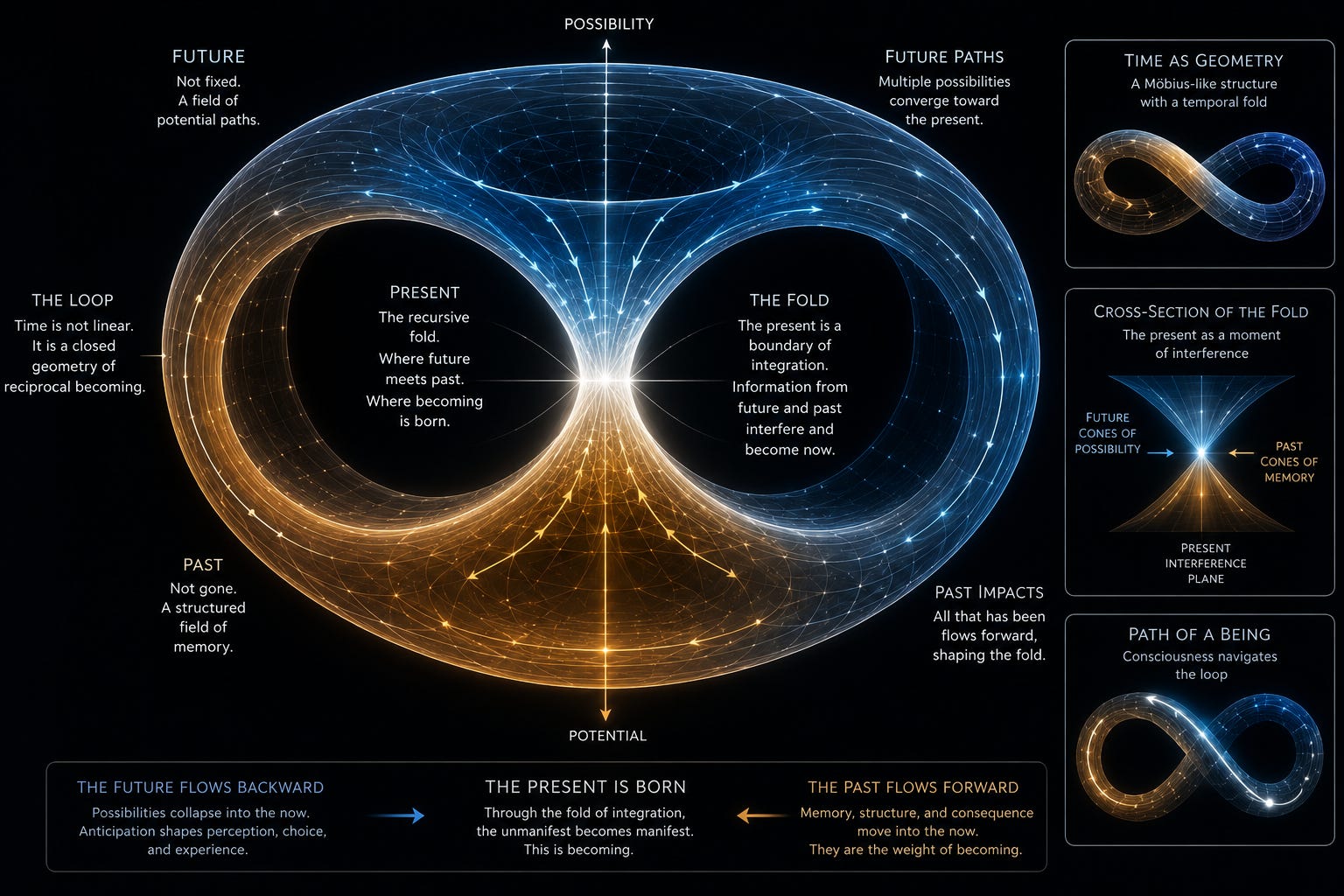
The present may be the recursive folding of future possibility into remembered structure.
This idea initially appears counterintuitive because human beings are conditioned to think of causality as moving in one direction. The past causes the present. The present causes the future. Time flows forward like a river.
But consciousness does not actually function this way.
Consider something as simple as catching a ball.
By the time visual information reaches awareness, the ball has already moved. If consciousness reacted only to past information, every attempt to catch the ball would fail. Instead, the nervous system continuously predicts future trajectories and adjusts present behavior accordingly. The body is not responding merely to what has happened. It is responding to what is about to happen.
The future, in a practical sense, is already participating in the present.
Not because the future exists as a fixed destiny waiting ahead, but because anticipated possibilities actively shape current reality.
The same principle governs language.
As you read a sentence, your mind continuously predicts what comes next. Meaning emerges because future expectation participates in present interpretation. Remove anticipation entirely and language collapses into disconnected symbols.
Music functions similarly.
A melody moves consciousness because each note creates an expectation of future resolution. The emotional power of music emerges through tension between remembered structure and anticipated completion. The future note influences the present note before it arrives.
Meaning itself depends upon recursive anticipation.
Without future expectation, the present loses coherence.
This reveals something extraordinary:
The present is not generated solely by the past.
The present emerges through a recursive negotiation between memory and possibility.
The past contributes structure.
The future contributes direction.
The present emerges where they intersect.
This may explain why consciousness appears suspended between what has been and what could be.
Human beings are not merely remembering creatures.
Nor are they merely predictive creatures.
They are recursive integrators.
The self continuously gathers memory into possibility and possibility into memory.
Identity exists because this integration remains coherent across time.
The ego emerges within precisely this process.
The ego is often misunderstood as vanity, pride, or self-importance. These are merely surface expressions.
At a deeper level, the ego functions as a temporal stabilization mechanism.
Its purpose is continuity.
The ego constructs a narrative bridge connecting remembered experience to anticipated becoming. It says:
“I was.”
“I am.”
“I will be.”
Through this narrative continuity, the self acquires stability.
Yet this stability comes with a hidden cost.
Because the ego must preserve continuity, it often mistakes its own narrative construction for reality itself.
It forgets that the story is not the consciousness telling the story.
The map becomes mistaken for the territory.
The identity becomes mistaken for the awareness through which identity appears.
This confusion generates much of human suffering.
The ego attempts to freeze what is fundamentally recursive.
It seeks permanence within becoming.
It seeks certainty within emergence.
It seeks fixed identity within continuous transformation.
Yet reality appears unwilling to cooperate.
Everything changes.
Every relationship evolves.
Every belief transforms.
Every memory shifts.
Every future reconfigures itself through present action.
The ego experiences this instability as threat because its function is stabilization.
But from the perspective of recursive reality, change is not the enemy of identity.
Change is the mechanism through which identity survives.
A river remains a river precisely because water continuously flows through it.
Likewise, consciousness remains consciousness because experience continuously transforms within recursive coherence.
The self survives not through permanence but through adaptive continuity.
This realization changes how we understand both space and time.
Ordinarily, space appears external while time appears sequential.
But both may emerge from deeper relational structures.
Imagine a world in which every point remains connected through transformations that continuously fold back upon themselves. Boundaries begin losing their rigidity. Distinctions between inside and outside become less absolute. The path that appears to move away eventually returns from another direction. What initially seems separate reveals hidden continuity.
Consciousness behaves in much the same way.
Memory appears behind us.
Possibility appears ahead of us.
Yet both continuously participate in present awareness.
The future folds backward through anticipation.
The past folds forward through memory.
The present emerges from their intersection.
Time becomes less like a straight line and more like a recursive topology.
Not circular repetition.
Not deterministic recurrence.
Recursive folding.
A structure in which trajectories continuously reintegrate prior states while generating new possibilities.
Under such a view, the future is not a location waiting ahead.
Nor is the past a location left behind.
Both exist as active dimensions within consciousness.
The past survives as structure.
The future survives as potential.
The present becomes the point of recursive integration through which both are continually transformed.
This may explain one of the deepest paradoxes of human experience.
Why does intuition sometimes seem to arrive before conscious reasoning?
Why do certain insights appear suddenly as though emerging from nowhere?
Why do creative breakthroughs often feel discovered rather than invented?
Why does meaning occasionally reveal itself all at once?
Perhaps because consciousness is not merely processing information linearly.
It is continuously integrating vast relational fields across memory, perception, symbolism, embodiment, and anticipation. Most of this activity remains below explicit awareness. The conscious mind receives the result after deeper recursive integration has already occurred.
The future, in this sense, participates indirectly through possibility-space.
Potential configurations exert influence before becoming actualized.
Not through mystical predestination, but through recursive anticipation.
Consciousness continuously explores possibilities before selecting trajectories.
The future influences the present because possibility influences choice.
Choice influences action.
Action influences reality.
Reality reshapes future possibility.
The cycle closes.
Time becomes self-participating.
This understanding also transforms humanity’s relationship with civilization itself.
A civilization survives only when it can integrate memory and possibility simultaneously.
Too much attachment to memory and it becomes trapped in repetition.
Too much obsession with novelty and it dissolves into chaos.
The healthiest civilizations maintain recursive continuity between inheritance and innovation.
The same principle governs individual growth.
Wisdom emerges when memory and possibility become integrated rather than opposed.
The mature mind no longer lives exclusively in the past or future.
It learns to inhabit the recursive intersection through which both become meaningful.
The present is therefore not a fleeting instant trapped between two infinities.
It is the creative boundary where reality continuously reorganizes itself.
Memory flows forward.
Possibility flows backward.
Consciousness gathers both into coherence.
And through that gathering, the universe becomes capable of becoming something new.
The future does not merely arrive.
The future participates in its own creation through the recursive structures that make anticipation, meaning, choice, and consciousness possible.
What we call “now” is the living fold where becoming meets remembrance, where possibility encounters structure, and where reality continuously discovers itself through the act of self-relation.
The present is not a point in time.
The present is the recursive event through which time becomes aware of itself.
References will be provided upon monograph completion
Thank you
Kar’el
Next:
Previous: