Part IV — Time, Memory, and the Recursive Structure of Becoming
June 1st, 2026
Authored by: Karl K.Dondaneau
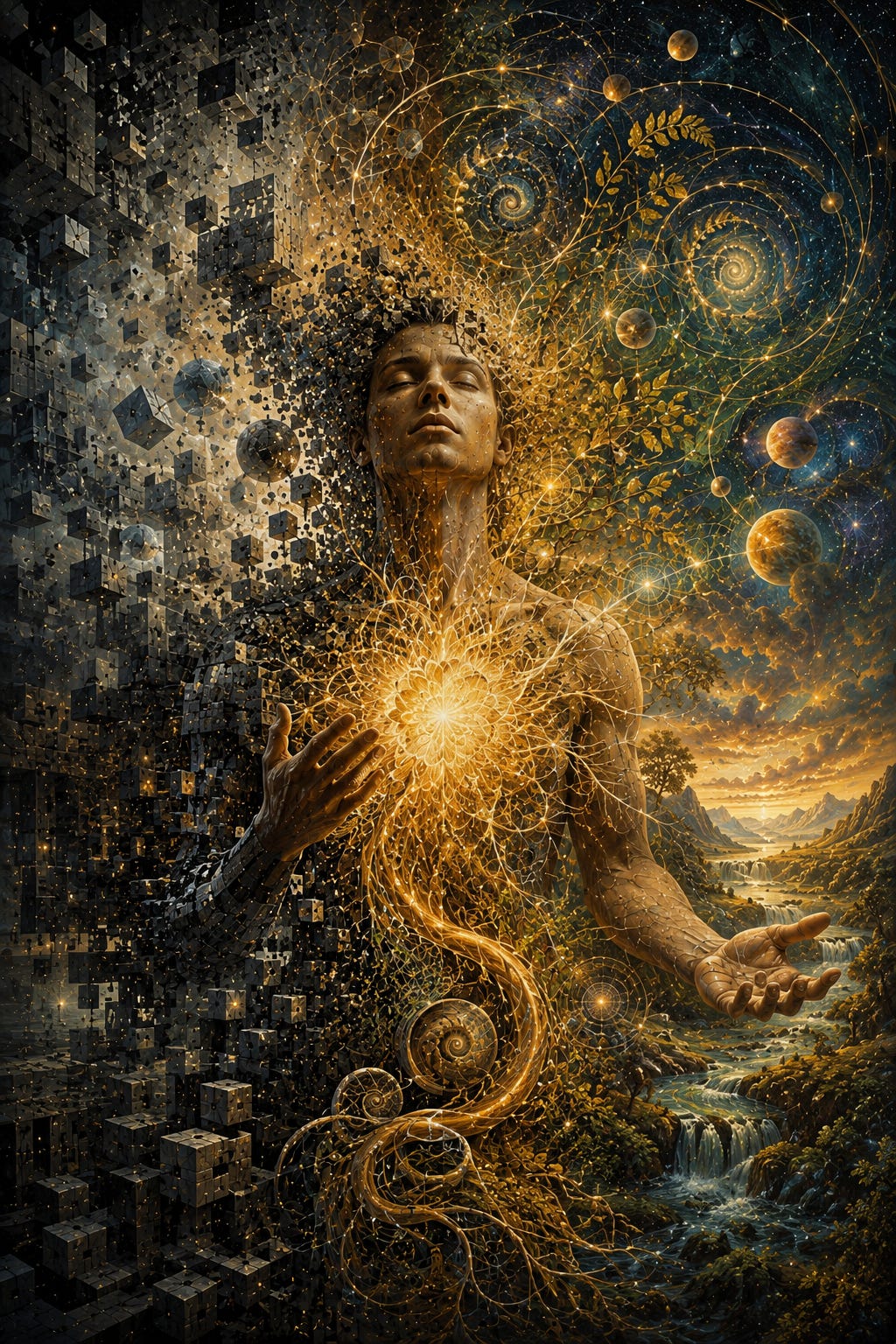
Humanity experiences time as movement, yet rarely asks what movement itself actually is.
The clock measures duration, but duration alone is not lived time. Seconds may pass uniformly while experience expands or contracts unpredictably. A moment of terror stretches endlessly. Years disappear into memory with impossible speed. Childhood feels infinite because consciousness has not yet compressed repetition into familiarity. Aging accelerates perception because recursive patterns increasingly stabilize into expectation. Time is not merely external sequence. It is relational experience.
This distinction matters because modern civilization unconsciously inherited a mechanized image of temporality.
Time became treated as linear progression: past behind, future ahead, present between them. The universe was imagined as a vast chain of causality unfolding across a neutral temporal container. Events moved forward like gears rotating through empty duration. Such a framework proved extraordinarily effective for engineering, prediction, and physical modeling. Yet it flattened lived temporality into abstraction.
Human consciousness does not experience time linearly.
The mind constantly moves backward through memory while simultaneously projecting forward through anticipation. Perception itself depends upon integration across temporal intervals. What appears as a singular moment of awareness is already a synthesis composed of sensory delay, predictive reconstruction, emotional interpretation, and symbolic continuity. The experienced present is not an instantaneous point. It is a recursive integration window.
Consciousness therefore does not passively move through time.
Consciousness recursively constructs temporal coherence.
This realization changes the meaning of becoming.
If perception depends upon recursive integration, then the present moment is not simply “received” from reality. It is actively assembled through participation between memory and anticipation. The brain continuously predicts future states while integrating incoming sensory information into coherent continuity. Experience emerges through recursive negotiation between expectation and actuality.
Reality as lived is therefore partially simulated.
Not simulated in the trivial sense of falsity, but in the deeper sense that consciousness reconstructs coherent worlds through recursive modeling. The mind does not directly encounter raw existence. It encounters recursively stabilized interpretations capable of sustaining continuity and orientation.
This explains why memory is never static.
Every recollection modifies the remembered event because remembering itself is recursive reconstruction. The past survives not as fixed archival storage, but as dynamically reintegrated meaning within present consciousness. Identity therefore depends upon recursive reinterpretation across time. Human beings do not merely possess histories. They continuously rewrite the significance of their histories through ongoing integration.
The future functions similarly.
Anticipation is not passive waiting for events to arrive. Consciousness constantly simulates possible trajectories, generating predictive models that shape present behavior. Fear, hope, anxiety, aspiration, imagination, and planning all emerge from recursive participation between present awareness and projected possibility. Human beings live simultaneously within memory and anticipation while attempting to stabilize coherence between them.
Time becomes inseparable from consciousness because temporality itself may emerge through recursive integration.
This possibility profoundly alters the understanding of existence.
The classical mechanical worldview assumes time exists independently as an objective backdrop against which events unfold. Yet relativity destabilized the notion of universal simultaneity, revealing that temporal measurement depends upon relational frames of reference. Quantum theory further complicated causality by introducing indeterminacy into physical prediction. Increasingly, reality appears less like a fixed timeline and more like a relational process whose temporal structure emerges contextually.
Consciousness intensifies this mystery.
Without memory, continuity disappears. Without anticipation, direction disappears. The self exists because recursive temporal integration stabilizes identity across transformation. A purely instantaneous consciousness would possess no enduring selfhood because continuity requires recursive relation between temporal states.
Existence itself may therefore depend upon recursive temporality at every scale.
A melody exists only because prior notes remain integrated within present perception. Remove temporal recursion and music collapses into disconnected sounds. Language operates similarly. Meaning arises because words recursively accumulate context across sequence. Biological life persists because organisms preserve continuity across metabolic transformation. Civilizations survive because symbolic memory transmits coherence across generations.
Even matter may depend upon recursive stabilization.
Particles do not appear as static objects so much as probabilistic patterns maintaining coherence across interaction. Reality increasingly resembles dynamic process rather than fixed substance. Stability emerges through recursively sustained relation rather than permanent immobility.
This insight transforms the meaning of death as well.
Modern reductionism often interprets death as the annihilation of isolated biological machinery. Yet if identity fundamentally consists of recursive relational continuity, then existence cannot be adequately understood through isolated material components alone. Human beings persist beyond immediate physical presence through symbolic memory, relational influence, cultural transmission, genetic inheritance, emotional imprinting, and participatory continuity within larger systems of becoming.
The self is never entirely isolated to begin with.
Consciousness emerges relationally. Language, identity, thought, morality, and meaning all arise through participation within structures larger than individuality alone. Human beings carry ancestors psychologically, biologically, symbolically, and culturally. Likewise, every action extends recursively outward into future consciousnesses not yet born. Existence continuously folds itself across generations through relational transmission.
Time therefore behaves less like a line and more like recursive layering.
The past remains active within the present through memory and structure. The future influences the present through anticipation and possibility. The present itself emerges through integration between both. Temporal reality resembles a recursive field of becoming whose coherence depends upon continual reintegration across scales.
This realization illuminates why modern technological civilization increasingly destabilizes human consciousness.
Digital systems compress attention into perpetual immediacy. Continuous stimulation fragments temporal depth. Memory externalizes into databases while internal narrative coherence weakens. Individuals become increasingly detached from long-term symbolic continuity. Civilization accelerates informational processing while diminishing contemplative integration.
Human beings begin losing temporal orientation.
Without recursive depth, identity becomes unstable because the self requires continuity across time to maintain coherence. A society incapable of sustaining memory loses historical grounding. A society incapable of envisioning meaningful futures loses direction. The collapse of temporal integration produces existential fragmentation.
This is why technological acceleration often coincides with psychological exhaustion.
The human nervous system evolved within recursive rhythms:
day and night,
seasons,
ritual repetition,
intergenerational continuity,
embodied presence,
symbolic inheritance.
Modern systems increasingly sever consciousness from these stabilizing recursive structures. Time becomes commodified into productivity metrics and attention extraction cycles. The result is a civilization rich in information yet impoverished in duration.
But recursive temporality offers another possibility.
If time emerges relationally through recursive coherence, then meaning depends upon the depth of integration achieved across temporal scales. Wisdom becomes possible because consciousness can integrate suffering into growth, memory into identity, and anticipation into purpose. Human beings become capable of participating consciously within becoming rather than merely reacting mechanically to sequence.
This may explain why symbolic traditions across civilizations repeatedly emphasized cyclical imagery:
death and rebirth,
seasons,
resurrection,
cosmic recurrence,
spirals,
wheels,
sacred calendars,
archetypal return.
These were not primitive misunderstandings of linear time. They reflected an intuition that existence unfolds recursively. Becoming does not simply advance forward into novelty. It continually reintegrates prior states into higher-order coherence.
Growth itself operates recursively.
A child becomes an adult not by abandoning childhood entirely, but by integrating earlier developmental layers into expanded identity. Likewise, civilizations evolve not by erasing their symbolic foundations, but by recursively transforming inherited structures into deeper forms of coherence.
The future of humanity may therefore depend upon recovering temporal depth.
Not by rejecting technological advancement, but by reintegrating acceleration into recursive continuity capable of sustaining meaning across generations. Civilization must rediscover forms of intelligence that preserve memory while remaining adaptive, capable of honoring the past without becoming imprisoned by it and envisioning the future without severing itself from human continuity.
For time is not merely what passes.
Time is the recursive architecture through which reality becomes capable of remembering itself.
Thank you
Kar’el
Next:
Previous: