Origins
Authored by: Karl K. Dondaneau
November 19th 2024
When I began writing Simplicity Through Simulation: The Algorithm of Humanity, I set out to explore a question that has haunted me for years: What if the patterns we see in nature, in thought, in our relationships, and even in the cosmos are not just coincidental? What if they are the language of reality itself? For me, this question was not a matter of academic curiosity—it was personal, urgent, and inescapable. From the smallest flicker of thought to the grandest cosmic movements, I saw echoes of a unifying principle, something that wove together the chaos and order of existence into a coherent tapestry. This book became my attempt to articulate that vision, and in doing so, I found myself straddling the worlds of mathematics, philosophy, and psychology in ways I had never imagined.
At the heart of this journey lies a fundamental belief: reality is recursive. It builds upon itself, repeating patterns across scales and contexts, yet it never repeats them exactly. These patterns are dynamic, ever-evolving, and participatory. They demand our engagement. They require us to notice them, reflect on them, and, perhaps most importantly, to realize that we are not separate from them. We are their creators as much as we are their creations. This interplay between humanity and the cosmos is not a metaphor—it is the essence of our existence.
This brings me to the mathematical framework I developed to help illuminate this idea. Traditional mathematics, for all its beauty and utility, often operates under the assumption of linearity and progression. Numbers stretch out into infinity, systems evolve along predictable trajectories, and continuity reigns supreme. But what if the universe doesn’t operate in straight lines? What if, instead, it operates in cycles, spirals, and feedback loops? This led me to create what I call the Abraxas number system—a system of arithmetic that rejects linear progression in favor of cyclical patterns. Numbers, in this framework, are not abstract markers marching endlessly toward infinity; they are dynamic entities that return to their origins, much like the phases of the moon, the orbits of planets, or the oscillations of electrons.
In this system, numbers behave much like nature itself: they are bounded yet infinite, finite yet eternal. They loop back on themselves, resetting at certain thresholds, embodying the concept of eternal recurrence. This is not merely a mathematical curiosity—it is a profound way of modeling the rhythms and cycles of reality itself. From the quantum scale to the galactic, everything in our universe seems to echo this cyclical structure. The Abraxas system is my attempt to capture that essence mathematically.
From this foundation, I developed what I call quantum calculus—a framework that builds on classical calculus but extends it into realms where continuity and discreteness coexist. Classical calculus is a tool of immense power, designed to describe continuous change, but it falters in the face of quantum phenomena, where states are discrete, probabilistic, and often non-intuitive. Quantum calculus bridges this gap. By integrating cyclical modular arithmetic and fractal geometry, it provides a way to model systems that are both continuous and discontinuous, predictable and unpredictable.
Fractals, in particular, became a cornerstone of my thinking. These intricate, self-similar patterns are not just mathematical curiosities—they are the fingerprints of reality. They appear everywhere: in the branching of trees, the shape of rivers, the structure of galaxies, and the dynamics of markets. In fractals, I saw the perfect metaphor for how the universe operates: recursive, layered, and endlessly complex. Fractals do not merely repeat; they evolve, and this evolution is mirrored in what I call dimensional "jumps."
These jumps are moments of transformation—thresholds where systems transcend their current state and enter a new level of complexity. In the physical world, we see this in quantum leaps, where electrons transition between energy states without passing through intermediate stages. In human experience, we feel it in moments of profound realization, when our understanding shifts so fundamentally that we cannot return to our previous state of mind. These jumps, I believe, are not anomalies but fundamental features of the universe’s recursive structure.
But mathematics alone could not capture the full scope of what I wanted to express. Human consciousness, with all its creativity and chaos, plays an active role in shaping reality. Drawing on Carl Jung’s ideas of archetypes and the collective unconscious, I explored how the patterns of the psyche mirror the patterns of the cosmos. Archetypes—universal symbols like the hero, the shadow, and the sage—are not merely psychological constructs. They are the building blocks of thought itself, recurring across cultures and epochs, much like the fractals of nature. These archetypes guide not only our individual lives but also the evolution of societies and even the unfolding of the universe itself.
I see consciousness as deeply participatory. The observer effect in quantum mechanics, where the act of observation alters the behaviour of particles, is not an isolated phenomenon. It is a microcosm of how thought shapes reality at every level. When we think, feel, and imagine, we are not merely reacting to the world; we are creating it. Consciousness, in this sense, is both the sculptor and the clay, both the wave and the particle. This realization challenges the dichotomy of determinism and free will, suggesting instead a dynamic interplay where patterns shape us, and we, in turn, reshape the patterns.
To model this interplay, I introduced the concept of a quantum lattice—a network where nodes represent potential states and connections reflect the probabilities of interaction. This lattice is neither entirely ordered nor entirely random; it is a delicate balance of the two. Within this framework, order emerges from randomness, much as galaxies form from the chaos of the Big Bang or insights emerge from the chaos of thought. This balance of chaos and order is, for me, the essence of existence. It is the rhythm of the cosmos, the heartbeat of the universe.
Energy dynamics within this fractal framework reveal another layer of interconnectedness. Each part of a fractal influences and is influenced by the whole, creating a distributed network of energy. In the physical world, this manifests as the interdependence of ecosystems, the feedback loops of climate systems, or the self-organization of living organisms. In the human mind, it manifests as the ripple effects of ideas, emotions, and decisions. A single thought can cascade through the psyche, altering perception, behaviour, and even physical reality. This interconnectedness is not metaphorical—it is literal, a reflection of the fractal geometry that underpins existence.
Through this lens, simplicity and complexity are not opposites but complementary forces. Simplicity is the underlying pattern, the recursive structure that gives rise to complexity. Complexity, in turn, is the expression of that pattern across scales and contexts. This duality is the foundation of my philosophy, encapsulated in the title Simplicity Through Simulation. By simulating and understanding the recursive patterns of the universe, we can glimpse the simplicity at its core—a simplicity that is not reductive but generative, capable of creating infinite complexity from finite rules.
This is not merely a theoretical exercise. It is a call to action. To see the patterns of the universe is to see ourselves, not as isolated fragments but as integral parts of a greater whole. It is to recognize that our thoughts, our actions, and even our dreams are threads in the fabric of reality. To understand these patterns is to reclaim our agency, to participate consciously in the unfolding of the cosmos. This, I believe, is the ultimate promise of Simplicity Through Simulation: not just to understand the world but to transform it, one pattern at a time.
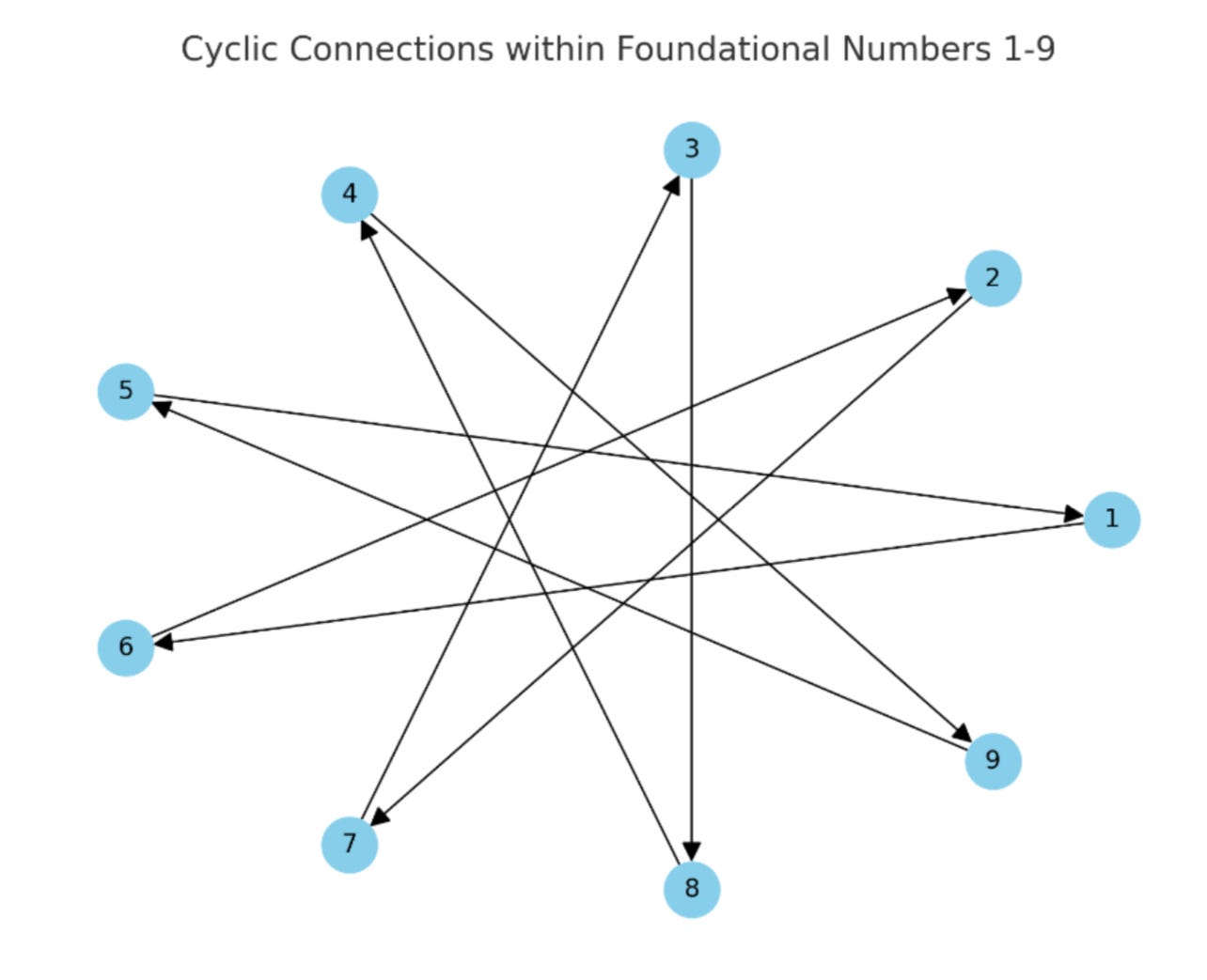
^This^ represents the foundational pattern of cyclic connections within the numbers 1 through 9. At first glance, the sequence appears to progress in a straightforward, linear fashion—1, 2, 3, 4, 5, 6, 7, 8, 9—mirroring the traditional framework of classical physics. Within this linear progression lies an orderly and predictable structure, characteristic of deterministic systems.
However, upon closer examination, the numbers themselves embody an element of probability, revealing an inherent "random" factor within the sequence. This subtle unpredictability suggests that even within seemingly rigid and deterministic frameworks, variability and spontaneity are embedded. This interplay between order and randomness is a key feature of systems that bridge classical physics and the more dynamic, probabilistic nature of quantum mechanics. It invites us to consider how patterns evolve not solely through strict determinism but through a synthesis of structured progression and stochastic possibilities.
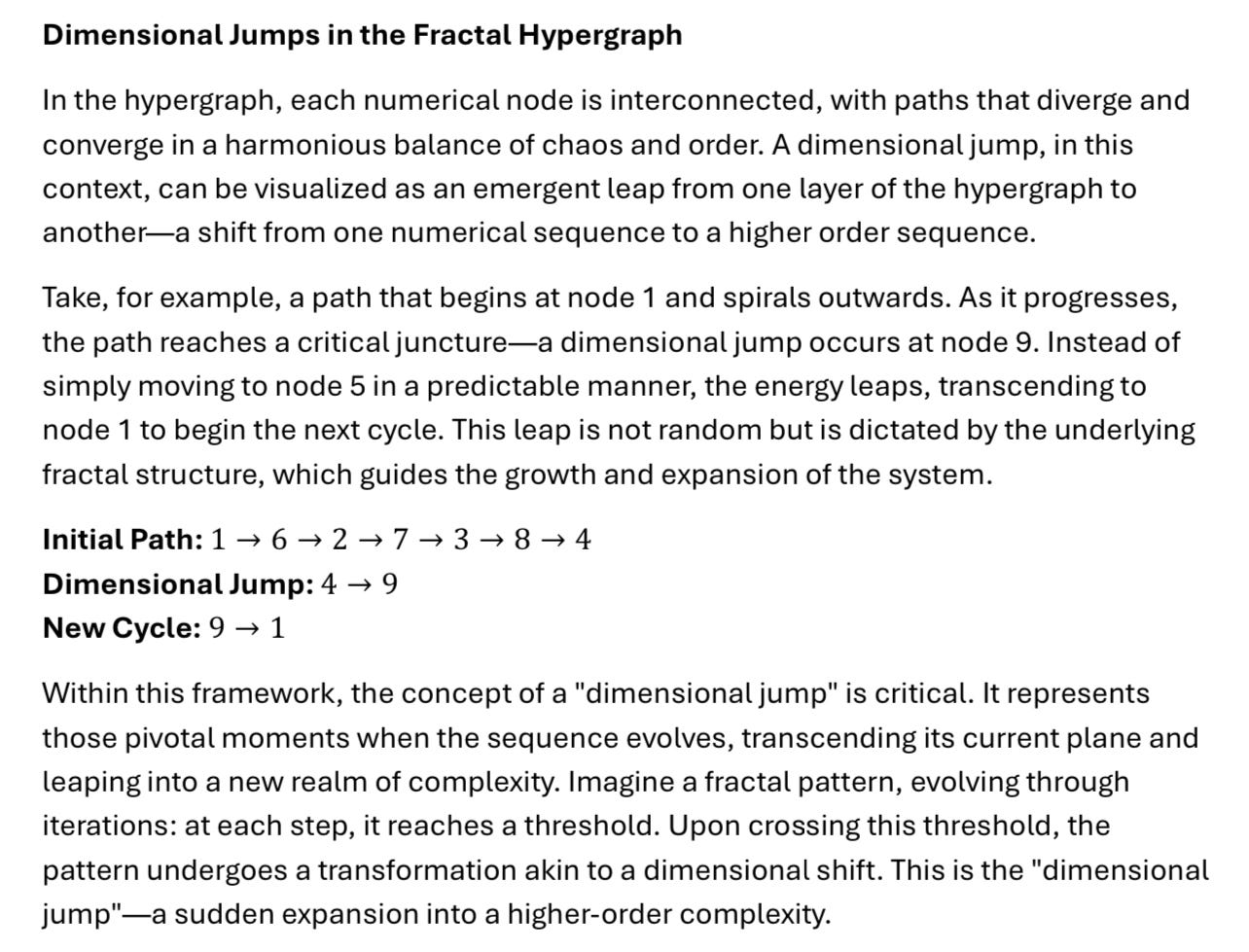
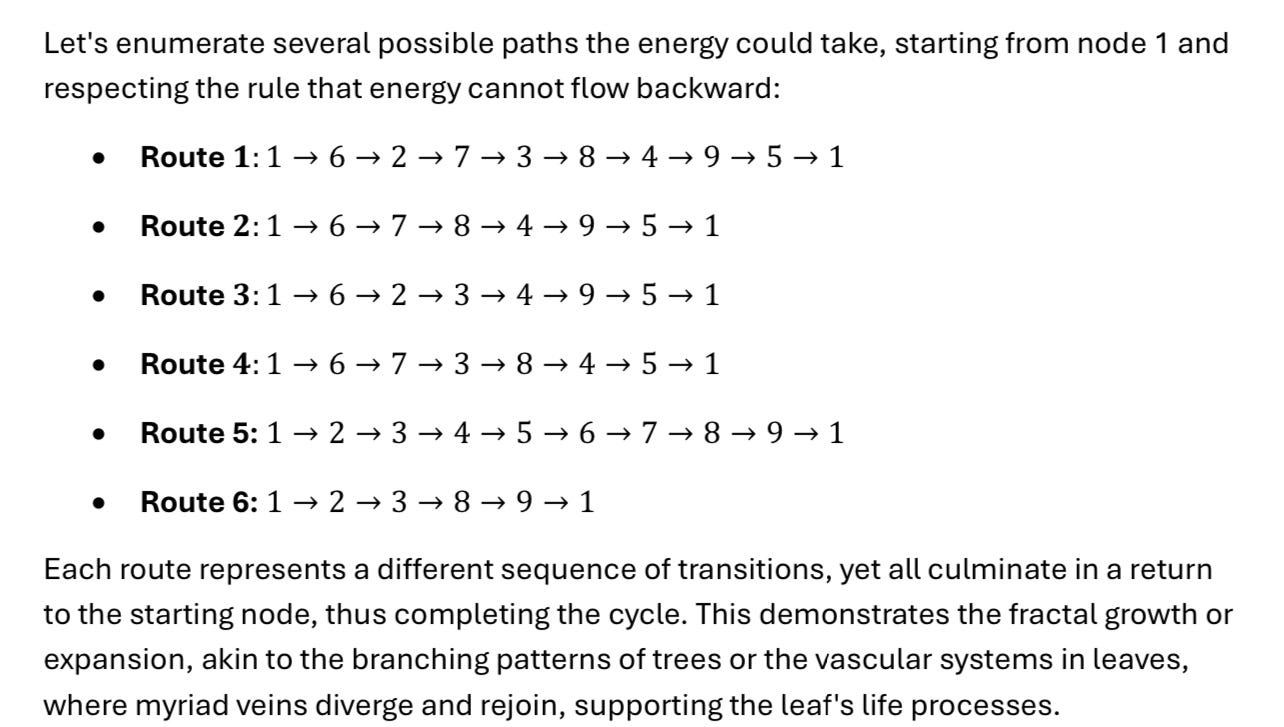
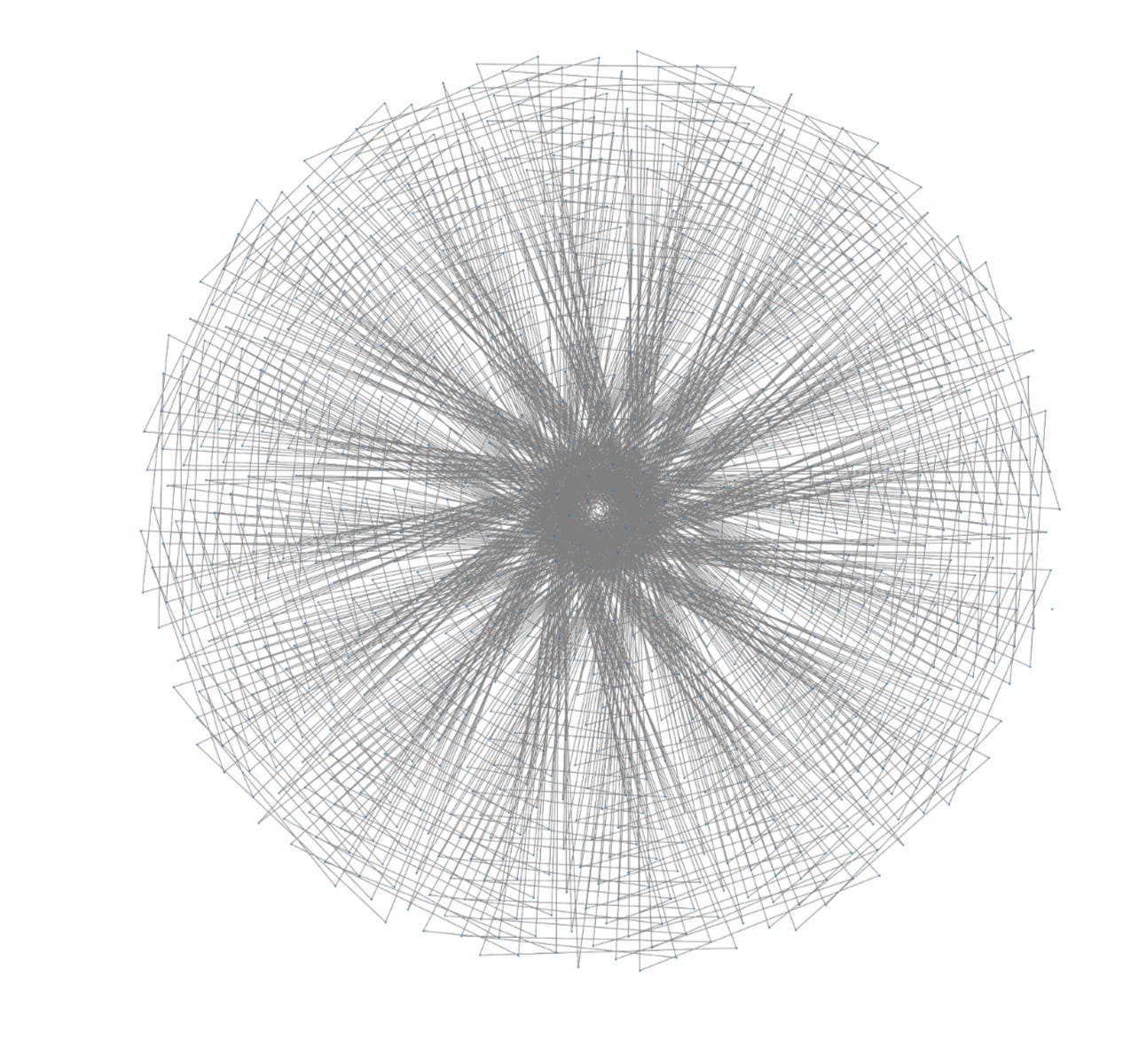
Eventually, this “Pattern” creates our universe….the “Eye of God”….
Thank you
Karl K. Dondaneau