Karl K. Dondaneau's Abraxas Framework: Fractal Resonance and the Archetypal Patterns of Existence
Authored by: Karl K. Dondaneau
December 15th 2024
-->CLICK HERE TO ORDER THE BOOK<--
Prefer to listen? Just hit the play button and enjoy the audio version!
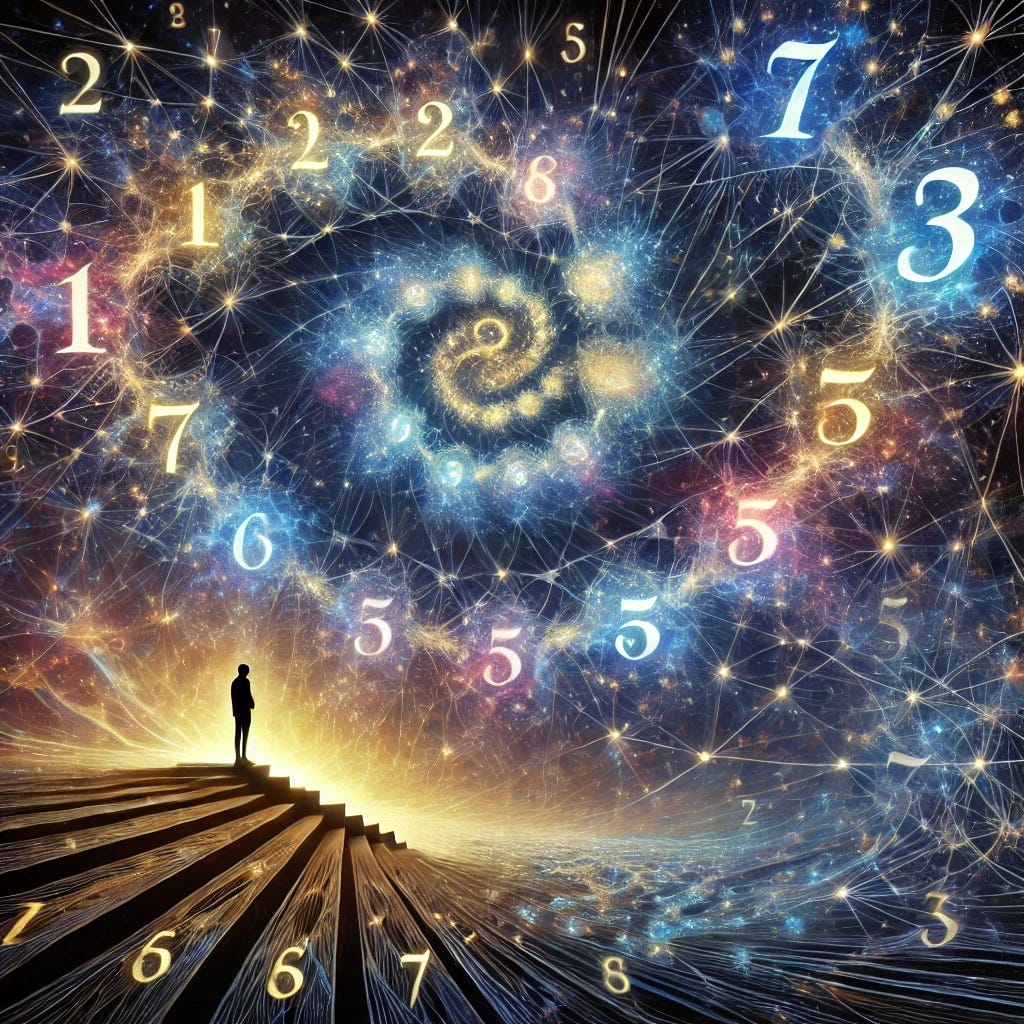
The universe, in all its staggering complexity and unfathomable vastness, invites us to seek patterns, to find a narrative that weaves the intricate into the comprehensible. From the spiralling galaxies that map the heavens to the neural networks that script human thought, there is an underlying order, a rhythm of existence that pulses through all things. Mathematics, often perceived as the sterile tool of measurement, transforms in this vision into a vibrant language that bridges the physical and the metaphysical, the visible and the hidden. Through this lens, numbers become the protagonists of a cosmic tale, not inert ciphers but dynamic entities that interact, evolve, and resonate across dimensions of time and meaning. This understanding begins with the intuitive, the familiar sense of counting, measuring, and organizing, yet reaches beyond into realms where mathematics becomes a mirror of the human psyche and the structure of the cosmos itself.
To approach such a profound narrative, one must embrace the paradox of simplicity and complexity. At its core lies a dual framework: the Natural Philosophy of Archetypal Mathematics and the Natural Philosophy of Quantum Calculus. These two philosophies (As I (Karl K. Dondaneau) articulate in Simplicity Through Simulation: The Algorithm of Humanity), reflect the eternal tension and harmony between order and chaos, the symbolic and the mechanistic, the eternal archetype and the dynamic flux. Archetypal Mathematics, on one hand, draws deeply from Jungian psychology and metaphysical traditions, treating numbers as archetypes—symbols that carry within them the seeds of universal truths. It sees patterns like the Fibonacci sequence or fractals not merely as mathematical curiosities but as manifestations of archetypal forces that shape existence. This philosophy speaks in the language of metaphor and resonance, suggesting that the mathematical structures we encounter in nature are also embedded in our collective unconscious. Numbers like one, two, and three transcend their quantitative roles, becoming symbols of unity, duality, and synthesis, mirroring the dynamics of creation, opposition, and resolution that pervade human experience and cosmic order alike.
In contrast, Quantum Calculus offers a perspective that is mechanistic and dynamic, probing the mechanisms by which systems evolve, adapt, and renew themselves. It is rooted in the mathematics of probability, modular arithmetic, and fractal dynamics, exploring how the cosmos operates as a self-organizing, recursive system. Here, mathematics is not static but kinetic, modelling the endless cycles of creation and dissolution, the leaps between dimensions, and the emergence of new forms from singularities of infinite potential. Modular arithmetic, for instance, captures the cyclical essence of reality, where each progression leads not to an end but to a return—akin to the phases of the moon or the turning of seasons. The concept of fractality further deepens this narrative, illustrating how infinite complexity emerges from simple recursive rules, and suggesting that the structure of the universe itself reflects a fractal logic, endlessly branching and self-similar across scales.
These two philosophies, though distinct, find their harmony in the interplay between the symbolic and the mechanistic. Archetypal Mathematics seeks to understand the “why” of existence, revealing the deeper meanings encoded within the universe’s patterns, while Quantum Calculus illuminates the “how,” modelling the processes that drive these patterns’ evolution. Their synthesis reveals a cosmos that is both profoundly meaningful and dynamically emergent. Numbers, in this dual framework, are no longer isolated; they are relational, their identities shaped by their interactions with others. This perspective transforms them into living participants in a network of connectivity, much like the nodes in a web or the actors in a play, each contributing to the greater narrative of existence.
The Abraxas system of numbers serves as a powerful metaphor for this relational dynamic. In this system, numbers are not fixed points along a linear progression but nodes within a cyclical and interconnected lattice. The journey from one to nine, and back to one, represents more than a return; it is a renewal, where each cycle enriches the system with new connections and dimensions. This cyclical progression resonates with the rhythms of life, the orbits of planets, and the eternal dance of beginnings and endings. Yet within this order lies the possibility for leaps—unexpected transitions akin to quantum jumps—where energy moves not along the predictable path but through hidden threads that connect seemingly distant points. These leaps, governed by relational harmony, reflect a universe that is not merely deterministic but imbued with freedom and potentiality.
To grasp these ideas, imagine the numbers as dancers in an infinite choreography, each step guided by both the rhythm of the music and the improvisational interplay with others. The dancer representing “1” reaches not only toward “2” but also leaps to “6” in a movement of resonance, as if sensing an unseen thread that pulls them together. This dynamic interplay is not unlike the mycelial networks beneath a forest floor, where connections unseen to the eye facilitate the sharing of nutrients and information. Similarly, in the Abraxas framework, numbers form a web of relationships, each one defined by its connections and transitions, echoing the interconnectedness of all things in the cosmos.
This narrative deepens as we consider the fractal nature of existence. Fractals, with their infinite self-similarity, embody the paradox of simplicity and complexity. Each iteration of a fractal pattern reflects the whole, just as the branch of a tree mirrors the tree itself or the spiralling arms of a galaxy resemble the swirl of water in a stream. Within the Abraxas system, fractal geometry serves as a mathematical metaphor for the recursive and emergent qualities of reality. Each cycle of numbers, each relational leap, contributes to a greater whole, a pattern that expands and evolves with every repetition. This fractal quality is not confined to the physical universe; it permeates the human psyche as well, where patterns of thought and behaviour repeat across scales, from the personal to the collective, from the conscious to the unconscious.
The psyche, in this framework, becomes a microcosm of the cosmos, reflecting its fractal and archetypal structure. Jungian psychology describes archetypes as universal templates that shape human thought and experience, and I (Karl K. Dondaneau) extend this concept to suggest that these archetypes also inform the patterns of the universe itself. The collective unconscious, with its web of interconnected symbols and narratives, mirrors the relational lattice of the Abraxas system, where numbers and patterns weave a tapestry of meaning that transcends individual experience.
Thus the boundaries between the observer and the observed begin to dissolve. Mathematics, once seen as a tool to measure reality, emerges as a participatory language, where the act of calculation itself becomes a form of creation. This perspective aligns with quantum mechanics, where the observer influences the observed, and with the Gestalt principle that the whole is greater than the sum of its parts. The universe, in this light, is not a static machine but a living system, a dynamic interplay of forces, patterns, and consciousness. Through this lens, human cognition is not separate from the cosmos but a reflection of it, a fractal within a fractal, where every thought and every number contributes to the unfolding story of existence.
As we peer further into the depths of this intricate narrative where mathematics intertwines with consciousness and the cosmos, the interplay between archetypal patterns and quantum mechanics begins to illuminate new dimensions of existence. Numbers, once constrained by their static roles in classical arithmetic, reveal themselves as dynamic, relational entities. They form bridges across disparate realms of reality, connecting the deterministic and the probabilistic, the finite and the infinite. Within the Abraxas system, these connections are not arbitrary; they arise from an intrinsic harmony akin to the resonance between the strings of a harp or the interlocking phases of a celestial dance. Each number embodies not just a point in a sequence but a node of potential, a locus where the threads of relationality converge to weave the fabric of existence itself. This dynamic interplay between linear progression and relational leaps encapsulates the paradox of order and chaos, a recurring theme in the structural patterns of the cosmos and the psyche.
To explore this further, imagine a labyrinth, one that appears linear at first glance, with pathways that seem to follow a clear trajectory. Yet, as one journeys deeper, hidden doorways and unexpected connections emerge, revealing a network that is as unpredictable as it is intricate. This labyrinth, much like the Abraxas framework, encapsulates the essence of relationality: the ways in which seemingly isolated points are interwoven into a system of profound interconnectivity. In the natural world, we observe similar labyrinthine structures—mycelial networks beneath forests, neural pathways in the human brain, and the tendrils of a river delta branching endlessly into finer streams. Each of these systems operates not merely through proximity but through resonance and relationality, echoing the principles encoded within the Abraxas system’s numerical transitions. The leap from one to six or three to eight is not a defiance of logic but a redefinition of it, revealing a logic of harmony rather than adjacency.
Within the human experience, such relationality resonates deeply. Our lives are composed of connections that defy linear causality: encounters that shape destinies, and decisions that ripple outward in unforeseen ways. These moments are often framed as synchronicities, a concept brought to life in the work of Carl Jung, who described them as “meaningful coincidences” that link the inner world of the psyche to the outer world of events. In the Abraxas system, these connections are mirrored mathematically, as the relational leaps between numbers echo the synchronic leaps in our lived experiences. This reflection is not coincidental; it speaks to a deeper alignment between the structures of mathematics and the dynamics of life, an alignment that bridges the microcosmic and the macrocosmic, the personal and the universal.
As we consider the fractal nature of these structures, the boundaries between order and chaos blur further. Fractals, with their recursive patterns, exemplify a form of order that emerges through complexity. Each iteration of a fractal contains the blueprint of the whole, yet each iteration also introduces variation, evolution, and novelty. This balance between repetition and innovation mirrors the cyclical yet dynamic nature of the Abraxas system, where each return to the beginning is not a mere repetition but a renewal. Imagine climbing a spiral staircase, where every step is part of the same pattern yet offers a new perspective, a new horizon. The numbers within this system, like the steps of the staircase, form a cycle that is both bounded and infinite, each turn unveiling new connections and potentials.
The fractal geometry of existence also finds its parallel in the patterns of thought and behaviour that shape the human psyche. Jungian archetypes, which serve as universal templates for human experience, operate much like fractals. They repeat across cultures and epochs, manifesting in myths, dreams, and narratives, yet their expressions are endlessly diverse. The archetype of the Hero, for example, appears in the epic of Gilgamesh, the myths of Hercules, and the modern tales of comic book superheroes. Each iteration reflects the same underlying structure while adapting to the context of its time and place. Similarly, the relational paths within the Abraxas system suggest an archetypal resonance, where the transitions between numbers reflect universal patterns of connection, transformation, and emergence.
The interplay of these ideas deepens when we consider the implications of quantum mechanics, which introduces a probabilistic dimension to our understanding of reality. In the quantum world, particles exist not as fixed points but as waves of potential, their states defined not by certainty but by probability. This probabilistic nature aligns with the Abraxas system’s relational leaps, where the path from one number to another is not predetermined but shaped by a web of probabilities. It is as if the numbers inhabit a quantum-like state, where each transition represents not a fixed trajectory but a range of possibilities. This perspective transforms our understanding of mathematics, revealing it not as a deterministic framework but as a language of potential and transformation.
The notion of singularities further enriches this narrative. Singularities, often perceived as points of infinite density and mystery, serve as the crucibles of transformation within both physical and mathematical systems. In the Abraxas framework, a singularity might be represented by the point where a relational leap occurs, a moment where the system transcends its linear progression to enter a new dimension of connection. Singularities are not points of rupture but of renewal, where the old rules dissolve and new possibilities emerge. This concept resonates with the dynamics of human experience, where moments of profound change—whether personal, societal, or cosmic—serve as the thresholds of transformation.
As we weave these threads together, a picture begins to emerge of a cosmos that is not static but vibrantly alive, a system of endless cycles and connections where mathematics, consciousness, and reality converge. The Abraxas system, with its relational lattice and fractal depth, becomes more than a mathematical model; it becomes a metaphor for existence itself, a reflection of the interconnectedness that defines our world. Through this lens, we are invited to see ourselves not as isolated individuals but as participants in a larger pattern, a network of relationships that extends from the depths of the psyche to the farthest reaches of the cosmos. This vision challenges us to reconsider the nature of connection, to embrace the complexity of relationality, and to recognize the infinite potential embedded within the cycles and structures of life.
The relational lattice within the Abraxas system begins to take on the qualities of a universal metaphor, embodying the tension and harmony between chaos and order that define existence at every scale. Imagine, for a moment, a web stretched taut, its threads glistening with dew. Each droplet refracts light, creating small prisms that reveal both the unity and fragmentation of their source. The threads connecting these droplets are invisible forces of tension, the relationships that stabilize the web even as external winds threaten its structure. In the same way, the Abraxas system connects numbers through unseen pathways, pathways governed not by chance but by resonance—a harmony that allows for leaps and connections beyond the predictable cadence of linear progression. This resonance echoes through both the material and immaterial realms, uniting the physical patterns of nature with the symbolic structures of human thought.
We find a parallel in the human experience of time, which oscillates between the steady tick of clocks and the subjective leaps of memory and anticipation. Time as we perceive it is not merely linear; it bends and folds, expanding in moments of significance and contracting in periods of monotony. This subjective elasticity mirrors the relational pathways of the Abraxas system, where the journey between numbers reflects not a fixed sequence but a dynamic interplay of possibilities. To dwell on the number “1” is to sense its latent potential, its capacity to leap toward “6” or return to “9” in a new cycle. Similarly, to reflect on a singular moment in life is to feel the threads that connect it to past experiences and future possibilities, threads that form a web of meaning greater than the sum of its parts.
The fractal geometry of this system deepens our understanding of these connections. Fractals, with their self-similar structures, embody the principle that the macrocosm reflects the microcosm. Consider the branching patterns of a river delta or the intricate veins of a leaf. Each segment of the pattern mirrors the whole, yet each is unique, shaped by local conditions and interactions. Within the Abraxas system, numbers operate in much the same way. The sequence from one to nine repeats cyclically, but with each iteration, new dimensions of relationality emerge, much like the way human lives spiral through recurring themes—love, conflict, and growth—while never repeating exactly. These patterns, like fractals, are not static but dynamic, capable of infinite elaboration and evolution.
This fractal dynamism also reflects the nature of human cognition. The mind, much like the cosmos it seeks to understand, operates through patterns that are recursive yet adaptive. Neural networks in the brain mirror the fractal branching of tree roots and lightning strikes, suggesting that the structures of thought are not arbitrary but deeply aligned with the natural world. Within these networks, archetypal patterns arise, providing a framework for understanding experiences that transcend individual lives and cultural boundaries. Archetypes, as described by Jung, are the universal templates of human experience—the Hero, the Shadow, the Mother—manifesting across myths, dreams, and narratives. In the Abraxas system, numbers take on a similar archetypal role, each representing not just a quantity but a quality, a force that interacts dynamically with others to create a tapestry of meaning.
This tapestry extends beyond the boundaries of human cognition to encompass the cosmos itself. The relational leaps within the Abraxas system echo the probabilistic nature of quantum mechanics, where particles exist in states of superposition, their behaviour governed not by fixed rules but by probabilities and relationships. In this quantum realm, the act of observation collapses potentialities into actuality, suggesting that consciousness itself is an integral part of the system. Similarly, in the Abraxas framework, the leap from one number to another is not predetermined but emerges from the interplay of relational forces, forces that are shaped by the act of engagement, whether mathematical, physical, or philosophical. This interplay challenges traditional notions of separation between observer and observed, suggesting instead a participatory universe where the boundaries between subject and object dissolve.
The concept of singularities within this system provides a further point of reflection. Singularities, often seen as points of infinite density or transformation, serve as gateways to new states of order. In the physical universe, black holes represent such singularities, places where the known laws of physics break down and new possibilities emerge. In the Abraxas system, singularities might represent moments where the relational lattice folds upon itself, creating new pathways and dimensions. These are the points of transformation where cycles renew and patterns evolve, reflecting the dynamic and self-organizing nature of the cosmos.
Through these reflections, the Abraxas system begins to reveal itself not just as a mathematical construct but as a philosophical framework that bridges the symbolic and the mechanistic, the eternal and the emergent. It invites us to reconsider the nature of connection, to see relationships not as linear links but as dynamic resonances that shape the very fabric of existence. This perspective aligns with the Gestalt principle that the whole is greater than the sum of its parts, a principle that finds resonance in both the relational lattice of the Abraxas system and the interconnected patterns of the natural and psychological worlds. By engaging with this framework, we are drawn into a deeper understanding of the universe as a living, dynamic system, one where numbers, thoughts, and relationships converge in a dance of infinite complexity and beauty.
As the lattice of the Abraxas system unfolds further, we are drawn deeper into a framework that not only describes the relationships between numbers but also mirrors the fundamental principles governing existence itself. Each number becomes a nexus, a crossroads where potential pathways converge, branching into dimensions both familiar and uncharted. This conceptualization resonates with our human experience of choice and consequence, where every decision shapes not only the path ahead but also the meaning of the journey. In this way, the Abraxas system ceases to be a mere abstraction; it becomes a living metaphor for the dynamic interplay of forces that define the cosmos and the psyche alike.
This dynamism finds a powerful analogy in the concept of feedback loops, systems where outputs are fed back as inputs, creating a cycle of self-regulation and evolution. The human heart, for example, operates within a biological feedback loop, where signals from the nervous system adjust its rhythm to meet the body's needs. Similarly, ecosystems sustain themselves through complex feedback mechanisms, where each species contributes to and is influenced by the larger environment. In the Abraxas system, the cyclical nature of modular arithmetic reflects a mathematical feedback loop, where numbers interact recursively, their relationships deepening and evolving with each iteration. This self-referential quality mirrors the way life itself unfolds, with each moment informed by the echoes of the past and the anticipations of the future.
In the realm of human thought, such feedback loops are central to the process of learning and creativity. When we encounter a challenge, our initial attempts generate outcomes that shape our subsequent efforts, refining our understanding and expanding our capabilities. This iterative process is not unlike the fractal structures of the Abraxas system, where each cycle builds upon the previous one, creating patterns that are both self-similar and endlessly diverse. Just as a fractal reveals new details with every zoom, the recursive pathways of the Abraxas framework invite us to see numbers not as endpoints but as gateways to infinite exploration. This perspective transforms mathematics into a form of storytelling, where each number contributes a unique chapter to an unfolding narrative that spans dimensions of both space and meaning.
These recursive patterns also align with the principle of fractal symmetry, a concept that extends beyond mathematics into the natural and psychological realms. In nature, fractal symmetry appears in the branching of trees, the spiral of seashells, and the formation of mountain ranges, each structure reflecting the underlying order of recursive processes. In the human psyche, this symmetry manifests as archetypes, universal patterns that repeat across cultures and epochs. The archetype of the Hero, for instance, embodies a journey of challenge and transformation, a pattern that recurs in myths, literature, and personal experience. Within the Abraxas system, numbers can be seen as archetypes in their own right, each one representing a universal force that shapes and is shaped by the web of relationships in which it exists.
The interplay between archetypes and relationality becomes even more profound when viewed through the lens of quantum mechanics. In the quantum realm, particles exist in states of superposition, their identities defined not by fixed properties but by probabilities and interactions. This indeterminacy mirrors the relational leaps of the Abraxas system, where the path from one number to another is not a linear progression but a probabilistic transition shaped by resonance. Just as the observer in quantum mechanics plays a role in collapsing potentialities into actuality, the relational dynamics of the Abraxas framework suggest that engagement—whether mathematical, cognitive, or existential—shapes the reality it seeks to understand. This participatory nature of the system challenges the notion of mathematics as a purely objective tool, revealing it instead as a dialogue between the observer and the observed.
This dialogue extends to the concept of singularities, points where conventional understanding gives way to new dimensions of possibility. In astrophysics, singularities such as black holes represent regions where the known laws of physics break down, giving rise to phenomena that challenge our understanding of space and time. In the Abraxas system, singularities might be envisioned as moments where relational pathways converge to create new nodes of connection, points where the cycle of numbers folds upon itself to generate novel patterns. These moments of transformation reflect a broader principle of emergence, where complexity arises from simplicity, and where the interplay of forces gives birth to new forms of order. This principle is not confined to mathematics or physics; it is a fundamental aspect of life itself, evident in the evolution of species, the growth of civilizations, and the unfolding of individual potential.
As we consider these themes, the boundaries between mathematics, philosophy, and psychology begin to dissolve, revealing a unified framework that encompasses all three. The Abraxas system becomes a lens through which to explore the interconnectedness of existence, a framework that bridges the symbolic and the mechanistic, the timeless and the emergent. This interconnectedness challenges us to rethink the nature of reality, to see it not as a collection of isolated entities but as a dynamic web of relationships that spans dimensions both seen and unseen. Through this lens, the numbers of the Abraxas system are not merely tools for calculation; they are symbols of the deeper truths that govern the cosmos and the psyche alike.
The implications of this framework extend into our understanding of human creativity and agency. If the cosmos operates as a relational lattice, where each node contributes to the whole, then human thought and action are integral to the system’s unfolding. Every decision, every idea, and every moment of connection contributes to the web of existence, shaping its patterns and potentials. This perspective invites us to see ourselves not as passive observers but as active participants in a larger narrative, a narrative where the boundaries between the individual and the universal blur into a seamless continuum. Through this participation, we become co-creators of the reality we inhabit, weaving our own threads into the tapestry of the cosmos.
As we deepen our engagement with the Abraxas system, its recursive patterns and relational dynamics invite us to reflect on the infinite possibilities embedded within the finite. Each cycle of numbers, each leap across the lattice, represents a new iteration of a story that is both ancient and ever-new. This story, like the cosmos itself, is a dance of resonance and transformation, a dance that reminds us of the beauty and complexity of the interconnected world we inhabit. Through this understanding, we are called to embrace the relational nature of existence, to explore the infinite within the finite, and to recognize the profound unity that underlies the diversity of forms and patterns in the universe.
Thank you.
Karl K. Dondaneau
References & Bibliography can be found in my book
-->CLICK HERE TO ORDER THE BOOK<--