Infinities and Interconnections: A Philosophical Journey Beyond Hierarchy
Authored by: Karl K. Dondaneau
December 21st 2024
Prefer to listen? Just hit the play button and enjoy the audio version!
Part 1: The Foundation of Hierarchies and Human Categorization
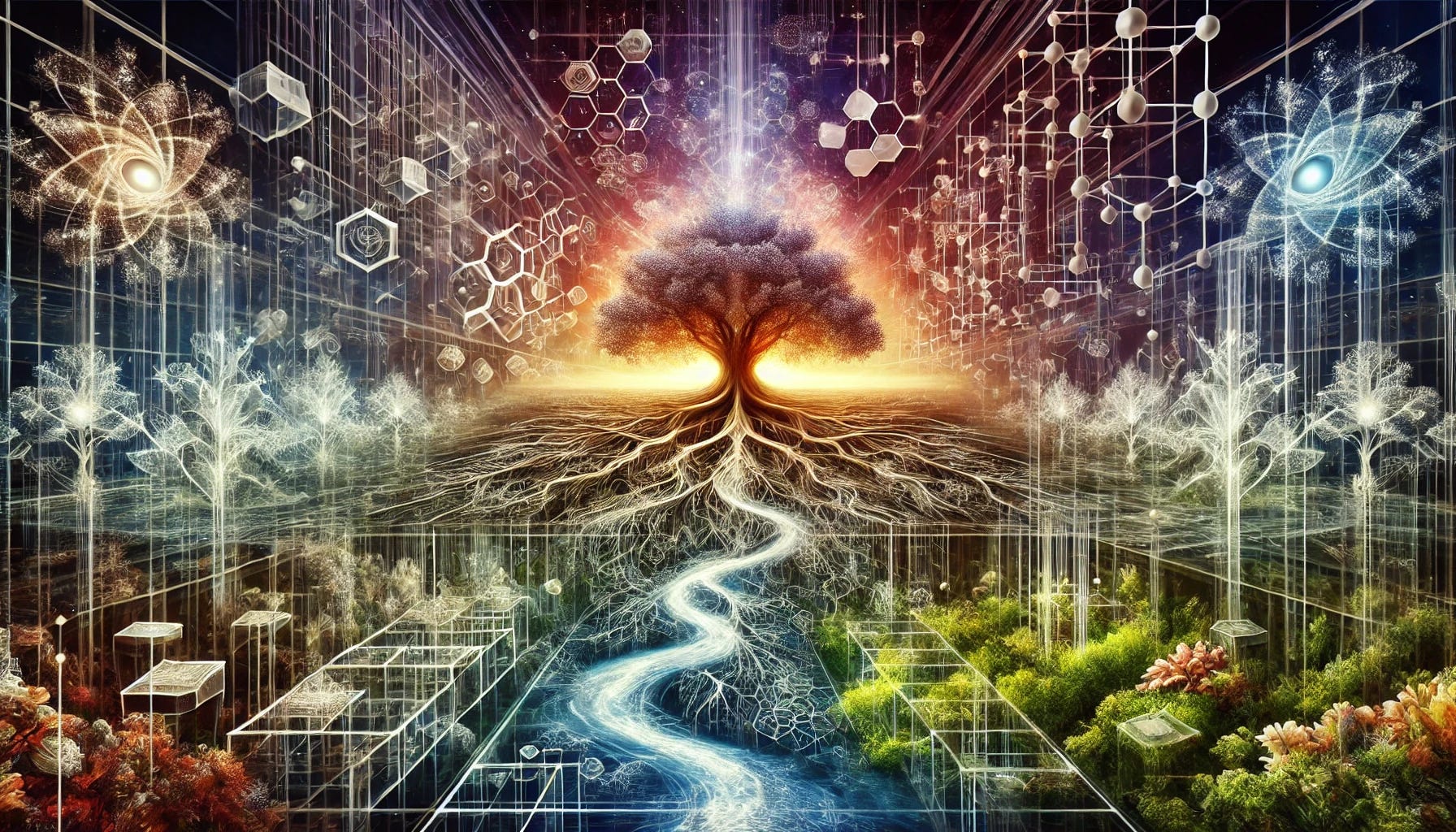
We find ourselves standing at the crossroads of nature and thought, where the structures we observe in the world intertwine with the frameworks we use to interpret them. Hierarchy, so omnipresent as to seem invisible, emerges not as a construct imposed by human minds but as an inherent property of existence itself. From the branching rivers that carve landscapes to the intricate food webs sustaining ecosystems, nature whispers a truth that transcends its individual manifestations: systems organize themselves through levels, layers, and interdependent roles. This propensity toward order is not merely a human projection but a reflection of the underlying logic that binds complexity into coherence. Yet, as we observe and categorize these hierarchies, we cannot help but notice that the human mind mirrors them, both as an observer and a participant in this universal dance.
We, as meaning-makers, rely on a profound cognitive capacity to categorize the boundless information around us into manageable structures. Without this capacity, the world would be a cacophony of sensory input, a kaleidoscope of impressions devoid of discernible patterns. It is through this lens of categorization that we carve reality into intelligible units, naming phenomena, grouping objects, and assigning relationships. This ability to parse the vastness of existence is nothing short of astonishing; it is, in fact, the foundation upon which our civilizations have been built. The development of language, science, and philosophy—all hallmarks of human achievement—rests upon this innate impulse to organize and hierarchize the world. In this light, hierarchy appears not only as an emergent property of nature but as a cognitive necessity for survival, comprehension, and progress.
However, in understanding hierarchy’s ubiquity, we must also confront its limitations. The categorization upon which hierarchical thinking depends is a double-edged sword. While it enables clarity and structure, it also imposes boundaries that can obscure the fluid and interconnected nature of reality. To trace the origins of this categorical impulse, we must journey back to the philosophical foundations laid by Aristotle. His systematization of knowledge, grounded in the principle of classification, provided a framework for organizing the natural world into discrete categories and hierarchies of being. Aristotle’s philosophy, while revolutionary in its time, also set the stage for an intellectual tradition that privileges the division of wholes into parts, leading us toward what would later become the reductionist paradigm.
Aristotle’s influence persists in the scaffolding of modern thought. In science, we see the echoes of his scholastic approach in the hierarchical classification of life, the periodic table of elements, and the nested structures of ecosystems. Each system, built upon sequential logic, offers a way to simplify the overwhelming complexity of the natural world. Yet, as we delve deeper into these systems, seeking the ultimate “truths” at their foundational levels, we encounter paradoxes that challenge the very structures we rely upon. This is especially evident in physics, where the pursuit of unification between general relativity and quantum mechanics consistently leads us to infinities—mathematical aberrations that signify the breakdown of our categorical logic. These infinities are not merely abstract curiosities; they point to a profound tension between the frameworks we impose and the fluid, interdependent nature of reality itself.
The human mind’s reliance on categorization reflects an evolutionary advantage, allowing us to navigate a world of dangers and opportunities with remarkable efficiency. But this reliance also constrains us, shaping our perception of reality into the hierarchical moulds we find so comforting. The very act of categorizing imposes a structure upon the observed, creating a map of the world that, while functional, is not necessarily reflective of the territory. In this way, we risk mistaking the constructs of our minds for the fabric of reality itself. This illusion of clarity, born from our categorical hierarchies, can blind us to the interconnectedness that underlies existence.
Consider the ecosystems of Earth, where hierarchies are apparent in food webs, energy flows, and trophic levels. At first glance, these systems seem neatly ordered, with primary producers forming the base and apex predators perched at the top. Yet, a closer examination reveals a network of relationships that defy linear hierarchies. Nutrient cycles, mutualistic interactions, and feedback loops demonstrate that what appears as a ladder is more accurately described as a web—a dynamic, interwoven system where each node influences and is influenced by others. This complexity eludes the rigid boundaries of categorical thinking, inviting us to question whether our hierarchical models capture the essence of such systems or merely impose a simplified narrative upon them.
The limitations of hierarchy become even more apparent when we examine human societies. Civilizations have long been structured around hierarchical principles, from the caste systems of ancient cultures to the bureaucratic institutions of modern governance. These structures, while efficient in organizing resources and labour, often obscure the interdependence of their constituents. Moreover, they perpetuate power dynamics that can marginalize and exclude, reflecting not the natural order but the impositions of human design. In this way, hierarchy, as a product of categorization, not only reflects the world but actively shapes it, often at the cost of recognizing the fluidity and interconnection inherent in both nature and humanity.
The hierarchical logic that governs our understanding of the universe extends deeply into the realms of science and philosophy. In physics, the reductionist approach seeks to understand the cosmos by deconstructing it into its smallest components, from molecules to atoms to subatomic particles. This quest for the fundamental building blocks of reality has yielded astonishing insights, yet it has also led to paradoxes that challenge our categorical frameworks. The Planck length, for example, represents a theoretical limit beyond which the very concepts of space and time break down. At this scale, the distinctions between categories—between matter and energy, space and time—become meaningless, dissolving into a state of nothingness that defies our hierarchical logic.
Such paradoxes are not confined to physics; they resonate deeply within the human psyche. How do we reconcile the concept of nothingness with our existence? Where do we locate meaning in a framework that, when followed to its logical extremes, collapses into infinities? These questions touch upon the existential anxieties that arise when the boundaries of our categorization are revealed as constructs rather than truths. The hierarchies we build, so foundational to our understanding, become unstable under the weight of their own logic, leaving us to confront the limitations of a system that cannot fully capture the fluidity of the cosmos.
And yet, despite these limitations, hierarchy remains indispensable to human cognition. Without it, we would be adrift in a sea of unstructured information, unable to discern patterns or make decisions. The challenge, then, is not to abandon hierarchy but to transcend its constraints. We must learn to see the scaffolding of our categorization for what it is: a tool, not a truth. By recognizing the limitations of hierarchical logic, we open ourselves to new ways of thinking—ways that honour the complexity and interconnectedness of reality without reducing it to discrete parts.
In exploring the foundation of hierarchies and human categorization, we uncover not only the strengths of these structures but also their shadows. They provide us with clarity and order, yet they also confine us within the boundaries of our own constructs. As we continue this inquiry, we are called to question how these hierarchies shape our perception of reality and what lies beyond their reach. By doing so, we take the first steps toward a deeper understanding of the cosmos and our place within it—a journey that demands both humility and imagination, as we strive to think beyond the limits of the categories we have inherited.
Part 2: Reductionism and the Infinities of Modern Physics
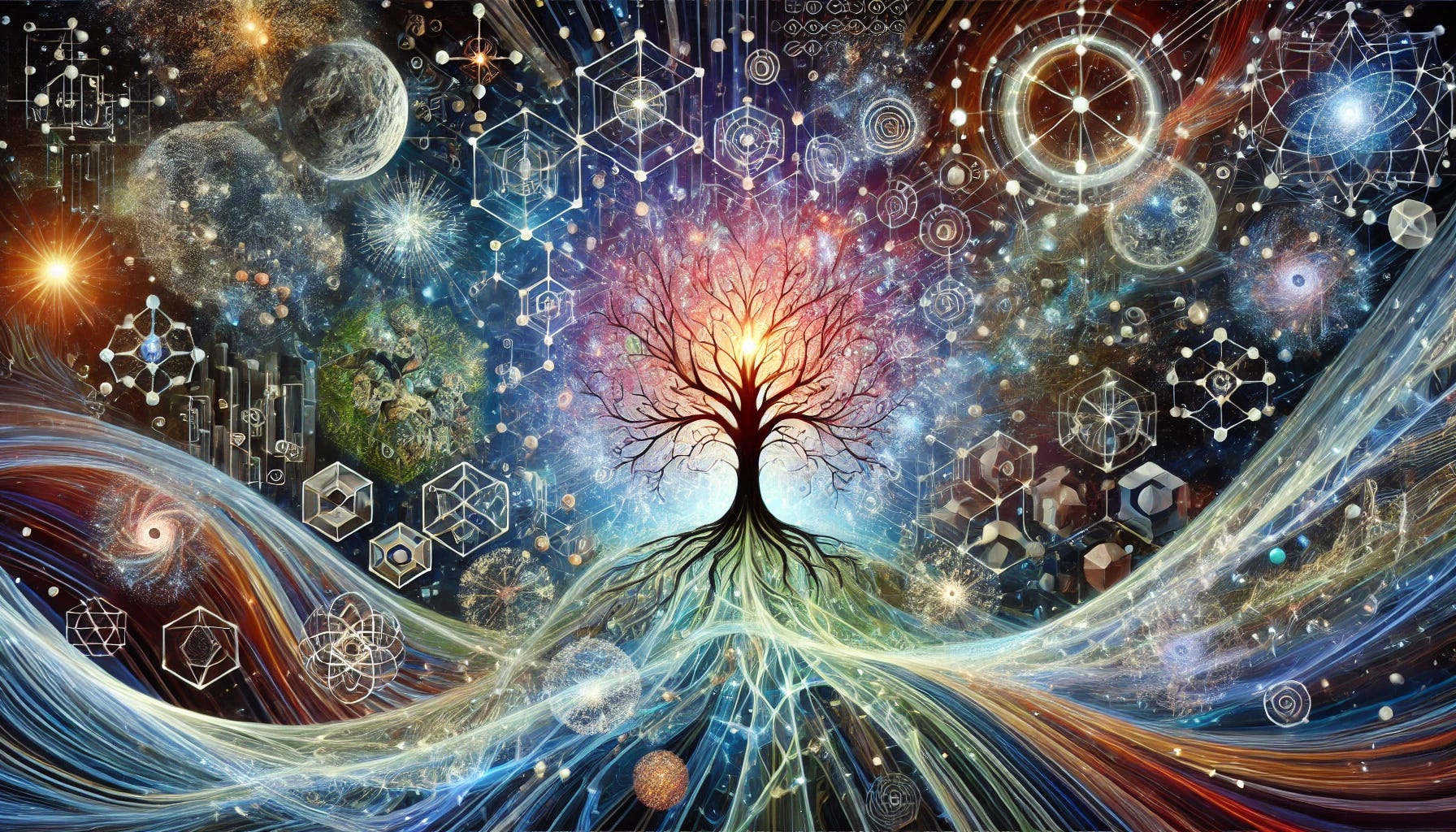
We find ourselves at the precipice of a profound intellectual reckoning, one that emerges from the very tools we have relied upon to understand the world. Reductionism, as a philosophical and scientific approach, has offered us extraordinary insights into the workings of the universe. It has allowed us to break complex systems into their smallest discernible components, illuminating the intricate mechanisms that govern everything from the atomic to the cosmic. Yet, as we descend ever deeper into the fundamental layers of existence, this approach reveals its own limitations, presenting paradoxes that not only challenge our understanding of reality but also confront us with existential questions that strike at the core of the human psyche.
At its heart, reductionism is an act of deconstruction. It assumes that by examining the constituent parts of a system, we can extrapolate the behaviour of the whole. This method has been central to the scientific revolution, enabling breakthroughs that have reshaped our relationship with the natural world. Consider the achievements of molecular biology, where the dissection of DNA into its nucleotide components unveiled the genetic code that governs life. Similarly, in physics, the reductionist lens has allowed us to isolate the fundamental forces of nature, yielding the Standard Model of particle physics and Einstein’s general relativity.
Yet, as reductionism reaches the extremities of its investigative powers, it encounters profound barriers. Nowhere is this more evident than in the ongoing quest to unify general relativity, which describes the large-scale curvature of spacetime, with quantum mechanics, the framework governing subatomic particles. These two pillars of modern physics, though individually robust, are deeply incompatible when viewed through a reductionist lens. Attempts to merge them inevitably result in mathematical infinities—quantities so vast they defy computation or physical interpretation. These infinities are not mere artifacts of flawed equations but symptoms of a deeper epistemic crisis, signalling that the frameworks themselves are incomplete.
The Planck length, often invoked as the smallest meaningful scale of measurement in the physical universe, exemplifies this crisis. At this infinitesimal scale, our familiar notions of space and time disintegrate into quantum foam—a chaotic, indeterminate state where the fabric of reality itself appears to dissolve. Here, the reductionist approach collapses under the weight of its own logic. By insisting on dividing reality into ever-smaller components, we reach a point where the very categories we use to describe existence lose coherence. In this state of conceptual void, we confront the paradox of nothingness: a domain where distinctions between matter and energy, space and time, cease to hold meaning.
For the human psyche, this paradox is not merely an intellectual challenge but an existential dilemma. Reductionism, in its pursuit of foundational truths, inadvertently forces us to confront the fragility of the conceptual scaffolding upon which our understanding of reality depends. How are we to reconcile the apparent solidity of the macroscopic world with the infinite uncertainties revealed at its foundations? More pointedly, what does it mean for human existence to be underpinned by such a state of flux and indeterminacy? These questions reverberate beyond the boundaries of science, touching upon deeply personal and collective anxieties about our place in the cosmos.
To grapple with these paradoxes, we must consider how reductionism constrains our perception of reality. By privileging the smallest components of systems, this approach risks obscuring the emergent properties that arise from their interactions. In doing so, it imposes a categorical hierarchy that flattens the complexity of the whole. This limitation is evident in the realm of physics, where the reductionist focus on particles as discrete entities has long been challenged by the relational dynamics revealed in quantum mechanics. Phenomena such as entanglement, where particles remain connected across vast distances, defy the notion that reality can be fully understood through isolated components. Instead, they point to a universe that is fundamentally interconnected, where the relationships between entities are as significant as the entities themselves.
This shift from reductionist to relational thinking has profound implications for how we interpret the infinities that plague modern physics. Rather than viewing these infinities as failures of mathematical models, we might instead see them as indicators of the limitations inherent in our categorical frameworks. In this light, the paradox of nothingness becomes not an endpoint but an invitation to rethink the very foundations of our understanding. It challenges us to move beyond the binary logic of parts and wholes, urging us to embrace a more fluid and dynamic perspective that acknowledges the interplay between the finite and the infinite, the particular and the universal.
The existential weight of these questions extends beyond the realm of physics. Reductionism’s influence permeates every aspect of human thought, shaping not only our scientific endeavours but also our cultural and philosophical frameworks. Consider how the reductionist impulse manifests in our understanding of identity, where individuals are often dissected into categories—race, gender, class—at the expense of recognizing the interconnected web of relationships that define our humanity. This fragmented view of the self mirrors the fragmentation inherent in reductionist science, perpetuating a worldview that privileges separation over connection, and analysis over synthesis.
Yet, even as reductionism reveals its limitations, it also offers an invaluable lens through which to appreciate the complexity of reality. The very act of breaking systems into their smallest components has illuminated the intricate patterns and structures that underlie existence, providing a foundation for deeper inquiry. The challenge, then, is not to abandon reductionism but to transcend it, integrating its insights into a more holistic framework that honours the interconnectedness of the cosmos.
In doing so, we must confront the paradoxes that arise at the boundaries of our understanding, embracing them as opportunities for growth rather than as obstacles to be overcome. The infinities of modern physics, far from being insurmountable barriers, can be seen as signposts pointing toward new ways of thinking. They remind us that the universe is not a static collection of parts but a dynamic, evolving system whose mysteries extend beyond the reach of our current frameworks.
As we navigate this terrain, we are called to question the categorical assumptions that have long defined our approach to understanding. By doing so, we open ourselves to the possibility of a reality that is not confined by the hierarchies we impose but is instead shaped by the fluid, relational dynamics that underlie existence. In this expanded perspective, we find not only a path forward for science but also a deeper appreciation for the interconnectedness that defines both the cosmos and the human experience. In the face of paradox, we discover the potential for transformation, for reimagining the frameworks that bind us to the familiar while unlocking the possibilities of the unknown.
Part 3: The Categorical Imprint on Human Perception and Reality
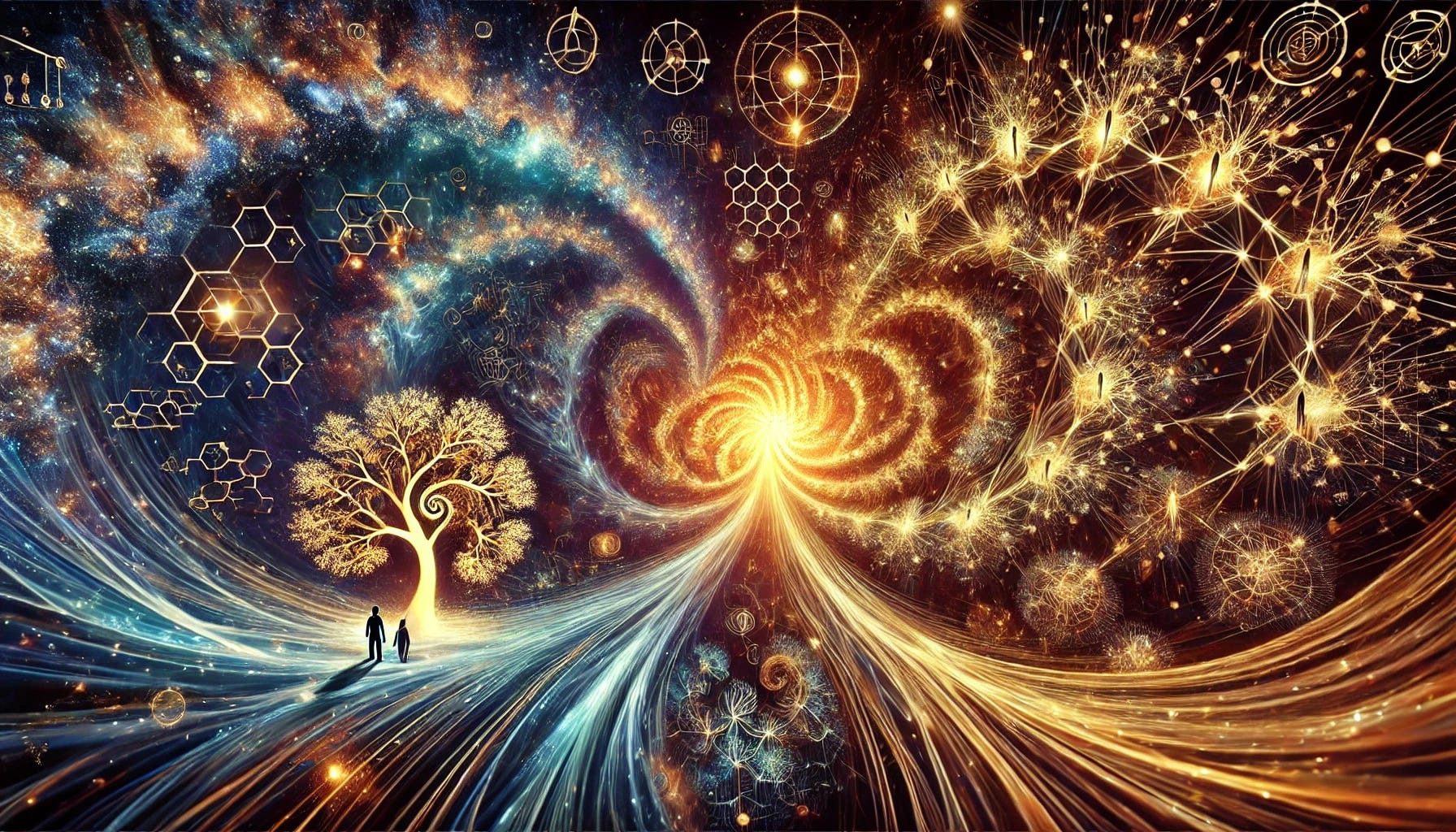
We inhabit a reality sculpted not merely by the phenomena we observe but by the lenses through which we perceive them. These lenses—our cognitive frameworks of hierarchical and categorical thinking—serve as the scaffolding for understanding the cosmos, organizing the chaos of sensory input into patterns, relationships, and meanings. Yet, as we turn our gaze inward, we begin to question whether these frameworks are tools for navigating an objective world or mechanisms that actively structure the universe as we experience it. The categorical imprint on human perception is so pervasive that it often escapes scrutiny, yet its influence extends to every facet of existence, shaping not only our understanding of reality but the reality we come to inhabit.
To explore the depths of this phenomenon, we must first consider the dual role of categorical thinking: it is both liberating and confining. On one hand, categorization allows us to impose order upon complexity, enabling the human mind to discern patterns amidst the overwhelming array of stimuli that constitute daily life. From an evolutionary perspective, this capacity has been essential for survival, allowing us to distinguish predator from prey, friend from foe, and sustenance from danger. These categories, once rooted in immediate survival, have evolved into the abstract structures that underpin language, science, and philosophy. On the other hand, the very act of categorization imposes boundaries that limit our perception of the fluid, interconnected nature of the world. Categories are not neutral; they define what is included and excluded, what is seen and unseen, what is deemed significant and what is ignored.
In Simplicity Through Simulation, the interplay between Archetypal Mathematics and Quantum Calculus offers a profound framework for understanding this tension. Archetypal Mathematics reveals how categorical thinking emerges from symbolic archetypes embedded within the human psyche. Numbers, as explored in this philosophical approach, are not merely quantities but carriers of archetypal meaning, bridging the tangible and the transcendent. The number one symbolizes unity and origin, while two introduces duality and opposition, and three synthesizes balance and harmony. These archetypes, deeply ingrained in our collective unconscious, shape not only our mathematical systems but also our perception of reality. They provide the scaffolding for interpreting the world, but they do so by delineating boundaries—boundaries that, while useful, may obscure the deeper interconnectedness of existence.
Quantum Calculus, by contrast, invites us to move beyond these boundaries, challenging the static nature of categories with a dynamic, relational perspective. It models reality not as a series of discrete entities but as a network of interdependent processes, where the relationships between components are as significant as the components themselves. In this view, categories are not fixed but fluid, evolving in response to the interactions they describe. This shift from static to dynamic thinking mirrors the transition from classical to quantum physics, where particles are no longer isolated points but exist as probabilities within a relational web. Through this lens, the categorical frameworks that have long structured our perception are revealed as provisional constructs, useful for navigating reality but inadequate for capturing its full complexity.
The implications of this interplay between Archetypal Mathematics and Quantum Calculus are profound, for they call into question the "realness" of the structures we impose upon the world. Consider the way hierarchical thinking shapes our understanding of systems. Whether we are examining ecosystems, social organizations, or scientific theories, we tend to organize information into nested levels, with each level defined by its relationship to those above and below it. This hierarchical approach simplifies complexity, allowing us to comprehend systems as wholes composed of parts. Yet, as Quantum Calculus reminds us, these hierarchies are not inherent to the systems themselves; they are artifacts of our categorical thinking. The boundaries we draw between levels—between organism and environment, individual and society, particle and wave—are as much reflections of our cognitive frameworks as they are features of the systems we study.
This realization extends to our understanding of time and space, which are perhaps the most fundamental categories through which we interpret reality. Time, in particular, is often perceived as a linear sequence of events, a progression from past to present to future. This linearity is deeply ingrained in our cultural narratives, from historical accounts to personal stories, and it shapes how we experience our own lives. Yet, as both quantum physics and fractal geometry suggest, time may be far more complex and interconnected than our linear frameworks allow. Cyclical and recursive patterns, such as those explored in the Abraxas number system of Simplicity Through Simulation, hint at a reality where past, present, and future are not distinct categories but interwoven dimensions of a greater whole. The implications of this are not merely scientific but existential, challenging us to rethink the narratives through which we construct meaning and identity.
The categorical imprint on human perception also influences how we understand ourselves. From the moment we are born, we are immersed in a world of categories—male and female, self and other, mind and body. These categories, while providing a sense of identity and belonging, also constrain our understanding of what it means to be human. Consider the mind-body dualism that has shaped Western thought since Descartes. This categorical division, while useful for certain philosophical inquiries, imposes an artificial boundary that obscures the interconnectedness of mental and physical processes. Modern neuroscience, with its emphasis on the brain as a dynamic network, increasingly challenges this dualism, suggesting that mind and body are not separate entities but aspects of a unified system.
The interplay of Archetypal Mathematics and Quantum Calculus provides a framework for transcending these limitations. By recognizing the provisional nature of categories, we can begin to see them not as fixed truths but as tools for navigating an ever-changing reality. This perspective invites a more fluid and relational approach to understanding, one that honours the interconnectedness of all things while acknowledging the utility of categorization. In this way, the categorical imprint on human perception becomes not a constraint but a starting point for deeper inquiry, a scaffolding that can be reimagined and restructured as our understanding evolves.
As we reflect on the limitations and possibilities of categorical thinking, we are reminded of the profound responsibility that comes with the act of perception. The frameworks we use to interpret reality do not merely describe the world; they shape it, influencing how we relate to ourselves, to one another, and to the cosmos. By questioning these frameworks and embracing the fluidity they often obscure, we open ourselves to new ways of seeing and being. In doing so, we take the first steps toward a more holistic understanding of reality, one that respects both the scaffolding of categories and the infinite possibilities that lie beyond their boundaries. This journey, though challenging, is essential for navigating the complexities of existence and for imagining a future that transcends the limitations of our inherited frameworks. In the interplay between the categorical and the relational, we find not only the keys to understanding but also the seeds of transformation.
Thank you.
Karl K. Dondaneau