Fractured Realities: Reclaiming Connection in an Age of Crisis
Authored by Karl K. Dondaneau
December 10th 2024
-->ORDER A COPY OF THE BOOK HERE<--
Prefer to listen? Just hit the play button and enjoy the audio version!
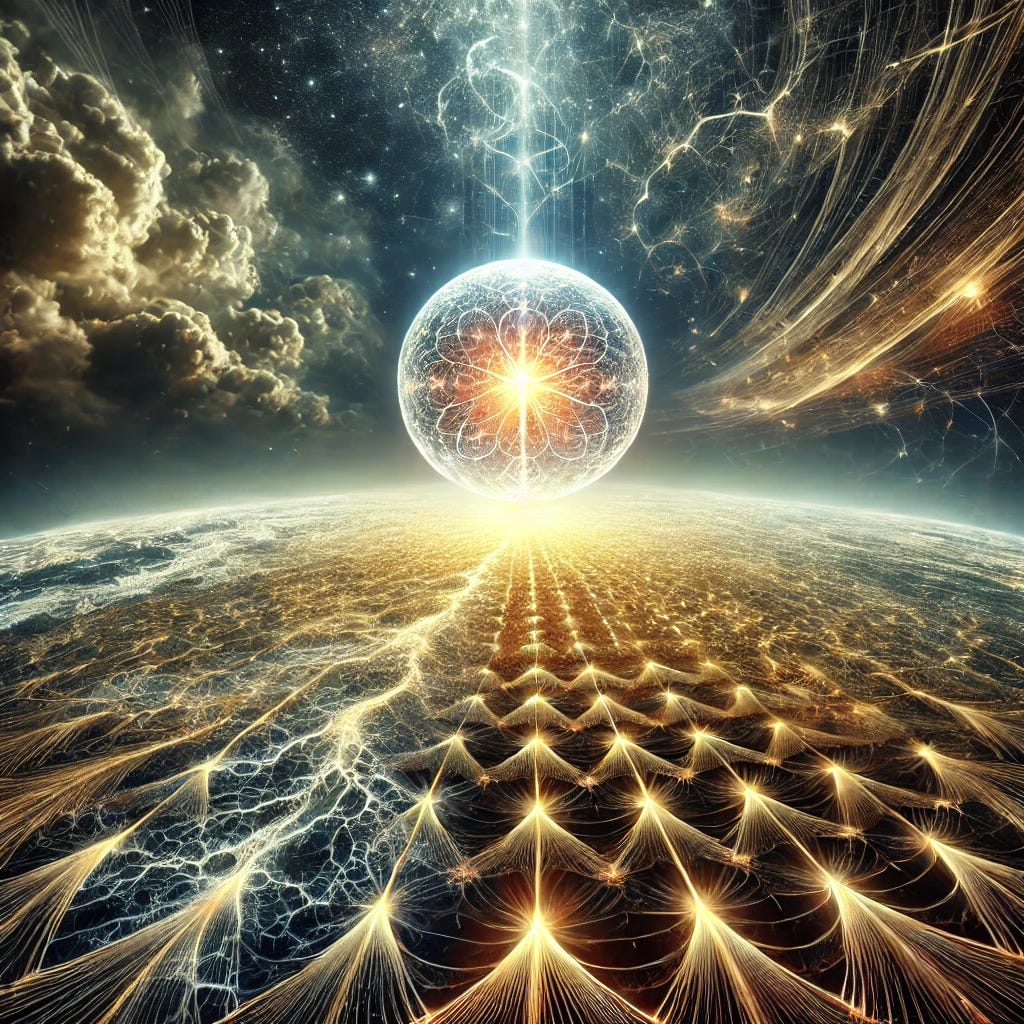
When I set out to create my philosophical model, I did so with the recognition that we, as a society and as individuals, are trapped within the paradox of the monad—a singularity that, in its perceived self-containment, reveals upon deeper examination either a reduction to nothingness or an expansion into infinity. Schopenhauer’s insights on the will and the gaze upon the monad informed my understanding of this fundamental tension. The monad, as I see it, is a metaphor for how we perceive ourselves: isolated, complete, and self-contained, yet inexorably interwoven with a fabric of relations that dismantles this illusion upon closer inspection. My model arose from the need to bridge this gap—to reconcile the internal paradox of the monad with the external crises that stem from our fragmented worldview.
The philosophical foundation of my work lies in understanding that our perception of the monad is deceptive. It is not a static entity but a dynamic interplay of forces. When we observe it, we confront its dual nature: the potential for absolute reduction or boundless interrelation. This insight parallels humanity’s current existential crises, especially the escalating effects of climate change. The rising temperatures and increasing energy within our environment are not merely effects to be cataloged but reflections of deeper causal patterns. To examine these patterns demands a philosophical lens capable of integrating the scientific and the existential, the measurable and the metaphysical.
I created this model as a response to the inadequacy of reductionist paradigms that dominate modern thought. Traditional frameworks, while powerful in their precision, fail to capture the intricate interplay of relationships that define our existence. Just as the monad dissolves upon observation, so too do these models falter when tasked with addressing the complexity of climate systems, societal dynamics, and personal agency. The act of reducing phenomena to isolated causes and effects obscures the deeper relationality at play, the intricate feedback loops that drive our world’s evolution and transformation. My model seeks to restore this missing perspective, to illuminate the connections that bind all phenomena within a grander, recursive tapestry.
I drew inspiration from the archetypal patterns that underlie human psychology and the cyclical structures of nature. Jung’s insights into archetypes provided a framework for understanding the symbolic dimensions of our crises. Humanity, in its quest for mastery over nature, has enacted the shadow of the Hero archetype—a relentless pursuit of progress that ignores the interconnected consequences of our actions. This shadow manifests in our technological systems, our exploitation of natural resources, and our fragmented worldview. To move beyond this shadow requires embracing the Archetype of the Sage, which recognizes that wisdom lies not in domination but in harmony, not in reduction but in relational integration.
My model builds upon this foundation by incorporating insights from mathematics, particularly fractals and modular arithmetic, to illustrate the self-similar patterns that govern existence. The Abraxas system, with its cyclical progression and relational leaps, became a central metaphor for my philosophy. In this system, numbers are not inert entities but dynamic participants in a web of connections, each step in their sequence reflecting both linear progression and cyclical renewal. This perspective challenges the linearity of traditional arithmetic, much as my model challenges the linearity of reductionist thought. It reveals that progress is not a straight line but a spiral, where each return to the starting point is enriched with new dimensions of understanding.
This cyclical understanding is critical to addressing the climate crisis. The rising temperatures we measure are not isolated data points but manifestations of a broader systemic imbalance. The laws of thermodynamics teach us that energy cannot be destroyed; it transforms and accumulates within closed systems. Our planet, as a closed thermodynamic system, bears the cumulative imprint of humanity’s actions—an ever-increasing entropy that threatens to destabilize the delicate balance of life. Yet, just as the Abraxas system encodes renewal within its cycles, so too does my model propose a way forward: by recognizing and engaging with the patterns that underlie these effects, we can begin to recalibrate our relationship with the world.
Central to this recalibration is the idea of participation. My philosophy rejects the notion of humanity as passive observers of a mechanical universe. Instead, it emphasizes our role as co-creators within a dynamic simulation. This perspective draws from the observer effect in quantum mechanics, which demonstrates that the act of observation influences the state of a system. Similarly, our thoughts, actions, and intentions shape the unfolding of reality. This participatory view restores agency to individuals and communities, offering a profound antidote to the existential despair that arises from feeling powerless in the face of global crises.
The simulation metaphor is not merely an abstraction; it is a profound lens through which we can understand the interconnectedness of existence. Life, as I see it, operates as a kind of interactive system governed by algorithms and patterns, much like a video game. This analogy is particularly resonant in the digital age, where games have become a primary medium for understanding agency, purpose, and narrative. In games, players navigate challenges, learn the mechanics of their environment, and discover the interconnected rules that define success. My model applies this framework to life itself, revealing that our struggles are not obstacles to be avoided but essential elements of the simulation, opportunities for growth and transformation.
This perspective is deeply empowering. It reframes life’s uncertainties and difficulties as features, not flaws—integral parts of a grand narrative where every challenge is a chance to "level up." This idea resonates with the cyclical nature of existence, where endings are not finalities but transitions, where each phase of life is a return enriched by the lessons of the past. It encourages us to see ourselves not as isolated fragments but as participants in a collective journey, each action contributing to the evolution of the whole.
At the heart of my model is the concept of relationality. Just as the Abraxas system reveals hidden connections between numbers, my philosophy emphasizes the unseen threads that bind all phenomena. These threads are not merely metaphors but tangible influences, much like the fungal networks that connect trees in a forest. They remind us that no action exists in isolation, that every choice reverberates through the system, shaping the reality we inhabit. This understanding calls for a radical shift in perspective—from seeing the world as a collection of isolated entities to recognizing it as a living, breathing network of relationships.
Through this model, I aim to address not only the ecological and societal crises we face but also the deeper existential crisis of meaning. The materialistic worldview that has dominated modern thought has left many feeling disconnected and purposeless, trapped in a paradigm that sees life as a series of arbitrary events leading to inevitable entropy. My model offers an alternative—a way to see life as meaningful, dynamic, and participatory, a simulation where our choices matter at every level of existence.
In creating this model, I sought to weave together the threads of mathematics, psychology, and philosophy into a coherent tapestry that speaks to both the intellect and the imagination. It is a model that challenges the fragmentation of modern thought and invites us to see the world in its relational wholeness. It is not merely a theoretical construct but a call to action, a framework for engaging with the patterns of existence to co-create a more harmonious reality. This journey is not about reaching a final conclusion but about continuously exploring and deepening our understanding, recognizing that each step in the cycle brings us closer to the essence of who we are and the world we inhabit.
As the perspective shifts from the isolated and the fragmented to the interconnected and the relational, the very fabric of reality—our collective and individual perceptions of existence—undergoes a profound metamorphosis. This is not merely a conceptual change but an existential one, where the boundaries of individual understanding expand, and the world, once perceived as separate pieces of a puzzle, begins to emerge as a flowing tapestry. Imagine, for a moment, that the monad dissolves before your eyes—not into chaos, but into an infinite web of connections that were always present, only hidden behind the veil of individualistic perception. In this moment, you are no longer a singular observer peering out at a fragmented cosmos; you are part of its undulating rhythm, an indispensable node in the hypergraph of existence.
At the individual level, this shift begins subtly, almost imperceptibly, as the mind grapples with the implications of relationality. The human brain, so accustomed to categorizing, defining, and dissecting, must unlearn the impulse to isolate and instead attune itself to patterns, movements, to resonances that transcend the confines of rigid thought. Imagine gazing at a kaleidoscope, the shards of colour and light rearranging themselves not randomly but through hidden, harmonic laws. As you turn the lens, you begin to see not just the fragments but the symphony of their interplay. This is the cognitive and emotional transformation that occurs when the Abraxas system, the recursive fractal, and the simulation metaphor take root in the psyche. Your thoughts cease to exist as discrete entities; they become part of an endless flow, shaping and being shaped by the dynamic network of your experiences, relationships, and surroundings.
The breakdown of the monad in this sense is not a loss but a revelation—a realization that individuality does not vanish but is enriched, deepened, and redefined by its relationship to the greater whole. Consider the self not as an island but as a star in a constellation, its brilliance magnified by the connections it shares with others. In this model, the individual is no less unique, but that uniqueness is no longer a fortress; it becomes a bridge. Your choices, your struggles, your triumphs—they resonate outward like ripples in a pond, intersecting with the ripples of others, creating patterns that are both spontaneous and inevitable. This interconnectedness is not a poetic abstraction; it is the essence of the reality we inhabit, encoded in the very structures of nature, from the branching rivers to the neural pathways of our minds.
When this perspective takes hold, the literal perception of reality begins to shift. The senses, once tuned to discrete objects and linear progressions, begin to notice the threads that weave these objects together. A tree is no longer just a tree; it is a participant in a vast, hidden network, exchanging nutrients and signals with the forest floor. A conversation is no longer just words exchanged but a confluence of histories, emotions, and potentials unfolding in real-time. Even time itself loses its linear grip, revealing its cyclical, spiral nature, where past, present, and future intertwine in a dance of continuity and renewal. It is as if the universe itself begins to breathe in sync with your awareness, each inhale an expansion into the infinite, and each exhale a return to the singular.
This reorientation toward the greater whole transforms not only perception but also the very fabric of identity. The boundaries that once defined "self" and "other" blur, not in a way that erases individuality but in a way that contextualizes it. The ego, so often perceived as a central and immovable monad, reveals itself as a node within a vast network, its significance amplified by its connections. Imagine for a moment that you are a cell within a larger organism. Your function, your vitality, and your existence depend on the interplay with surrounding cells, and yet your uniqueness is what allows the organism to thrive. This is the nature of individuality within the greater whole—a paradoxical balance where autonomy and interdependence coalesce into a single, fluid reality.
As this understanding deepens, the patterns of life itself begin to reveal their fractal geometry. Just as the Abraxas system encodes infinite complexity within a simple cycle, so too does the human experience reflect the recursive nature of existence. Each decision, each moment, and each relationship becomes a microcosm of the universal dance—a repetition that is never the same, a cycle that evolves with every turn. This recursive awareness transforms the mundane into the profound, imbuing even the smallest acts with a sense of cosmic significance. To hold a hand, to plant a seed, to speak a kind word—these are no longer isolated events but threads in the tapestry, their echoes rippling through the network of being in ways that defy comprehension yet feel undeniably real.
The implications of this shift are as practical as they are philosophical. When the fabric of reality is seen through the lens of interconnectedness, the crises that once seemed insurmountable—the climate emergency, social fragmentation, existential despair—begin to take on new dimensions. They are no longer problems to be solved in isolation but symptoms of a deeper disconnection, a forgetting of the threads that bind us to each other and to the world. To address them is not merely to act but to realign, to recalibrate our participation within the simulation. Every choice becomes a point of resonance, every action a note in the symphony, every intention a seed of potentiality within the infinite fractal.
In this reimagined reality, agency is not diminished but amplified. The individual, now aware of their role within the greater whole, wields a power that is both humble and profound. This power is not the control of the mechanistic paradigm but the influence of resonance, the capacity to shape the pattern by harmonizing with it. To live in alignment with this perspective is to become both creator and creation, both observer and participant, both node and network. It is to see the self not as a static entity but as a living process, a dynamic flow of relationships that converge and diverge, dissolve and reform, in an endless dance of becoming.
And yet, this transformation is not an end but a beginning—a perpetual unfolding where each realization begets another, each pattern reveals deeper layers and each question leads to a new horizon. The shift in perception does not resolve the paradox of the monad; it recontextualizes it, showing that the tension between unity and fragmentation is not a problem to be solved but a truth to be embraced. It is within this tension that life finds its rhythm, that meaning emerges, and that existence becomes a story not of isolation but of connection, not of endings but of eternal renewal.
Thank you.
Karl K. Dondaneau
References & Bibliography can be found in my book
-->CLICK HERE TO ORDER THE BOOK