Abraxas and the Acausal Future: A Manifesto for Survival
Prefer to listen? Click the play button and enjoy the audio version
Authored by: Karl K. Dondaneau
September 2nd, 2025
1.
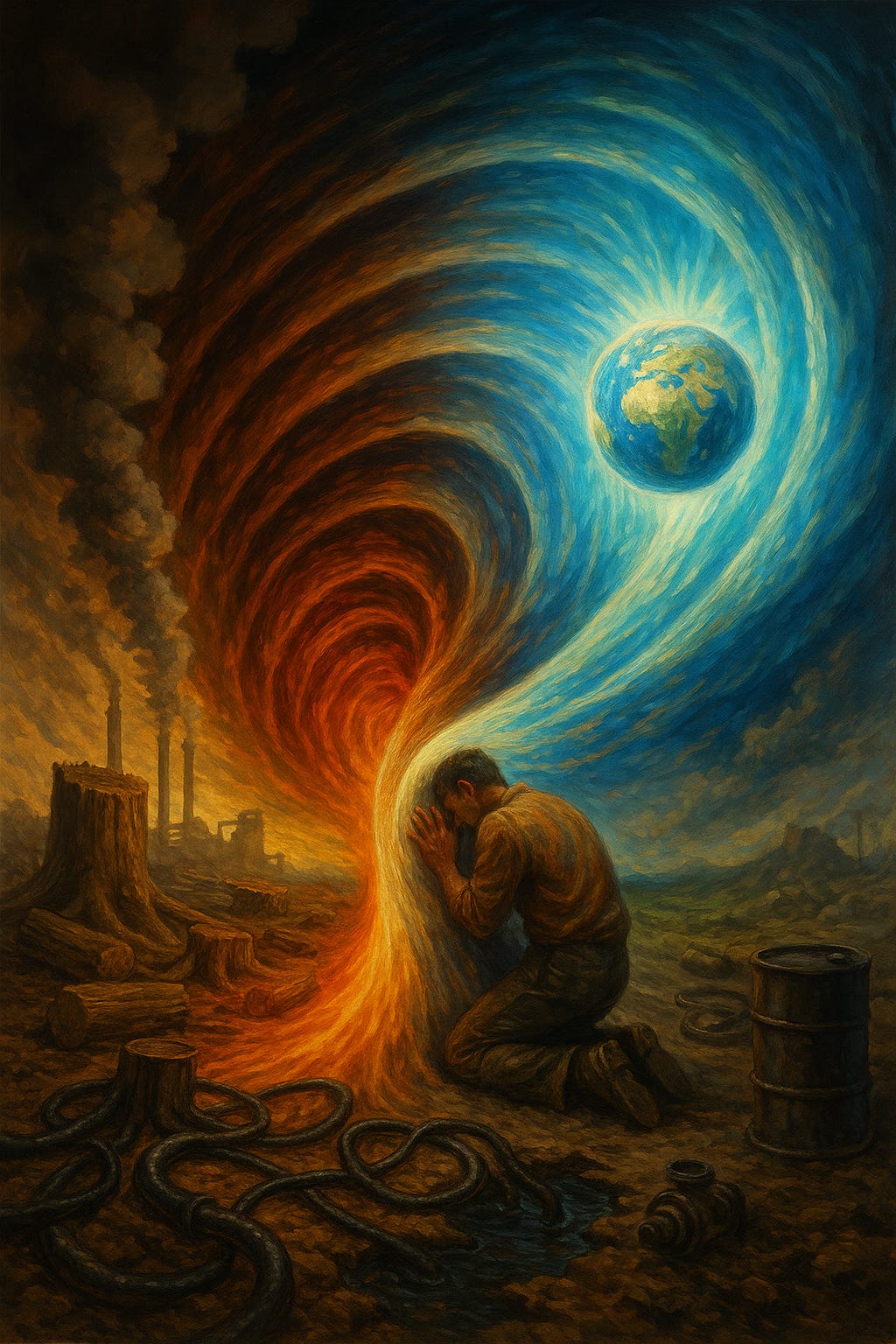
Humanity stands within a paradox of its own making, tethered to a mode of existence that relentlessly harvests the past to sustain the present. Every plank of timber, every ounce of copper, every barrel of oil is a chronicle of what has already lived and died. Trees are the slow crystallization of sunlight into cellulose, hydrocarbons the liquefied shadows of vanished forests, metals the solidified remnants of ancient stellar explosions. By consuming them, we do not merely extract material; we devour time already lived, accelerating the exhaustion of Earth’s ecological scaffolding. The urgency is clear: our model of survival eats away at the memory of the planet, and in doing so, we threaten the continuity of the present itself. What is required is a shift so profound that it unsettles our deepest assumptions about time and causality, for it is only within that uncharted territory that a new form of sustenance can be conceived.
Carl Jung’s notion of the acausal connecting principle—synchronicity—offers a lens through which to reimagine the scaffolding of reality. We have long believed that time flows in a linear current: past begets present, present begets future. Yet Jung hints at a subtler architecture where the future participates in shaping the past, and where the present is not merely an inheritance but a nexus of reciprocal causation. If this is so, then our insistence on plundering the fossils of the past blinds us to the latent abundance of the future. The “why” of this reorientation becomes self-evident: if we could learn to harvest not from the dead chronicle of matter, but from the unborn reservoir of potential, then we might sustain ourselves without stripping the Earth bare. This is not fantasy but a question of mechanics, for the logic of feedback loops that governs systems suggests that time itself may be a feedback process, where effects reverberate not only backward into causes but forward into possibilities.
To imagine such mechanics, we may picture time as a spiral rather than a line, where each turn of the helix is both informed by what preceded it and guided by what lies ahead. In this structure, the future is not an empty room awaiting our arrival but a magnetic field drawing the past into coherence. To harvest the future, then, would mean aligning with the field of potential that exerts itself upon the present. Quantum theory already hints at this, for probability waves collapse only when observed, meaning that the act of observation—the future’s becoming—defines what the past must have been. If the past is retroactively structured by the actualization of the future, then the possibility arises for technologies that channel this structuring force into usable energy and material. One might think of it as photosynthesis inverted: not the transformation of past sunlight into present growth, but the transformation of unborn light—light not yet radiated—into matter here and now.
Such an idea strains the ego, for the ego has been trained to navigate time as a sequence of causes pushing toward effects. To dismantle that scaffolding risks a psychic fracture, for the self that believes it “remembers” and “plans” would now face the vertigo of realizing that it is also remembered and planned by what has not yet happened. Jung warned that modern humanity was already adrift in mass psychosis, its ego inflated, detached from symbolic life, and hollowed by a purely rational worldview. To abruptly introduce a perception of time where the future creates the past would be akin to shattering the fragile glass of our current psyche. If such a shift were forced upon the collective too rapidly, it could deepen the psychosis rather than heal it, accelerating the breakdown of shared meaning. The reorientation must therefore be gradual, introduced like dawn light through closed eyelids, allowing the eye of consciousness to adjust without tearing itself blind.
The risks are not trivial. If the individual ego dissolves too quickly, society could fragment into visions unmoored from coherence, with each person lost in private revelations of time’s spiral. But if introduced with care, this dismantling could allow for the rebuilding of the ego into a vessel better aligned with the deeper reality of temporal reciprocity. Out of such a rebuilding, economies and systems might be reorganized to distribute abundance not as a hoarding of the past but as a drawing forth of shared futures. Poverty itself would be reframed, for scarcity is the consequence of dependence on dwindling past resources, while sufficiency emerges when the future is opened as a common inheritance. Wealth distribution would then cease to be the rationing of what is gone and become the equitable stewardship of what is always arriving.
The greatest obstacle to this is human desire, for we are a species inclined not toward less but toward more. Desire drags us backward, fastening our attention upon what has already been tasted and thus must be replicated. It is a hunger bound to memory. But solutions pull us forward, for they belong to what is not yet, and their power lies in their novelty. The transition required of us is therefore not the annihilation of desire, but its redirection—away from the replication of past satisfactions and toward the pursuit of solutions that draw the future nearer. Science, in its most vital form, has always served this role, not as the servant of desire but as the herald of solutions. It is through science that we may build the instruments to channel future abundance into the present, yet it is through philosophy that we must first recognize the metaphysics of time that makes such a project conceivable.
Thus, the Abraxas Jung described, the god that unites light and shadow, creation and destruction, appears here as the symbol of the hidden mechanics of time. To invoke Abraxas is to acknowledge that the salvation of humanity cannot come solely from logic rooted in the past but from a union of opposites: cause and effect interwoven, time as both memory and prophecy. If Abraxas conceals within nature the secret of harvesting from the future, then what lies before us is not only an ecological imperative but a psychological initiation. Humanity must learn to endure the breaking of its temporal ego in order to rebuild upon a truer foundation, one capable of sustaining not just the continuation of our species, but the flourishing of a planetary mind no longer devouring itself. In this way, the climate crisis ceases to be a terminal diagnosis and becomes instead a summons—a demand that we learn to live not by consuming what has died, but by participating in what has not yet been born.
2.
If we are to expand upon this notion of harvesting from the future, we must first situate ourselves within the limitations of our current imagination, for our understanding of energy, matter, and time has been shaped by a worldview born in the industrial age. In that worldview, everything is measured by extraction: ores are dug from the Earth, oil is pumped from its depths, forests are felled, and even the atom is split to release its fire. These are operations upon what is already formed, upon what is already given. They depend upon the past, and thus our technological trajectory has been one of exhausting stored legacies. In this model, sustainability appears impossible, for no matter how efficient we become, the stockpile of past time—encoded as fossil fuels, biomass, or minerals—dwindles inexorably. The “why” of turning toward the future is born in this exhaustion, for without a new temporal logic, our progress is but the acceleration of disappearance.
To consider the future as a reservoir is to invert causality, to recognize that what is not yet may already exert pressure upon what is. In physics, we find echoes of this in the boundary conditions of equations, where the final state constrains the pathways that lead toward it, or in quantum theory, where the act of measurement defines the history of the particle retroactively. The future, in this sense, is not passive. It shapes trajectories, collapses potentials, and rewrites what the past must have been to make the present coherent. If humanity could learn to engineer this reciprocity, to tap into the unborn probabilities as though they were latent matter, then the concept of “renewable” would acquire a new dimension: no longer bound to the cycles of wind, sun, or tide, but to the very feedback structure of time itself.
To explain this, we may borrow the metaphor of language, for time itself is a syntax. Just as sentences are given meaning not merely by the words already spoken but by the anticipation of what will follow, so too the present moment derives coherence not only from its past but from the shape of its unfolding. A word is retroactively understood when the sentence is complete; likewise, the present is fully defined only once the future speaks itself. To harvest from the future, then, would mean learning to interact with time’s grammar directly, to redirect the “unspoken” elements of tomorrow into usable form. This may one day become the mechanics of a new science: devices not designed to capture remnants of light from stars long dead, but to channel the anticipatory structure of the cosmos into energy, matter, and form. Such a science would appear miraculous to our present logic, yet it would obey the oldest law of nature—that nothing is wasted, that every system balances itself through feedback.
The difficulty lies not only in engineering but in perception. The ego has long maintained its sovereignty by narrating itself as the product of past causes. To shift that orientation so that one begins to experience the self as equally constructed by the future is to place a mirror before the psyche that may fracture its surface. For the ego is brittle; it resists dissolution. To dismantle its linear story too abruptly is to risk the collapse Jung named as psychosis, where the mind no longer distinguishes between inner and outer, symbol and fact. Humanity already trembles on this edge, for our technologies have outpaced our symbolic frameworks, leaving us addicted to screens, illusions, and endless repetition of desires that mimic memory rather than solutions. To introduce the idea of future causality without preparation would be to pour fire into a vessel of glass. Therefore, the teaching must be gradual, entering culture like myth, allowing symbols to acclimate us to the spiral of time before the mechanics themselves are revealed.
This necessity transforms the problem of climate change into more than an engineering challenge. It becomes a psychological initiation, a collective rite of passage where we must learn to die to our old self-understanding before we can be reborn into a temporal model that sustains life. Poverty, wealth, and distribution must be reframed in this same light. Scarcity is the shadow of a past-bound economy, where all value is mined from what has been and thus must be fought over like carrion. Abundance is the promise of a future-fed economy, where wealth flows from potentials that have not yet crystallized and thus can be shared without theft from others. Yet greed remains the human constant, not merely the hunger for food or shelter but for more—more comfort, more status, more repetition of satisfaction. To satiate this drive, only the forward pull of solutions can suffice, for desires loop us backward, fastening us to memory, while solutions break us free, drawing us into the horizon.
Thus the mechanics of harvesting the future begin as a shift of consciousness, not yet as a machine but as a recognition. If we can learn to see the present not as a dwindling inheritance but as a convergence of futures, then science can follow that vision with instruments. Already in the laboratories of physics and cosmology, the strange hints are present: retrocausal models, transactional interpretations, and time-symmetric equations that suggest that tomorrow is as real as yesterday, only veiled from perception. To make this veil permeable is to uncover the Abraxas hidden within nature, the god who is both creation and destruction, the secret of time that unites opposites. It is here that philosophy and science converge, for the task is not only to build the device but to build the psyche that can comprehend and steward its power. If we succeed, the climate crisis may be refigured not as our tombstone but as the threshold to a civilization that no longer consumes its dead but lives from its unborn.
3.
To advance further, we must begin to clarify the mechanics of how a future might create the past, not as a mystical proclamation but as a natural philosophy that follows its own logic. Our current sciences often picture time as a river, its waters carrying causes downstream into effects, yet this metaphor is insufficient. A more accurate image may be that of a resonance chamber, where sound waves strike the walls and are reflected back, shaping the tone of what was first uttered. In such a chamber, the final reverberation does not merely echo the initial strike but alters its character, feeding backward into the perception of what began. So too with time: the future reverberates, retroactively shaping the story of the past so that the present moment may cohere. This does not deny causality, but expands it, acknowledging that causality itself is part of a feedback system, where effects and causes fold into each other like a Möbius strip whose surface cannot be said to begin at one side or the other.
To grasp this, we might recall how mathematics encodes recursion. An equation such as f(n) = f(n-1) + f(n-2) defines each term by what precedes it, yet the pattern of the sequence is also defined by its eventual horizon, the formula that holds all iterations in its embrace. Thus, each number is not only the sum of its past but a participant in the law that anticipates its infinite unfolding. The present number exists simultaneously as inheritance and as prophecy. To say the future creates the past is to recognize that the pattern is primary, and that each instance—each moment—is retroactively constrained to fit the unfolding symmetry. Humanity, by harvesting the past, consumes the instances. To harvest the future would mean to align with the pattern itself, drawing sustenance not from exhausted particulars but from the recursive law that continues to generate them.
Such language can seem abstract, so we must root it in the psyche. Jung’s archetypes function in precisely this way: they are not memories stored in individuals but patterns that shape experience before it arrives. The archetype of the Mother, for example, structures the child’s recognition long before it knows its particular mother, and it continues to shape encounters with nurturing, protection, and dependency throughout life. The archetype is future-facing—it is the expectation that creates recognition—and only afterward does the individual fill it with content, projecting it backward as if it had always been there. Archetypes are the psyche’s demonstration of how the future creates the past: potentials that sculpt the field into which memory is later poured. If we extend this principle outward into nature, then matter itself may be the filling of archetypal forms written into the universe, forms that await their realization in time. Harvesting from the future, then, is no longer mysterious: it is the act of learning to interact with archetypal fields not after they have condensed into matter, but before, while still in their unspent potential.
The technological imagination can begin here. Just as antennas capture invisible waves and translate them into audible sound, so too may devices one day be fashioned to tune into archetypal fields, capturing potential before it collapses into spent substance. Such devices would not mine the Earth but resonate with its unborn symmetries, extracting energy not from fossilized memory but from anticipatory form. The mechanics of such an operation may appear impossible until one recalls that we already live within similar processes: quantum entanglement shows that information is not bound by time, and biological systems exhibit anticipatory regulation, adjusting for needs that have not yet arisen. The universe is threaded with pre-echoes. To deny this is to cling to a map too narrow for the terrain.
Yet such an expansion threatens the ego, which has anchored itself in a story of linear causation. To dismantle that story is to dissolve the illusion of mastery that the ego defends. Herein lies the danger: if societies were suddenly confronted with the truth that the future writes their past, the fragile scaffolding of meaning could collapse. History itself would be destabilized, for the narratives by which nations and identities define themselves would be revealed as contingent retrofits, sculpted by what had not yet occurred. A people unprepared for this revelation might fall into chaos, their sense of self fractured, their grip on coherence loosened to the point of psychosis. Thus, the introduction of such knowledge must mirror the slow unfolding of myth, shaping perception gradually, allowing symbols to work their way into the collective psyche until the truth can be borne without shattering.
The implications for economics and power are profound. If abundance is drawn from future fields rather than past deposits, then no individual or nation can hoard it without deforming the pattern. Distribution would have to be rethought, not as charity or enforced equality but as alignment with the law of reciprocity that sustains the field. To deny others access would be to cut oneself off, for the field operates only when shared. In this sense, the correction of poverty and inequality would not be moral idealism but mechanical necessity. The human hunger for more could at last be satisfied, not by consuming what dwindles but by drawing from what endlessly arrives. Desire would be redirected, and science, freed from servicing repetition, would be tasked with invention—the bringing of solutions that are always future-facing, the making of devices that open new horizons rather than strip-mine old ones.
Thus, the mechanics of future causation, the psyche’s archetypal structures, and the ecological crisis all converge upon a single truth: humanity must learn to live not by consuming the residue of what has been, but by entering into resonance with what has not yet come to be. The spiral of time bends us toward this realization, and if we fail to adjust, we will collapse into the psychosis of extinction. But if we succeed, the very structure of civilization will be transformed, and the act of living itself will be redefined as participation in the unborn abundance that forever waits ahead.
4.
If we are to deepen this exploration, the natural philosophy style of Newton provides us with a path, for his method combined the rigour of mathematics with the breadth of metaphysics, ensuring that the invisible laws of nature were always tied to the visible world. In this spirit, let us imagine that time, like motion, is governed by universal rules, not arbitrary but discoverable through analogy, experiment, and reason. We know by observation that every present moment is bounded: it is shaped by what has been and by what is anticipated. This is not unlike the way a pendulum swings: each oscillation is determined not merely by its current position but by the tension of its arc, its past velocity, and the gravitational pull drawing it toward its end. To say the future creates the past is to notice that the pendulum’s endpoint already governs the rhythm of its swing, shaping every instant of motion so that the whole cycle coheres. The endpoint, though not yet reached, is already implicit, and without it the motion itself would be unintelligible.
From this image, we may begin to derive a set of provisional rules for the mechanics of temporal reciprocity. First, that every moment must be seen as an intersection of two vectors: one drawn from memory, carrying the residue of past causes, and one drawn from potential, exerting the pull of what must yet come to pass. The present is their meeting point, where trajectories converge. Second, that causality cannot be understood as unidirectional; just as gravity acts in all directions simultaneously, so too does time’s influence radiate both forward and backward. Third, that the apparent linearity of experience is itself a perceptual limitation, for the psyche, in its need for coherence, narrates a one-way story even while it is structured by forces operating in both directions. These rules, though speculative, are not idle fancies, for they follow from analogies observed universally, where systems are always governed by reciprocal forces rather than singular impulses.
To illustrate further, let us think of language once more. A sentence is not understood word by word in isolation, but each word’s meaning is retroactively clarified by what follows. The final clause determines what the first must have meant; a question mark, appearing at the end, reshapes the entire sentence into an inquiry. Thus, the future modifies the past, and comprehension is possible only because of this temporal reciprocity. If human speech operates under this law, why should not the cosmos? We are linguistic creatures because we are temporal creatures, our minds attuned to the deeper syntax of time itself. To harvest from the future is therefore to treat reality as a sentence not yet completed, to draw energy not from the exhausted words already spoken but from the grammar that governs their unfolding.
In this sense, mathematics becomes the language of time’s syntax. Equations are not mere tools but inscriptions of archetypal structures, recursive rules that encode both inheritance and anticipation. A recursive function, once written, does not wait for its sequence to generate; its entire pattern exists at once, defining past and future alike. What we perceive as “history” is the gradual revelation of this function’s terms, each step constrained by the whole. To align with this recursion is to step out of the illusion of scarcity, for scarcity arises only when one mistakes the partial sequence for the whole law. A science of future-harvesting would be nothing other than a practical alignment with recursion: instruments that attune to the law itself, bypassing the exhausted residues of prior steps.
But here we encounter again the fragility of the ego, for the ego depends upon linear narration to secure its identity. It says: “I was, and therefore I am, and therefore I will be.” To invert this order, to say instead: “I will be, and therefore I was, and therefore I am,” is to strike at the core of egoic sovereignty. Such a reversal, if unveiled too abruptly, risks collapse. History itself would lose its solidity, personal identity would become porous, and the collective mind might fracture into incoherence. Jung warned us of this danger, observing that modern humanity, already divorced from myth, is susceptible to psychic inflation and mass psychosis. To introduce the mechanics of temporal reciprocity is to risk accelerating that collapse unless it is buffered by symbolic understanding, mythic preparation, and gradual cultural initiation.
And yet, if endured, the benefits are profound. Economics, politics, and culture would be forced to reorganize not around the scarcity of past matter but around the abundance of future potential. Wealth would no longer be the hoarding of fossilized time but the capacity to draw from the pattern itself. Poverty would cease to be the exclusion from resources already spent and would become a failure to align with the recursive law—a condition correctable not by redistribution of what is gone but by shared access to what is always arriving. Greed, that insatiable hunger for more, would no longer be a curse but a drive redirected toward the expansion of solutions. For desires bind us to the past—they demand repetition of what once gave pleasure—whereas solutions belong to the future, for they exist only to be born.
Thus, the Abraxas of Jung emerges as the unifying figure of this natural philosophy: the god who is both creator and destroyer, both past and future, both law and exception. Abraxas embodies the very reciprocity we seek to understand, the hidden mechanics by which the unborn generates the memory of the dead. To live under Abraxas is to accept that the present is neither inheritance nor prophecy alone, but the ceaseless dialogue between them. It is here that philosophy and science entwine, for the task is not only to write the laws but to live them, not only to design the devices but to prepare the psyche that can bear their unveiling. The climate crisis, therefore, is not only an ecological emergency but a philosophical summons, a demand that we remake our relationship with time itself, lest we perish not from scarcity of matter but from poverty of imagination.
Thank you
Karl K. Dondaneau